Archive
The coming US Depression has an added dimension: “…a huge underclass of very desperate people with their minds chemically blown beyond anybody’s comprehension” which may fuel unprecedented unrest.
by Tom Dennen
Money talks and here is what it is saying: Here are the Current Account Balances of 163 Countries in the World COMPARED WITH LEVELS OF STREET VIOLENCE (all except Egypt at the bottom of the debt list) :
Notice the amazing entry at the bottom of this list (scroll down) taken from Gerald Celentes’ Trends Journal, the full report, 2011.The Current Account Balance records a country’s net trade in goods and services, plus net earnings from rents, interest, profits, and dividends, and net transfer payments (such as pension funds and worker remittances) to and from the rest of the world during the period specified. These figures are calculated on an exchange rate basis, i.e., not in purchasing power parity (PPP) terms.
China is No. 1, Hong Kong No. 15, Egypt N.37 … check who is No. 163
World Ranking – Current Acct Balance (in Millions of US$)
1 People’s Republic of China (PRC) 179,100
2 Japan 174,400
3 Germany 134,800 Read more…
World needs $100 trillion more credit, says World Economic Forum
The world’s expected economic growth will have to be supported by an extra $100 trillion (£63 trillion) in credit over the next decade, according to the World Economic Forum.

This doubling of existing credit levels could be achieved without increasing the risk of a major crisis, said the report from the WEF ahead of its high-profile annual meeting in Davos.
But researchers warned that leaders must be wary of new credit “hotspots”, where too much lending takes place, as the world emerges from a financial catastrophe blamed in large part “to the failure of the financial system to detect and constrain” these areas of unsustainable debt.
“Pockets of credit grew rapidly to excess – and brought the entire financial system to the brink of collapse,” said the report, written in conjunction with consulting firm McKinsey. “Yet, credit is the lifeblood of the economy, and much more of it will be needed to sustain the recovery and enable the developing world to achieve its growth potential.”
The global credit stock has already doubled in recent years, from $57 trillion to $109 trillion between 2000 and 2009, according to the report.
The WEF said the continued demand for credit could be met “responsibly, sustainably – and with fewer crises”. However, it cautioned that to achieve this goal, financial institutions, regulators, and policy makers need more robust indicators of unsustainable lending, risk, and credit shortages.
U.S. Treasury Secretary Admits U.S. Default is Imminent
By James West
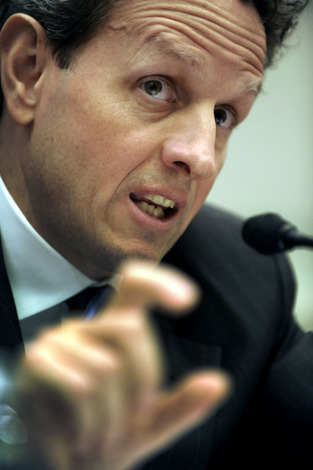 Timothy Geithner, U.S. Treasury Secretary, admitted in a letter to congress dated January 6th, that the United States Treasury would be forced to default on its credit obligations without clearance from congress to raise the amount of money tha the treasury is allowed to borrow.
After citing a list of “extraordinary measures” congress has had to resort to int he past to avoid entering a state of defualt, Geithner stated, “Once these steps have been taken, no remaining legal and prudent measures would be available to create additional headroom under the debt limit, and the United States would begin to default on its obligations. The extraordinary measures include, “suspending sales of State and Local Government Series (SLGS) Treasury securities; suspending reinvestment of the Government Securities Investment Fund (G-Fund); suspending reinvestment of the Exchange Stabilization Fund (ESF); and determining that a “debt issuance suspension period” exists, permitting redemption of existing, and suspension of new, investments of the Civil Service Retirement and Disability Fund (CSRDF).
That the United States has already defaulted on its obligations is beyond dispute, at this point, as its the rate at which its debt service obligations is growing exceeds the rate at which the United States GDP could possibly grow, meaning that, without drastic cuts to governmenbt spending, the debt can only continue to grow.
Before our very eyes, the so-called leadership of the world’s largest economy is intentionally bankrupting the country and devaluing its currency in what can only be a precursor to rampant inflation. Since the integrity necessary to manage this problem does not exist within the United States political system, the rest of the world has no choice but to stand by and watch the value of their United States Treasury Bills diminish incrementally on a daily basis. Selling them will only exacerbate the problem, but the question must be asked, how long until the remedy is preferred over the miserable condition?
Geithner goes on to say, in a remarkable baring of the national soul,
However, if Congress were to fail to act, the specific consequences would be as follows:
The Treasury would be forced to default on legal obligations of the United States, causing catastrophic damage to the economy, potentially much more harmful than the effects of the financial crisis of 2008 and 2009. Read more…
Fed chief expects high unemployment, economic growth in 2011
Vicki Needham
 Unemployment will remain high, the nation’s economy could expand by 4 percent and interest rates may need go up, Federal Reserve Bank of Philadelphia President Charles Plosser said Monday.
“If economic growth in the United States continues to gain traction and the prospects begin to look ever better, it might be time for us to begin thinking about how do we begin to gradually take our foot off the accelerator,” Plosser told reporters after a speech at the Central Bank of Chile in Santiago, according to news reports.
Plosser said he may favor a rate increase if economic growth necessitates a change.
“It might. I’m not going to rule that out,” he said.
The central bank has said that it plans to keep short-term interest rates low for an “extended period.”
During Monday’s speech, Plosser also predicted that the U.S. could grow between 3 percent and 4 percent this year.
The Fed’s plan to purchase $600 billion in government debt will probably continue through June while the nation’s 15 million unemployed look for work, although Plosser didn’t rule out pulling the stimulus funds back earlier.
“It could end earlier if economic conditions call for it, but right now I’m not sure that that’s the most likely outcome,” he told reporters. “It obviously creates challenges for some countries because of appreciating currencies. But I think that will pass. Those are short-run issues.”
Plosser has expressed concern about whether the Fed’s quantitative easing, also known as QE2, will spur economic growth while lowering the jobless rate that has remained above 9 percent for 20 months.
“Monetary policy is not going to be able to speed up the adjustments in labor markets or prevent asset bubbles, and attempts to do so may create more instability, not less,” he said.
“Expecting too much of monetary policy will undermine its ability to achieve the one thing that it is well-designed to do — ensuring long-term price stability.”
QE2 has brought harsh criticism from some lawmakers on Capitol Hill who argue that the plan could devalue the dollar and cause inflation.
Ireland’s Titanic Bailout at Risk, Iceland looms ahead
 The announcement by Brian Cowen that he was resigning as the leader of the Fianna Fail party, but is going to stay on as Taoiseach (Prime Minister) until the March 11 election, has put the Irish bailout into question. The November bailout of the Irish economy consisted of a series of different financing packages being combined into a larger total.
The first funds available under the bailout were provided by the raiding of the Irish retirement fund by its bankers. The next steps were to be funded by the EU and IMF funding sources, once the people of Ireland were legally subjected to the bailout requirements. The bailout never made it to a full vote before the collapse of the Fianna Fáil party.
This leaves Ireland in the unique position of being able to reclaim its future, by denying its past. The citizens of Ireland have not accepted the bailout. The coalition is not expected to be able to put the matter to a vote before the election.
“All we know is we are going to get an election on or before March 11 but that is about it,” said Micheal Marsh, professor of politics at Trinity College Dublin, calling the events of the past week “bizarre.” Read more…
California Declares Fiscal Emergency

Jerry Brown, California’s governor, declared a state of fiscal emergency on Thursday for the government of the most populous US state to press lawmakers to tackle its $25.4 billion budget gap.
Democrat Brown’s declaration follows a similar one made last month by his predecessor Arnold Schwarzenegger, the former Republican governor.
Democrats who control the legislature declined to act on Schwarzenegger’s declaration, saying they would instead wait to work on budget matters with Brown, who served two terms as California’s governor in the 1970s and 1980s.
Brown was sworn in to his third term early this month and has presented lawmakers with a plan to balance the state’s books with $12.5 billion in spending cuts and revenue from tax extensions that voters must first approve.
Brown has said he wants lawmakers to act on his plan by March.
His fiscal emergency declaration is meant to underscore that target, an official said.
Brown’s declaration, which is largely procedural, says it affirms Schwarzenegger’s December declaration, giving lawmakers 45 days to address the state’s fiscal troubles.
The 72-year-old governor also wants the legislature to back a ballot measure for a special election in June that would ask voters to extend tax increases expiring this year to help fill the state budget’s shortfall.
Brown needs a handful of Republican votes to put the measure to voters.
Republican leaders in the legislature have said they doubt those votes will come.
By contrast, Darrell Steinberg, the state senate president pro tem, told Reuters on Thursday he is backing Brown’s budget plan and that he would press other lawmakers to do so as well: “I think the Brown framework is the right framework …We intend to meet the March deadline.”
Europe faces a new crisis
Yevgeny Kryshkin
 The European Union is facing a new phase of the economic crisis. This depressing forecast was made by a report on the World Economic Situation and Prospects-2011 presented by the United Nations Conference on Trade and Development. Our commentary is by Yevgeny Kryshkin.
Despite the fact that the EU has taken tough austerity measures and is planning to cut the budget deficit, it is risking another economic recession. This opinion was expressed by the authors of the report. They emphasize that a repeated recession in the EU countries and stagnation in the U.S. and Japan may trigger another wave of a global economic crisis.
This pessimistic assessment is based on the state of affairs in the economies of Greece, Ireland, Portugal and Spain, the four countries that were most affected. Greece and Ireland managed to avert a collapse of their financial systems. However, this required incredible joint efforts by all EU member states. Ireland alone received 85 billion euro and with serious risks. Stabilization loans from the International Monetary Fund and the EU are being used to cover budget deficits and support banks. Nevertheless, neither Ireland nor Greece has solved the problems that they faced last year. Here is an opinion from an expert at the Institute of Europe, Vladislav Belov.
“The situation is developing according to the prior scenario. Greece, Spain, Portugal and Ireland have taken austerity measures to reduce the budget deficit through cutting government spending, the salaries of public servants and social expenses, and increasing taxes. At the same time, France and Germany are making attempts to consolidate their efforts. However, the problem has not been solved yet. As before, there is a danger of default, as far as the Euro-zone goes,” Vladislav Belov said.
Gold May Gain as Europe Debt Concern, Price Drop Spur Demand
Sungwoo Park
 Jan. 18 (Bloomberg) — Gold may gain as concerns that the European sovereign-debt crisis may linger boost demand for precious metals as a protector of wealth, and as a price drop in the past two weeks spurs physical buying. Platinum gained.
Bullion for immediate delivery was little changed at $1,364.18 an ounce at 1:33 p.m. in Seoul. The metal, which rose to a record $1,341.25 in December, dropped 4 percent this month, heading for the first monthly decline since July. The February- delivery contract rose 0.2 percent to $1,363.50 an ounce in New York.
“Around this level, we still see quite good physical demand,” Bruce Ikemizu, head of commodity trading at Standard Bank Plc in Tokyo, said today by phone. “I’m rather pessimistic. The problems won’t be resolved overnight. This European financial problem will be a long-term bullish factor for gold and precious metals.”
The euro was little changed against the dollar after yesterday falling 0.7 percent amid concern that an agreement among European finance ministers will fail to contain the region’s debt crisis. Euro-area finance ministers indicated after a meeting yesterday they aren’t facing immediate pressure to tame the crisis, while pledging to strengthen the safety net for debt-strapped countries.
Morgan Stanley raised its gold forecast through 2015, the bank said in a report today. It expects gold to average $1,400 an ounce this year, 6 percent more than a previous forecast.
Assets in 10 gold exchange-traded products dropped 6.54 metric tons to about 2,078 tons as of Jan. 14, the lowest since Sept. 15, according to data compiled by Bloomberg.
Platinum for immediate delivery gained 0.5 percent to $1,813.70 an ounce. Spot palladium declined for a fourth day, dropping 0.4 percent to $791.50 an ounce, while silver was little changed at $28.2975 an ounce.
Could the U.S. central bank go broke?
Reuters
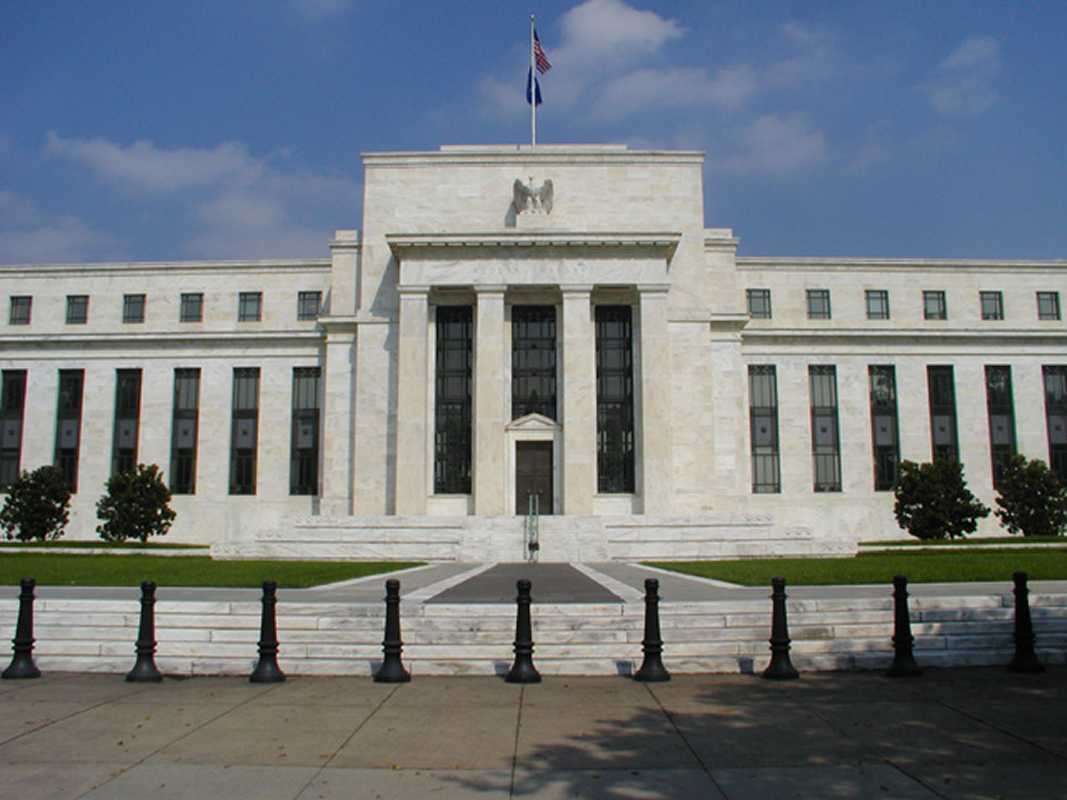 The U.S. Federal Reserve’s journey to the outer limits of monetary policy is raising concerns about how hard it will be to withdraw trillions of dollars in stimulus from the banking system when the time is right.
While that day seems distant now, some economists and market analysts have even begun pondering the unthinkable: could the vaunted Fed, the world’s most powerful central bank, become insolvent?
Almost by definition, the answer is no.
As the monetary authority, the central bank is the master of the printing press. It can literally conjure up money at will, and arguably did exactly that when it bought about $2 trillion of mortgage-backed securities and U.S. Treasuries to push down borrowing costs and boost the economy.
The Fed’s unorthodox steps helped it generate record profits in 2010, allowing it to send $78.4 billion to the U.S. Treasury Department. But its swollen balance sheet leaves the central bank unusually exposed to possible credit losses that could create a major headache at a time of increasing political encroachment on the Fed’s independence. Read more…
Treasury Five-Year Notes Advance as Bernanke Predicts Slow Growth in Jobs
 Treasury five-year notes had the first back-to-back weekly gains since October as U.S. payrolls grew less than forecast and Federal Reserve Chairman Ben S. Bernanke said the labor market’s recovery will be gradual.
Yields on the notes touched the lowest level in two weeks yesterday after Labor Department data showed nonfarm payrolls expanded by 103,000 last month, versus a median forecast of 150,000 in a Bloomberg News survey. The Treasury will sell $66 billion in securities next week in the year’s first note and bond auctions.
“The five-year leads the way up, and it leads the way down,” said Brian Edmonds, head of interest-rates at Cantor Fitzgerald LP in New York, one of central bank’s 18 primary dealers. “The Fed chairman is setting expectations back further and making people aware that there aren’t a lot of quick fixes and it’s not going to turn on a dime.”
The yield on the five-year note fell five basis points yesterday, or 0.05 percentage point, to 1.96 percent, from 2.01 percent on Dec. 31, according to BGCantor Market Data. It touched 1.93 percent, the lowest since Dec. 21. The yield hadn’t declined for more than a single week at a time since Oct. 8.
Benchmark 10-year note yields rose three basis points to 3.32 percent, from 3.29 percent at the end of last week. Two- year note yields were little changed at 0.59 percent. Read more…


![[Most Recent Quotes from www.kitco.com]](https://i0.wp.com/www.kitconet.com/charts/metals/gold/t24_au_en_usoz_2.gif)
![[Most Recent Quotes from www.kitco.com]](https://i0.wp.com/www.kitconet.com/charts/metals/silver/t24_ag_en_usoz_2.gif)

 crisisboom
 CRISISBOOM
You must be logged in to post a comment.