Archive
Dollar Declines to Lowest Since November on Wagers Fed Will Lag Behind ECB
 The dollar fell to its lowest level since November against the currencies of six U.S. trade partners on bets the European Central Bank will be more aggressive than the Federal Reserve about controlling inflation.
The euro rose against the dollar on speculation ECB President Jean-Claude Trichet may indicate this week a readiness to increase borrowing costs while Fed Chairman Ben S. Bernanke may signal economic stimulus will continue. Sweden’s krona climbed to a 30-month high after Riksbank Governor Stefan Ingves said interest rates may be raised at every meeting this year.
“The big driver for the euro has been short-term interest- rate differentials, which had moved against the dollar,” said Paresh Upadhyaya, head of Americas G-10 currency strategy at Bank of America Corp. in New York. “Since the beginning of the year it’s been pretty much a one-way trend.”
IntercontinentalExchange Inc.’s Dollar Index, which tracks the greenback against six currencies, decreased as much as 0.7 percent to 76.756, the lowest level since Nov. 9, before trading at 76.893 at 5 p.m. in New York, down 0.5 percent. The gauge, which is weighted 57.6 percent on euro movements, fell 1.1 percent in February. Read more…
Dollar on the Edge of the Abyss
By Toby Connor
The dollar is now poised on the edge of the abyss.
The current intermediate cycle has rolled over and is making lower lows and lower highs. The current daily cycle has formed a swing high and is in jeopardy of rolling over into a left translated cycle. If the dollar breaks below the November intermediate bottom of 75.63 it will be an incredibly bearish sign as not only will the current intermediate cycle have topped in only 4 weeks but the larger yearly cycle will also have topped in only 4 weeks.
If that happens there is little chance the dollar will be able to hold above the March`08 lows as the crash down into the three year cycle low begins in earnest.

The Fed is Wrong About Commodity Prices
Author: David Weinstein
I imagine he has to say it, but Bernanke is wrong when he says US monetary policy has nothing to do with international commodity prices. At the height of the Egyptian crisis, which was partly driven by rising food prices, Bernanke couldn’t say, “Oh yea, US policy economic policy is part of the problem in Egypt.” This attitude, however, is both prevalent and respected, and it’s largely wrong.
First of all, commodities as a group are not commoditized – they are not all the same. For instance, the amount of gold in the world is largely fixed relative to annual gold production. Along with its historical position as a store a value, Gold’s consistent volume about ground is a primary reason for its currency-like quality; i.e. almost entirely driven by overall liquidity. Corn production, on the other hand can vary greatly from year to year given the amount of land devoted to it and the weather. Oil is somewhere in the middle because production can vary, but the worlds known reserves are relatively fixed. The resulting differences in price volatility have been studied ad nauseam and are most simply articulated by the so-called ‘cob-web model’ (see chart below).
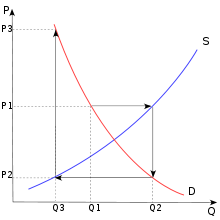
Very simply put: Read more…
China sees U.S. stoking Brazil and India anger over yuan
By Zhou Xin and Koh Gui Qing
 BEIJING (Reuters) – The United States has incited Brazil and India to criticize China’s currency policy, but Beijing need not worry too much because it can defuse the tension through talks, a series of Chinese government advisers told Reuters.
Independent analysts warned, however, that a belief that Brazil and India are doing Washington’s bidding and are not truly aggrieved could make Beijing complacent and undermine fledgling ties between the emerging powers.
Increasingly widespread calls for a stronger yuan are awkward for China, which is accustomed to facing U.S. pressure over its tightly controlled exchange rate but has long tried to cast itself as the natural ally of other developing nations.
Brazil and India are unlikely to be any more successful than the United States in persuading Beijing to permit faster appreciation, researchers in Chinese government think tanks said.
“They must realize that the root of problem is not China but Read more…
Obama signature creates ‘continental perimeter’
Move described as key step in advance of North American Union
By Jerome R. Corsi
© 2011 WorldNetDaily
 Barack Obama and Canadian Prime Minister Stephen Harper quietly have taken a major step toward erasing the border between the two nations with a new “Beyond the Border” bilateral declaration.
In a ceremony designed to remain below the radar of national public opinion, Obama and Harper bypassed Congress to sign on the basis of their executive authority a declaration that put in place a new national security vision defined not by U.S. national borders, but by a continental view of a “North American perimeter.”
It happened Friday, the day the Obama administration usually pushes through issues that it prefers the media ignore.
By signing the declaration, the Obama administration has implemented without congressional approval a key initiative President Bush began under the Security and Prosperity Partnership of North America, moving the United States and Canada beyond the North American Free Trade Agreement, commonly known as NAFTA, toward a developing North American Union regional government.
The declaration signed by the two heads of state and titled “Beyond the Border: A Shared Vision for Perimeter Security and Economic Competitiveness,” was described as “For Immediate Release” on the websites of the White House and the Canadian chief executive.
Harper followed Obama’s lead in signing the declaration as a form of executive order, deciding to bypass the Read more…
IMF Calls for Dollar Alternative
 The IMF is trying to move the world away from the U.S. dollar and towards a global currency once again. In a new report entitled “Enhancing International Monetary Stability—A Role for the SDR“, the IMF details the “problems” with having the U.S. dollar as the reserve currency of the globe and the IMF discusses the potential for a larger role for SDRs (Special Drawing Rights). But the IMF certainly does not view SDRs as the “final solution” to global currency problems. Rather, the IMF considers SDRs to be a transitional phase between what we have now and a new world currency. In this newly published report, the IMF makes this point very clearly: “In the even longer run, if there were political willingness to do so, these securities could constitute an embryo of global currency.” Yes, you read that correctly. The SDR is supposed to be “an embryo” from which a global currency will one day develop. So what about the U.S. dollar and other national currencies? Well, they would just end up fading away.
CNN clearly understands what the IMF is trying to accomplish with this new report. The following is how CNN’s recent story about the new IMF report begins….
“The International Monetary Fund issued a report Thursday on a possible replacement for the dollar as the world’s reserve currency.”
That is exactly what the IMF intends to do.
They intend to have SDRs replace the U.S. dollar as the world reserve currency.
So exactly what are SDRs?
Well, “SDR” is short for Special Drawing Rights. It is a synthetic currency unit that is made up of Read more…
THE EURO & U.S. DOLLAR COLLAPSE & DEVALUATION OF 50-70%
Gold buying spree grips Chinese households
In this world of chaos and tumult, the Chinese people know what to do to preserve their wealth – they buy gold. When Americans finally wake up, if that ever happens, there is a good chance that there won’t be any gold to buy at any price.
By David Lew
 BEIJING (Commodity Online):An unprecedented investor interest in gold is turning Chinese households as store houses of wealth these days as people are on a gold buying spree across the rural and urban areas of the dragon country.
Bundles of news stories are these days written on the gold buying spree by the Chinese households. If not an overstatement, it is now a fact that people’s houses in China have soared in value thanks to the rising prices of gold in the last two years.
“People in China are buying gold like never before. They believe that gold is the best form of investment. So they are buying gold coins, bars and jewelery items and stocking up safely in their homes,” says Beijing-based bullion dealer J Kim Lee.
Quoting the World Gold Council figures, Lee says that if the gold buying spree by Chinese households goes on at the current pace, private gold Chinese demand may overtake Indian gold demand by 2014, giving the world’s two most populous nations two ounces of gold in every five sold worldwide that year.
Indian households are estimated to be owning 15,000 tonnes of gold. India continues to the largest consumer and importer of gold worldwide.
According to precious metals analyst Steven Jon Kaplan, a significant percentage of gold’s price increase in 2009-2010 was caused by the incremental demand from Read more…
Egypt is Just the Beginning for Gold’s Next Move
 Watching CNN, its easy to be lulled into the sense that the cute little third world African country that is home to Cleopatra, mummies and pyramids is having a little revolution to get rid of a tired old tyrant. That the old goat is putting up such resistance to the national message is to be expected, and might be forgiven. Unleashing bands of paid thugs under the guise of ‘supporters’ reveals true brutality and illuminates the character of the man, Hosni Mubarak – a sociopath.
This phenomenon, originated in Tunisia, a nation of 10 million, and now raging in Egypt, of 85 million has spread to Yemen, population 25 million and Jordan, population 6 million is no mere regional political shift: this is the beginning of America’s loss of control over the region.
That the democratic process even got a foothold in the tribal and historically despotically governed middle east is due to a series of historical power plays, and not so much to a nascent and organic inclination towards the idea of democracy. When oil emerged to become the most strategic substance on earth after the second world war, the United States, armed with the economic windfall from the war machine, set about toppling governments and seeding insurrection through the offices of the C.I.A., bolstering governments that were ‘incentivized’ to protect U.S. interests, and destroying those that were not.
Back then, before the light-sped connected world, the C.I.A. could operate with Read more…


![[Most Recent Quotes from www.kitco.com]](https://i0.wp.com/www.kitconet.com/charts/metals/gold/t24_au_en_usoz_2.gif)
![[Most Recent Quotes from www.kitco.com]](https://i0.wp.com/www.kitconet.com/charts/metals/silver/t24_ag_en_usoz_2.gif)

 crisisboom

You must be logged in to post a comment.