Archive
ENASA satellite finds Earth’s clouds are getting lower
(PhysOrg.com) — Earth’s clouds got a little lower — about one percent on average — during the first decade of this century, finds a new NASA-funded university study based on NASA satellite data. The results have potential implications for future global climate.
 This image of clouds over the southern Indian Ocean was acquired on July 23, 2007 by one of the backward (northward)-viewing cameras of the Multi-angle Imaging SpectroRadiometer (MISR) instrument on NASA’s polar-orbiting Terra spacecraft. Credit: NASA/JPL-Caltech
Scientists at the University of Auckland in New Zealand analyzed the first 10 years of global cloud-top height measurements (from March 2000 to February 2010) from the Multi-angle Imaging SpectroRadiometer (MISR) instrument on NASA’s Terra spacecraft. The study, published recently in the journal Geophysical Research Letters, revealed an overall trend of decreasing cloud height. Global average cloud height declined by around one percent over the decade, or by around 100 to 130 feet (30 to 40 meters). Most of the reduction was due to Read more…
Arctic Warming Continuing, Approaching Tipping Point?
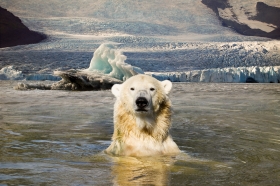
Last year the Arctic, which is warming faster than anywhere else on Earth due to global climate change, experienced its warmest twelve months yet. According to recent data by NASA, average Arctic temperatures in 2011 were 2.28 degrees Celsius (4.1 degrees Fahrenheit) above those recorded from 1951-1980. As the Arctic warms, imperiling its biodiversity and indigenous people, researchers are increasingly concerned that the region will hit climatic tipping points that could severely impact the rest of the world. A recent commentary in Nature Climate Change highlighted a number of tipping points that keep scientists awake at night.
“If set in motion, [tipping points] can generate profound climate change which places the Arctic not at the periphery but at the core of the Earth system,” Professor Duarte, a climatologist with the University of Western Australia’s Ocean Institute and co-author other paper, said in a press release. “There is evidence that these forces are starting to Read more…
CU-Boulder study shows global glaciers, ice caps, shedding billions of tons of mass annually
Study also shows Greenland, Antarctica and global glaciers and ice caps lost roughly 8 times the volume of Lake Erie from 2003-2010

IMAGE: A new CU-Boulder study using the NASA/Germany GRACE satellite shows Earth is losing roughly 150 billion tons of ice annually. Credit-NASA
Earth’s glaciers and ice caps outside of the regions of Greenland and Antarctica are shedding roughly 150 billion tons of ice annually, according to a new study led by the University of Colorado Boulder.
The research effort is the first comprehensive satellite study of the contribution of the world’s melting glaciers and ice caps to global sea level rise and indicates they are adding roughly 0.4 millimeters annually, said CU-Boulder physics Professor John Wahr, who helped lead the study. The measurements are important because the melting of the world’s glaciers and ice caps, along with Greenland and Antarctica, pose the greatest threat to sea level increases in the future, Wahr said.
The researchers used satellite measurements taken with the Gravity Recovery and Climate Experiment, or GRACE, a joint effort of NASA and Germany, to calculate that the world’s glaciers and ice caps had lost about 148 billion tons, or about 39 cubic miles of ice annually from 2003 to 2010. The total does not count the mass from individual glacier and ice caps on the fringes of the Greenland and Antarctic ice sheets — roughly an additional 80 billion tons.
“This is the first time anyone has looked at all of the mass loss from all of Earth’s glaciers and Read more…
Did You Know That Earth Is Getting Lighter Every Day?
 Earth is getting 50,000 tonnes lighterevery year, even while 40,000 tonnes of space dust fall on our planet’s surface during the same period. So, why are we losing so much weight? You will be surprised.
At least, I never considered this and I was surprised to hear the reasoning in More or Less, a BBC Radio 4 program about statistics and numbers. According to Dr Chris Smith and Cambridge University physicist Dave Ansel’s calculations, despite those 40,000 tonnes of space dust that become part of our planet every year, Earth loses 50,000 tonnes of mass. Is it because we keep launching rockets? No. These are their back-of-the-napkin calculations:
Adding weight
• Earth gains about 40,000 tonnes of dust every year, the remnants of the formation of the solar system, which are attracted by our gravity and become part of the matter in our planet. Our planet is actually made from all that starstuff.
• NASA says that Earth gains about 160 tonnes of matter a year because the global temperature is going up: “If we are adding energy to the system, the mass must Read more…
Earth twin discovered 22 light-years away
The Kepler mission initiated to find habitable Earth-like planets near our own has turned up another candidate for places we might visit in the future: GJ 667Cc. This planet has an orbital period of about 28 days regularly and has a mass that’s at least 4.5 larger than Earth. This planet is neither too hot nor too cold for liquid water to exist on the surface, and it sits aside two or three additional planets that may well be similar enough to also be Earth candidates. This newest discovery was made by astronomers from UC Santa Cruz Steven Vogt and Eugenio Rivera, lead by Guillem Anglada-Escudé and Paul Butler of the Carnegie Institution for Science.

The host star in this system is called GJ 667C and is an M-class dwarf star. Two more stars sit in the Read more…
Sun Delivered Curveball Of Powerful Radiation At Earth Say UNH Scientists
A potent follow-up solar flare, which occurred Friday (Jan. 17, 2012), just days after the Sun launched the biggest coronal mass ejection (CME) seen in nearly a decade, delivered a powerful radiation punch to Earth’s magnetic field despite the fact that it was aimed away from our planet.According to University of New Hampshire scientists currently studying and modeling various aspects of solar radiation, this was due to both the existing population of energetic particles launched by the first CME and a powerful magnetic connection that reeled particles in towards Earth from the Sun’s blast region, which had spun to an oblique angle.”Energetic particles can sneak around the ‘corner,’ as was the case in Friday’s event when it was launched at the Sun’s limb, or edge,” says astrophysicist Harlan Spence, director of the UNH Institute for the Study of Earth, Oceans, and Space (EOS) and principal investigator for the Cosmic Ray Telescope for the Effects of Radiation (CRaTER) instrument onboard NASA’s Lunar Reconnaissance Orbiter (LRO) mission. CRaTER is designed to measure and characterize aspects of the deep space radiation environment.
Caption: Particle radiation from the Jan. 23, 2012 solar flare speeds away from the Sun along curved magnetic field lines (blue lines) and arrives before the coronal mass ejection (orange mass from the Sun) and its driven shock.

Arctic climate change ‘to spark domino effect’
 The rate of Arctic climate change was now faster than ecosystems and traditional Arctic societies could adapt to.
WA-based scientists have warned of “dire consequences” to the human race after detecting the first signs of dangerous climate change in the Arctic.
The scientists, from the University of WA, claim the region is fast approaching a series of imminent “tipping points” which could trigger a domino effect of large-scale climate change across the entire planet.
In a paper published in the Royal Swedish Academy of Sciences’ journal AMBIO and Nature Climate Change, the lead author and director of UWA’s Oceans Institute, Winthrop Professor Carlos Duarte, said the Arctic region contained arguably the greatest concentration of Read more…
Nasa study solves case of Earth’s ‘missing energy’

Clouds play a vital role in Earth's energy balance, cooling or warming Earth's surface depending on their type. This painting, "Cumulus Congestus," by JPL's Graeme Stephens, principal investigator of NASA's CloudSat mission, depicts cumulus clouds, which transport energy away from Earth's surface. Image credit: Graeme Stephens
(PhysOrg.com) — Two years ago, scientists at the National Center for Atmospheric Research in Boulder, Colo., released a study claiming that inconsistencies between satellite observations of Earth’s heat and measurements of ocean heating amounted to evidence of “missing energy” in the planet’s system.
Where was it going? Or, they wondered, was something wrong with the way researchers tracked energy as it was absorbed from the sun and emitted back into space?
An international team of atmospheric scientists and oceanographers, led by Norman Loeb of NASA’s Langley Research Center in Hampton, Va., and including Graeme Stephens of NASA’s Jet Propulsion Laboratory in Pasadena, Calif., set out to investigate the mystery.
They used 10 years of data — spanning 2001 to 2010 — from NASA Langley’s orbiting Clouds and the Earth’s Radiant Energy System Experiment (CERES) instruments to measure changes in the net radiation balance at the top of Earth’s atmosphere. The CERES data were then combined with estimates of the heat content of Earth’s ocean from three independent ocean-sensor sources.
Their analysis, summarized in a NASA-led study published Jan. 22 in the Read more…
Earthquakes Skyrocket in 2011-2011

Click to Enlarge- Credit StanDeyo
NASA on the Moon – Lunar Gravity Shifting
Scientists say that a recent analysis of a Lunar Laser Ranging data record across a period of 38.7 years revealed an anomalous increase of the eccentricity of the lunar orbit.
This phenomena occurring in the interiors of both the Earth and the Moon, cannot be explained say expert in quantum cosmology.
They have examined numerous dynamical effects, not modeled in the data analysis, in the framework of long-range modified models of gravity and of the standard Newtonian/Einsteinian paradigm. The results are puzzling since none of them can explain the Read more…


![[Most Recent Quotes from www.kitco.com]](https://i0.wp.com/www.kitconet.com/charts/metals/gold/t24_au_en_usoz_2.gif)
![[Most Recent Quotes from www.kitco.com]](https://i0.wp.com/www.kitconet.com/charts/metals/silver/t24_ag_en_usoz_2.gif)

 crisisboom
 CRISISBOOM
You must be logged in to post a comment.