Archive
Is The Number Of Earthquakes Increasing? Why The 5.8 Virginia Earthquake Might Just Be A Preview Of Things To Come
 Is the number of earthquakes increasing? Are major earthquakes becoming more frequent? In the aftermath of the magnitude-5.8 earthquake in Virginia, a whole lot of people are asking those questions. All over the mainstream media, “experts” are coming on and assuring the public that all of this is “normal” and that the number of earthquakes is not actually increasing. The USGS continues to insist that the frequency of major earthquakes has been “fairly constant” and that there is no reason for alarm. But is that really the truth? In this article, you will be presented with evidence that the number of earthquakes is definitely increasing. Please approach the evidence with an open mind. The truth is that this year we are on pace to have more than twice Read more…
Ancient faults still prove to be powerful
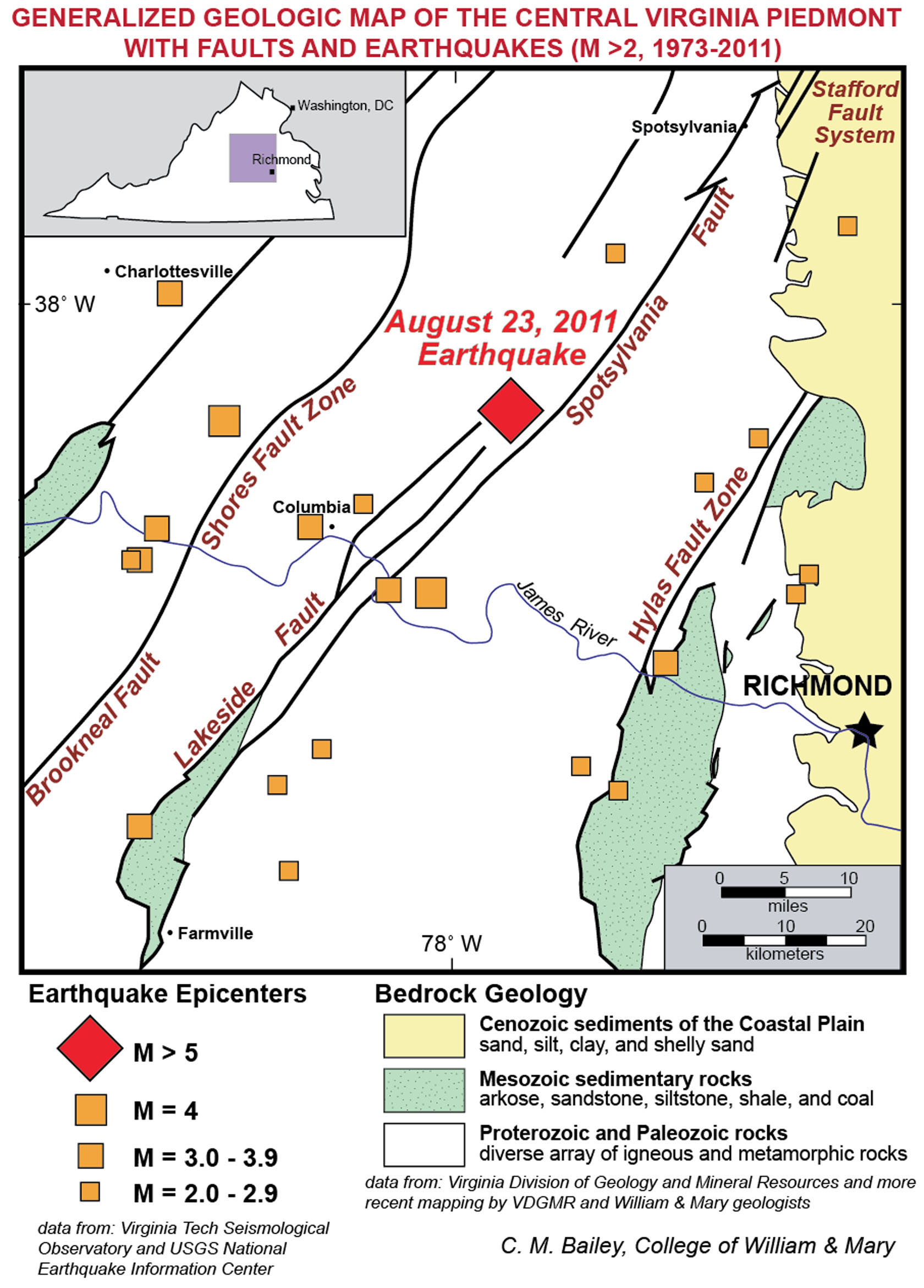
Click to Enlarge
“Our discussion was interrupted,” Department Chair Chuck Bailey said, “by a motion from the floor.”
All joking aside, even the experts didn’t realize what was going on at first.
“We thought it was construction,” Chancellor Professor of Geology Heather Macdonald said.
However, when the tremor continued for nearly 20 seconds the geologists realized they had a quake on their hands – a major quake. A 5.8 on the Richter scale is significant for the region.
According to reports, the earthquake occurred at 1:51 p.m. and was centered in Mineral, Va., which is about half way between Richmond and Charlottesville. Tremors were felt as far north as Maine.
Bailey, a structural geologist who teaches courses on Virginia geology, is particularly familiar with the area’s seismic activity. Following Tuesday’s event, his expertise was sought out by national and local media.
“This is a once-in-a-century earthquake, anyway you slice it”, Bailey told the Associated Press, adding that quakes of a similar Read more…
Strong East Coast quake highly unusual: scientist

Washington Monument tilting as a result of the 5.9 earthquake
(Reuters) – The strong earthquake that rattled the eastern United States on Tuesday was highly unusual in its severity, though it was centered in a part of Virginia known for smaller quakes, seismologists said.
The initial earthquake, which registered a magnitude of 5.9 just before 2 p.m. EDT, was felt from the Carolinas to New England.
“One of this size is highly unusual,” said Karen Fisher, a professor of seismology at Brown University and president-elect of the seismology section at the American Geophysical Union. “This is the largest earthquake by far that I am aware of occurring there in recent history.”
The quake’s epicenter in central Virginia is in an area the U.S. Geological Survey calls the Central Virginia Seismic Zone, Fisher said by phone from Providence, Rhode Island.
While the strength of the quake was unusual, the Read more…
Comet Elenin heads towards Earth…
The ancient Mayan calendar predicts that we will be coming to an end of a cycle in the year 2012. The winter solstice is believed to be the date that the world will end. Lately there has been a lot of buzz about the comet Elenin. The comet is set to come close to earth on October 16th of this year and many believe this will have atrocious affects on the planet. Brooks Agnew, author and host of X-squared radio, tells us why we should care.
Earthquake map shows epicenter in central Virginia (Video)
 View full sizeU.S. Geological Survey
The U.S. Geological Survey has posted this map of the 5.9-magnitude earthquake that hit central Virginia just before 2 p.m. today, sending tremors up and down the East Coast.
The yellow glow represents the area where potential damage is deemed “light” and perceived shaking is “moderate.”
The quake’s frequency hit the geology of the region just right, like a tuning fork, and reverberated outward, said Alexander Gates, the chairman of earth and environmental sciences at Rutgers-Newark, and an earthquake expert. But there’s no likely danger for aftershocks of the Virginia quake, which will be significantly more minor, he said.
“That was pretty good, huh? I was impressed,” Gates said. “You don’t get earthquakes like that so often on the East Coast.”
Though small earthquakes occur in New Jersey all the time, earthquake experts said today’s shaking was highly unusual.
“It’s probably the largest one people have felt in New Jersey in decades,” Read more…
Colorado: Midnight earthquake felt in Springs, largest in state since ’73

GOLDEN — A magnitude 5.3 earthquake shook southern Colorado late Monday, waking some people up and startling hundreds of others, including some in Colorado Springs.
Colorado Springs residents reported feeling the temblor about 11:49 pm Monday on Twitter at @csgazette.
The USGS link online confirmed the tweets’ accuracy.
The magnitude 5.3 earthquake was recorded at about 11:46 p.m. MDT Monday about nine miles southwest of Trinidad, and about 135 miles south of Colorado Springs, according to the National Earthquake Information Center in Golden. The quake followed two smaller ones that hit the area earlier in the day.
The quake is the largest in Colorado since a magnitude 5.7 was recorded in 1973, U.S. Geological Service geophysicist Amy Vaughn said. That one was centered in the northwestern part of the state — about 50 miles north of Read more…
7.0-magnitude undersea quake hits near Vanuatu in South Pacific, no tsunami alert
 Tsunami animation courtsey GDACS
NEW YORK — The U.S. Geological Survey is reporting a powerful undersea earthquake off the South Pacific island of Vanuatu.
The U.S.G.S. says a magnitude 7.0 earthquake struck at 5:19 a.m. Sunday local time (1819 GMT) at a depth of 28.5 kilometers (17.7 miles). Its epicenter was 69 kilometers (42 miles) south-southwest of the Vanuatu capital of Port-Vila.
The Pacific Tsunami Warning Center says no tsunami warning is in effect.
Vanuatu is part of the Pacific “Ring of Fire,” an arc of earthquake and volcanic zones stretching from South America through Alaska and down through the South Pacific. Read more…
Japan’s Northeast Hit by 6.8 Magnitude Quake
 A 6.8-magnitude earthquake struck off Japan‘s northeastern coast Friday, triggering a 50 cm (20 inch) tsunami warning that was lifted about 35 minutes later.
The epicenter of the quake, which hit at 2:36 pm, was off the coast of Fukushima, 20 km below Earth’s surface, the same region where the massive 9.0 magnitude earthquake struck on March 11, followed by the devastating 30-meter tsunami, according to the Japan Meteorological Agency.
The agency said there was no damage from Fridays’s quake and the tsunami advisory was lifted after no waves were sighted. Some highways were closed and high-speed bullet trains were halted after the quake, public broadcaster NHK said.
Friday’s tremor was felt in Tokyo where buildings Read more…
Unusual Fault Pattern Surfaces in Earthquake Study
 This 3-D view of the surface rupture of the April 4, 2010, El Mayor-Cucapah earthquake (red line) reveals a new fault line connecting the Gulf of California with the Elsinore fault, which could become a major part of the boundary between the Pacific and the North America Plates. Image credit: Caltech Tectonics Observatory |
Like scars that remain on the skin long after a wound has healed, earthquake fault lines can be traced on Earth’s surface long after their initial rupture. Typically, this line of intersection between the area where the fault slips and the ground is more complicated at the surface than at depth.
But a new study of the April 4, 2010, El Mayor-Cucapah earthquake in Mexico reveals a reversal of this trend. While the fault involved in the event appeared to be superficially straight, the fault zone is warped and complicated at depth.
The study-led by researchers at the California Institute of Technology (Caltech) and documenting findings from the magnitude 7.2 event, which was centered in the Baja California state of Mexico-is available online in the journal Nature Geoscience.
The El Mayor-Cucapah earthquake happened along a system of Read more…
China quake measuring 5.8 leaves 26 injured
Beijing: Twenty-six people were injured, three of them critically, and a number of houses damaged when a 5.8-magnitude earthquake on Thursday hit northwest China, the official media said.
The epicentre of the quake was at the border area between the region’s Atux City in the Kizilsu Kirgiz Autonomous Prefecture and Jiashi County in Kashghar, state news agency Xinhua reported.
The quake that struck Xinjiang Uygur Autonomous Region occurred at 6:06 pm local time, the China Earthquake Networks Center said.

It has also toppled more than 30 units of housing, according to a spokesman with the Jiashi County Committee of the Communist Party of China.
Two days ago three persons were injured and more than 40,000 people affected when a 5.2-magnitude earthquake hit southwest Yunnan Province.


![[Most Recent Quotes from www.kitco.com]](https://i0.wp.com/www.kitconet.com/charts/metals/gold/t24_au_en_usoz_2.gif)
![[Most Recent Quotes from www.kitco.com]](https://i0.wp.com/www.kitconet.com/charts/metals/silver/t24_ag_en_usoz_2.gif)

 crisisboom
 CRISISBOOM
You must be logged in to post a comment.