Archive
Egypt is Just the Beginning for Gold’s Next Move
 Watching CNN, its easy to be lulled into the sense that the cute little third world African country that is home to Cleopatra, mummies and pyramids is having a little revolution to get rid of a tired old tyrant. That the old goat is putting up such resistance to the national message is to be expected, and might be forgiven. Unleashing bands of paid thugs under the guise of ‘supporters’ reveals true brutality and illuminates the character of the man, Hosni Mubarak – a sociopath.
This phenomenon, originated in Tunisia, a nation of 10 million, and now raging in Egypt, of 85 million has spread to Yemen, population 25 million and Jordan, population 6 million is no mere regional political shift: this is the beginning of America’s loss of control over the region.
That the democratic process even got a foothold in the tribal and historically despotically governed middle east is due to a series of historical power plays, and not so much to a nascent and organic inclination towards the idea of democracy. When oil emerged to become the most strategic substance on earth after the second world war, the United States, armed with the economic windfall from the war machine, set about toppling governments and seeding insurrection through the offices of the C.I.A., bolstering governments that were ‘incentivized’ to protect U.S. interests, and destroying those that were not.
Back then, before the light-sped connected world, the C.I.A. could operate with Read more…
Inflation Group Says U.S. Cities Will Be Like Egypt in Four Years
The National Inflation Association has issued a chilling new advisory in which it warns that the inflationary time bomb being created by the policies of the Federal Reserve will lead to American cities experiencing similar chaos currently unfolding in Egypt by 2015.
Egyptian dictator Hosni Mubarak has been in power for three decades and in that time has managed to handle all manner of threats to the stability of his regime. But it was the huge unrest sparked by soaring food prices that finally led the Egyptian people to launch a revolution which is likely to see Mubarak forced out of office for good.
“Food inflation in Egypt has reached 20% and citizens in the nation already spend about 40% of their monthly expenditures on food. Americans for decades have been Read more…
HOW BANKS AND INVESTORS ARE STARVING THE THIRD WORLD
Ellen Brown
“What for a poor man is a crust, for a rich man is a securitized asset class.”
–Futures trader Ann Berg, quoted in the UK Guardian
 Underlying the sudden, volatile uprising in Egypt and Tunisia is a growing global crisis sparked by soaring food prices and unemployment. The Associated Press reports that roughly 40 percent of Egyptians struggle along at the World Bank-set poverty level of under $2 per day. Analysts estimate that food price inflation in Egypt is currently at an unsustainable 17 percent yearly. In poorer countries, as much as 60 to 80 percent of people’s incomes go for food, compared to just 10 to 20 percent in industrial countries. An increase of a dollar or so in the cost of a gallon of milk or a loaf of bread for Americans can mean starvation for people in Egypt and other poor countries.
Follow the Money
The cause of the recent jump in global food prices remains a matter of debate. Some analysts blame the Federal Reserve’s “quantitative easing” program (increasing the money supply with credit created with accounting entries), which they warn is sparking hyperinflation. Too much money chasing too few goods is the classic explanation for Read more…
Stocks Up, Houses Down, And What This Means for Most Americans
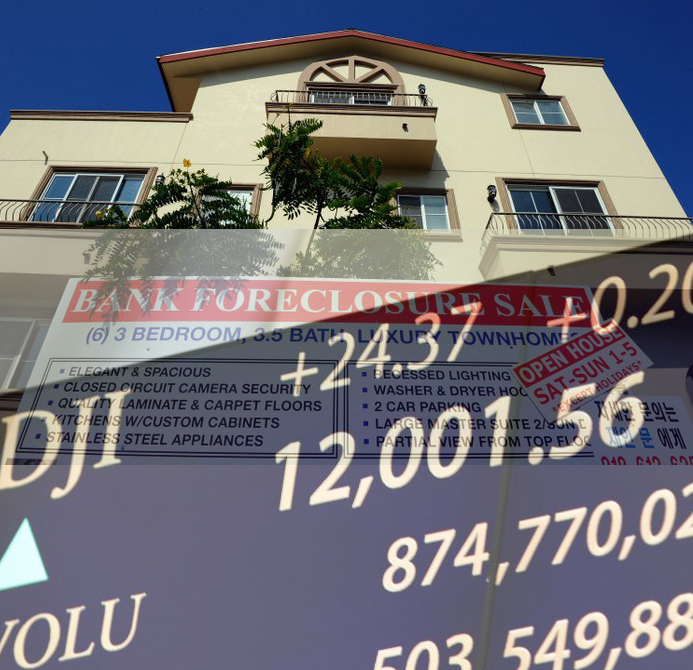
Put your ear to the ground and you can almost hear the bulls stampeding. The Dow closed above 12,000 Tuesday for the first time since June 2008. The Dow is up 4 percent this year after increasing 11 percent in 2010. The Standard & Poor 500 is also up 4 percent this year, and the Nasdaq index, up 3.7 percent.
“The U.S. economy is back!” says a prominent Wall Streeter.
Ummm. Not quite.
Corporate earnings remain strong (better-than-expected reports from UPS and Pfizer fueled Tuesday’s rally). The Fed’s continuing slush pump of money into the financial system is also lifting the animal spirits of Wall Street. Traders like nothing more than speculating with almost-free money. And tumult in the Middle East is pushing more foreign money into the relatively safe and reliable American equities market.
It’s simply wonderful, especially if you’re among the richest 1 percent of Americans who own more than half of all the shares of stock traded on Wall Street. Hey, you might feel chipper even if you’re among the next richest 9 percent, who own 40 percent.
But most Americans own a tiny sliver of Read more…
Even Donald Trump Is Warning That An Economic Collapse Is Coming
 In a shocking new interview, Donald Trump has gone farther than he ever has before in discussing a potential economic collapse in America. Using phrases such as “you’re going to pay $25 for a loaf of bread pretty soon” and “we could end up being another Egypt”, Trump explained to Newsmax that he is incredibly concerned about the direction our economy is headed. Whatever you may think of Donald Trump on a personal level, it is undeniable that he has been extremely successful in business. As one of the most prominent businessmen in America, he is absolutely horrified about what is happening to this nation. In fact, he is so disturbed about the direction that this country is heading that he is seriously considering running for president in 2012. But whether he decides to run in 2012 or not, what Trump is now saying about the U.S. economy should be a huge wake up call for all of us.
Trump says that the U.S. government is broke, that all of our jobs are being shipped overseas, that other nations are heavily taking advantage of us and that the value of the U.S. dollar is being destroyed. The following interview with Trump was originally posted on Newsmax and it is really worth watching….
Now, you may or may not think much of Donald Trump as a politician, but when a businessman of his caliber starts using apocalyptic language to describe where the U.S. economy is headed perhaps we should all pay attention.
The following are 12 key quotes that were pulled out of Trump’s new interview along with some facts and statistics that show that what Trump is saying is really happening. Read more…
A New World Order Reserve Currency
 What do the riots in Egypt and a new world reserve currency have in common?
Perhaps more than we think.
Consider the following statements from George Soros in a recent interview:
Some statements of Soros (who happens to be a Fabian Socialist):
The efficient market hypothesis has failed.
Markets are not tending toward equilibrium.
There is imperfect knowledge of regulators and market participants.
He has an economic theory that is “more relevant” than the dominant one and is supporting an institute for new economic thinking….
Inflation (in the United States) is helpful because the burden of debt was getting too heavy.
The problem is you don’t have a Read more…
Quantitative Easing Causing Food Prices to Skyrocket
 As I’ve previously noted, interest rates have risen both times after the Fed implemented quantitative easing.
Graham Summers points out that food prices have also skyrocketed both times:
In case you’ve missed it, food riots are spreading throughout the developing world Already Tunisia, Algeria, Oman, and even Laos are experiencing riots and protests due to soaring food prices.
As Abdolreza Abbassian, chief economist at the UN’s Food and Agriculture Organization (FAO), put it, “We are entering a danger territory.”
Indeed, these situations left people literally starving… AND dead from the riots.
And why is this happening?
A perfect storm of increased demand, bad harvests from key exporters (Argentina, Russia, Australia and Canada, but most of all, the Fed’s money pumping. If you don’t believe me, have a look at the below chart: Read more…
Fed chief expects high unemployment, economic growth in 2011
Vicki Needham
 Unemployment will remain high, the nation’s economy could expand by 4 percent and interest rates may need go up, Federal Reserve Bank of Philadelphia President Charles Plosser said Monday.
“If economic growth in the United States continues to gain traction and the prospects begin to look ever better, it might be time for us to begin thinking about how do we begin to gradually take our foot off the accelerator,” Plosser told reporters after a speech at the Central Bank of Chile in Santiago, according to news reports.
Plosser said he may favor a rate increase if economic growth necessitates a change.
“It might. I’m not going to rule that out,” he said.
The central bank has said that it plans to keep short-term interest rates low for an “extended period.”
During Monday’s speech, Plosser also predicted that the U.S. could grow between 3 percent and 4 percent this year.
The Fed’s plan to purchase $600 billion in government debt will probably continue through June while the nation’s 15 million unemployed look for work, although Plosser didn’t rule out pulling the stimulus funds back earlier.
“It could end earlier if economic conditions call for it, but right now I’m not sure that that’s the most likely outcome,” he told reporters. “It obviously creates challenges for some countries because of appreciating currencies. But I think that will pass. Those are short-run issues.”
Plosser has expressed concern about whether the Fed’s quantitative easing, also known as QE2, will spur economic growth while lowering the jobless rate that has remained above 9 percent for 20 months.
“Monetary policy is not going to be able to speed up the adjustments in labor markets or prevent asset bubbles, and attempts to do so may create more instability, not less,” he said.
“Expecting too much of monetary policy will undermine its ability to achieve the one thing that it is well-designed to do — ensuring long-term price stability.”
QE2 has brought harsh criticism from some lawmakers on Capitol Hill who argue that the plan could devalue the dollar and cause inflation.
Gold: Major Buy Signals!
Gold and Precious Metals
UUP (US Dollar Proxy) Chart.
US Dollar Analysis:

- The Dollar decline on soft volume over the past few days has given me a buy signal. I use our US dollar signals to play the dollar, and to coordinate your Gold and Gold Stock purchases.
- Let me be clear; the move up here in the dollar is nothing more than a dead cat bounce, so don’t play it too big. When looking at the decline in the dollar from July through November, the dollar dropped nearly 15%. The most troubling sign I see for the USD over the longer term is the distribution in the ensuing rally in the Nov- Dec time frame. The dollar is in a major bear market, and rallies in bear markets tend to be sharp, and can end long before they are “supposed to”.
- The performance of the US Dollar over the last ten years is pathetic. The dollar has lost massive purchasing power against almost every single other asset. Consider: Crude Oil is up over 250%, and the Commodity Agricultural Raw Materials Index is up 57%. Many other commodities are up over 200% against the dollar, in the same timeframe. Why has this happened?
- The answer is: Debt Accumulation. Debt is growing, so the fundamental causes of the dollar bear market are also growing. The financial crisis is not ending. It is getting worse. Read more…
Bank of America posts loss on mortgage problems
Joe Rauch
and Maria Aspan
CHARLOTTE, N.C./NEW YORK, Jan. 21, 2011 (Reuters) — Bank of America Corp, the largest U.S. bank, reported weaker-than-expected revenue and a second straight quarterly loss after its limping mortgage business triggered writedowns and legal settlements.

As the financial crisis was ramping up, then Chief Executive Kenneth Lewis bought Countrywide Financial Inc for $4.2 billion. Current CEO Brian Moynihan is still coping with the aftermath.
In the fourth quarter, Bank of America took a writedown of $2 billion to recognize the declining value of Countrywide. The bank also set aside $4.1 billion for legal costs linked to home loans it is buying back from investors, or is likely to buy back.
“Countrywide is still hurting them and it will continue to. It’s like a tooth being pulled — it’s only going to feel good when it’s done,” said Matt McCormick, portfolio manager at Bahl & Gaynor Investment Counsel Inc in Cincinnati, which does not own Bank of America shares.
It was not clear how Bank of America’s results compared with analysts’ average estimates, given the profusion of special items in the report. Read more…


![[Most Recent Quotes from www.kitco.com]](https://i0.wp.com/www.kitconet.com/charts/metals/gold/t24_au_en_usoz_2.gif)
![[Most Recent Quotes from www.kitco.com]](https://i0.wp.com/www.kitconet.com/charts/metals/silver/t24_ag_en_usoz_2.gif)

 crisisboom
 CRISISBOOM
You must be logged in to post a comment.