Archive
China’s Inflation Problem Looms Large
Peter Schiff
 |
The global economy has become so unbalanced that even government ministers who would normally have trouble explaining supply or demand clearly recognize that something has to give. To a very large extent the distortions are caused by China’s long-standing policy of pegging its currency, the yuan, to the U.S. dollar. But as China’s economy gains strength, and the American economy weakens, the cost and difficulty of maintaining the peg become ever greater, and eventually outweigh the benefits that the policy supposedly delivers to China. In the first few weeks of 2011 fresh evidence has arisen that shows just how difficult it has become for Beijing.
Twenty years ago, China’s leaders decided to ditch the disaster of economic communism in favor of privatized, export-focused, industry. The plan largely worked. Over that time, China has arguably moved more people out of poverty in the shortest amount of time in the history of the planet. But somewhere along the way, China’s leaders became addicted to a game plan that outlived its usefulness.
In order to maintain the peg, China must continually buy dollars on the open market. But the weaker the dollar gets, the more dollars China must buy. And with the U.S. Federal Reserve pulling out all the stops to create inflation and push down the dollar, Beijing’s task becomes nearly impossible. Last week, it was announced that China’s foreign exchange reserves, the amount of foreign currency held at its central bank (mostly in U.S. dollars), increased by a record $199 billion in 4th quarter 2010, to reach $2.85 trillion. These reserves currently account for a staggering 49% of China’s annual GDP (if the same proportional amount were held by the U.S., our measly $46 billion in reserves would have to increase 163 times to $7.5 trillion).
In order to buy these dollars, the Chinese central bank must print its own currency. In essence, China is adopting the Fed’s expansionary monetary policy. In the U.S. the inflationary impact of such a strategy is mitigated by our ability to export paper dollars in exchange for inexpensive Chinese imports. Although prices are rising here, they are not rising nearly as much as they would if we had to spend all this newly printed money on domestically produced goods. The big problem for China is that, unlike the U.S., the newly printed yuan are not exported, but remain in China bidding up consumer prices. As a result, inflation is becoming China’s dominant political issue.
It was recently announced that in November China’s consumer price index rose 5.1% from the same time a year earlier, with food prices rising more than 10%. As unrest builds, the Chinese government has unleashed a series of policies to address the symptoms of the disease while ignoring its root cause.
12 Economic Collapse Scenarios That We Could Potentially See In 2011
 What could cause an economic collapse in 2011? Well, unfortunately there are quite a few “nightmare scenarios” that could plunge the entire globe into another massive financial crisis. The United States, Japan and most of the nations in Europe are absolutely drowning in debt. The Federal Reserve continues to play reckless games with the U.S. dollar. The price of oil is skyrocketing and the global price of food just hit a new record high. Food riots are already breaking out all over the world. Meanwhile, the rampant fraud and corruption going on in world financial markets is starting to be exposed and the whole house of cards could come crashing down at any time. Most Americans have no idea that a horrific economic collapse could happen at literally any time. There is no way that all of this debt and all of this financial corruption is sustainable. At some point we are going to reach a moment of “total system failure”.
So will it be soon? Let’s hope not. Let’s certainly hope that it does not happen in 2011. Many of us need more time to prepare. Most of our families and friends need more time to prepare. Once this thing implodes there isn’t going to be an opportunity to have a “do over”. We simply will not be able to put the toothpaste back into the tube again.
So we had all better be getting prepared for hard times. The following are 12 economic collapse scenarios that we could potentially see in 2011….
#1 U.S. debt could become a massive crisis at any moment. China is saying all of the right things at the moment, but many analysts are openly worried about what could happen if China suddenly decides to start dumping all of the U.S. debt that they have accumulated. Right now about the only thing keeping U.S. government finances going is the ability to borrow gigantic amounts of money at extremely low interest rates. If anything upsets that paradigm, it could potentially have enormous consequences for the entire world financial Read more…
QE2 Reality Check
The Federal Open Market Committee (FOMC) announced on November 3, 2010 that it would purchase longer-term Treasury securities at a pace of $75 billion dollars per month through the Federal Reserve’s Permanent Open Market Operations (POMO) facility by the end of the second quarter 2011 and potentially beyond. The Quantitative Easing Two (“QE2”) program, championed by Ben Bernanke, chairman of the U.S. Federal Reserve, is expected to total at least $600 billion — and may well total more, if Bernanke and the FOMC deem it to be necessary.
Currently, QE2 is expected to continue until the end of 2011, i.e. up to $1.2 trillion, although there is ongoing policy debate within the Federal Reserve amidst growing fears that the policy may backfire.

Chart courtesy of Shadow Government Statistics |
Chinese President Hu Disses the Dollar; Says U.S. System is a ‘Product of the Past’

“The current international currency system is the product of the past,” Hu noted in answers to questions submitted to his foreign ministry office by The Wall Street Journal and the Washington Post.
BEIJING—Chinese President Hu Jintao emphasized the need for cooperation with the U.S. in areas from new energy to space ahead of his visit to Washington this week, but he called the present U.S. dollar-dominated currency system a “product of the past” and highlighted moves to turn the yuan into a global currency.
“We both stand to gain from a sound China-U.S. relationship, and lose from confrontation,” Hu said in written answers to questions from The Wall Street Journal and the Washington Post.
Hu acknowledged “some differences and sensitive issues between us,” but his tone was generally compromising, and he avoided specific mention of some of the controversial issues that have dogged relations with the U.S. over the past year or so—including U.S. arms sales to Taiwan that led to a freeze in military relations between the world’s sole superpower and its rising Asian rival. Read more…
Empty Store Shelves Coming to America
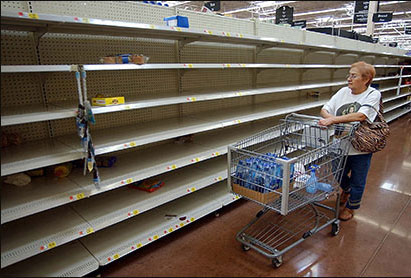 The National Inflation Association today issued a warning to all Americans that empty store shelves will likely be coming to America as a result of government price controls during the upcoming hyperinflationary crisis. This morning, NIA released a video preview of what hyperinflation will look like in the U.S. This extremely important must see video is now available on NIA’s video page.
NIA’s six-minute video released today goes into detail about an event that took place just outside of Boston, Massachusetts in May of this year. This story was widely ignored by the nationwide mainstream media, but NIA believes it was one of the most important news events of the first half of 2010. Although this particular crisis in Boston was due to decaying infrastructure, NIA believes a currency crisis will lead to the same type of panic on a nationwide basis.
NIA hopes that this video serves as a wake-up call for Americans to take the necessary steps to prepare for hyperinflation and become educated about the U.S. economy. In Zimbabwe during hyperinflation, Zimbabweans were forced to transact in gold and silver. It’s only a matter of time before the U.S. dollar becomes worthless and the only Americans with wealth will be those who own Read more…
Treasury Five-Year Notes Advance as Bernanke Predicts Slow Growth in Jobs
 Treasury five-year notes had the first back-to-back weekly gains since October as U.S. payrolls grew less than forecast and Federal Reserve Chairman Ben S. Bernanke said the labor market’s recovery will be gradual.
Yields on the notes touched the lowest level in two weeks yesterday after Labor Department data showed nonfarm payrolls expanded by 103,000 last month, versus a median forecast of 150,000 in a Bloomberg News survey. The Treasury will sell $66 billion in securities next week in the year’s first note and bond auctions.
“The five-year leads the way up, and it leads the way down,” said Brian Edmonds, head of interest-rates at Cantor Fitzgerald LP in New York, one of central bank’s 18 primary dealers. “The Fed chairman is setting expectations back further and making people aware that there aren’t a lot of quick fixes and it’s not going to turn on a dime.”
The yield on the five-year note fell five basis points yesterday, or 0.05 percentage point, to 1.96 percent, from 2.01 percent on Dec. 31, according to BGCantor Market Data. It touched 1.93 percent, the lowest since Dec. 21. The yield hadn’t declined for more than a single week at a time since Oct. 8.
Benchmark 10-year note yields rose three basis points to 3.32 percent, from 3.29 percent at the end of last week. Two- year note yields were little changed at 0.59 percent. Read more…
Alex Jones and Porter Stansberry
National Debt $200 Trillion Dollars
Dr. Laurence Kotlikoff economics professor at Boston University, discusses the national debt and unfunded liabilities – Aug. 11, 2010
Using CBO data, Kotlikoff says the real national debt is $202 trillion.
Compare the official deficit numbers for July – $165 billion – with the numbers for all of 2002 – where $165 billion covered the deficit for the entire fiscal year.
—
Excerpt:
The Congressional Budget Office whose Long-Term Budget Outlook, released in June, shows an even larger problem.
‘Unofficial’ Liabilities
Based on the CBO’s data, I calculate a fiscal gap of $202 trillion, which is more than 15 times the official debt. This gargantuan discrepancy between our “official” debt and our actual net indebtedness isn’t surprising. It reflects what economists call the labeling problem. Congress has been very careful over the years to label most of its liabilities “unofficial” to keep them off the books and far in the future.
Federal Reserve Banking System Explained
Federal Reserve Banking System Explained
What is the true value of your dollar?
Ever since 1913 when the Federal Reserve was created the dollar has been loosing its purchasing power. Currently you can only purchase at 3 percent today of the 100% that you could buy in 1913 resulting in a 97% loss. For instance milk was just an average of 32 cents a gallon in 1913. Today, the average price for a gallon of milk is $4 or more. Almost everyone tends to think that everything is getting more expensive when in reality the purchasing power of the dollar is going down which is the cause from inflation (which have averaged about 3.3% a year). It is only a matter of time when these Reserve Notes are declared worthless, hopefully, I pray you were wise enough to invest in physical precious metals. Remember the age old cliche “Where there’s smoke, there’s fire”.
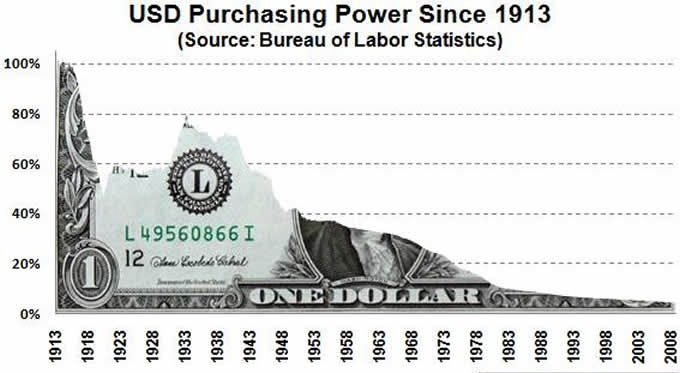
USD Purchasing Power since 1913
Coinflation.com shows what the actual value of the metal contained in our coins today. At the time of this writing, the market value of each coin is as follows:
- Pennies are worth $0.0053329 (1/2 cent)
- Nickels are worth $0.0525026 (just over 5 cents)
- Dimes are worth $0.0183166 (1.8 cents)
- Quarters are worth $0.0457932 (4.5 cents)
- Half Dollars are worth $0.0915876 (9.1 cents)


![[Most Recent Quotes from www.kitco.com]](https://i0.wp.com/www.kitconet.com/charts/metals/gold/t24_au_en_usoz_2.gif)
![[Most Recent Quotes from www.kitco.com]](https://i0.wp.com/www.kitconet.com/charts/metals/silver/t24_ag_en_usoz_2.gif)

 crisisboom
 CRISISBOOM
You must be logged in to post a comment.