Archive
What You Need to Know About the International Monetary Fund
 The International Monetary Fund is in the news again for scandals of a more personal and dubious type—the arrest of fund chief Dominique Strauss-Kahn over allegations of sexual assault. This comes at a time when the IMF can least afford to be embroiled in political scandals—the global recovery is tenable at best, and the combination of rising prices, declining credit, and falling faith in fiat currencies is becoming a cocktail for disaster. But this does give us a great opportunity to help people understand what the IMF does, who pays for it, and how it works.
What the Heck is it?
Most people in the world couldn’t describe what the IMF does; yet if your country is one of the 187 member countries, you have paid for it. ABC World News says this:
And what do they do with all that fiat currency? To answer that, we need a little history lesson.
The IMF was founded after World War II during the beginning of the Bretton Woods system. In the Bretton Woods system, exchange rates were Read more…
EU Ministers OK $110.8 Billion Portugal Rescue
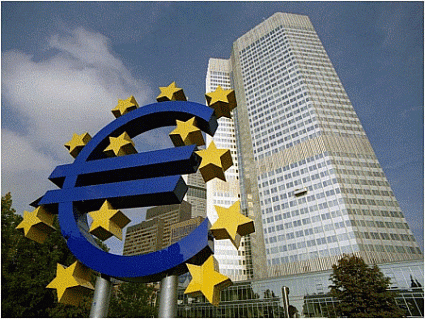 European Union finance ministers cleared the way for Portugal to receive 78 billion euros ($110.8 billion) in aid, making it the third euro-area country to fall back on official loans.
The EU’s two bailout funds, the European Financial Stability Facility and European Financial Stabilization Mechanism, will each provide one-third of the assistance, while the International Monetary Fund will contribute the rest, the EU said in a statement after a unanimous vote in Brussels today.
Finance ministers called Portugal’s planned budget cuts “ambitious but credible,” according to the statement. The aid program will run for three years.
Portugal follows Greece and Ireland in requesting a bailout from the EU and International Monetary Fund. Politicians are struggling to convince investors that 256 billion euros in aid to the three countries will be enough to stamp out Europe’s debt crisis and prevent the euro region’s first restructuring.
Portuguese Finance Minister Fernando Teixeira dos Santos said before the meeting he was confident of approval because “all the issues that we had to clarify were clarified.” German Finance Minister Wolfgang Schaeuble had also been upbeat about Portugal’s aid request.
The meeting was clouded by the May 14 arrest of IMF Managing Director Dominique Strauss-Kahn on Read more…
Signals Spain may seek bailout spelling disaster for eurozone
Violent protests against austerity cuts have broken out in Spain, as the country struggles to deal with record-high unemployment signaling that Madrid could possibly be next in line for an EU bailout.
Across the border, Portugal’s crumbling economy is desperate for a €78 billion rescue package. Read more…
IMF Says Europe’s Debt Woes Could Spread
 The International Monetary Fund is warning that the governmental debt problems in Greece, Ireland and Portugal could spread to other European countries that employ the euro currency and also to the emerging economies in eastern Europe.
In its semi-annual report on the European economy, the IMF said Thursday that officials so far have been able to contain the continent’s debt contagion to the three countries on Europe’s geographic periphery. But the Washington-based financing agency said there “remains a tangible downside risk” of debt problems spreading. It said European nations will have to make “unrelenting” efforts to contain their financial problems.
The IMF said weak banking systems remain a threat to the financial health of the 17 nations where the euro is the common currency. It said the reduction in the number of banks in Europe is proceeding too slowly and that greater financial integration on the continent is needed.
Greece and Ireland reluctantly accepted bailouts from the IMF and their European neighbors last year and now Portugal is Read more…
Greece ‘runs out of tear gas’ during violent protests
Greece has issued an international appeal for more tear gas after supplies ran low because police fired so much of it during a week of violent protests across the country.

Officers released 4,600 capsules of tear gas during confrontations in Athens and nearly a dozen other cities since riots erupted over the fatal shooting of a 15-year-old schoolboy by a policeman last Saturday.
The greek government is urgently seeking fresh supplies of tear gas from Israel and Germany, the police said.
Yesterday, a report disputed claims by lawyers for the policeman accused of killing Alexandros Grigoropoulos that the bullet hit the boy after ricocheting.
The Kathimerini newspaper said that the results of forensic tests on the bullet indicated that it had been fired directly at the teenager.
Athens Bar Association condemned the policeman’s lawyer, Alexis Kougias, for “desecrating the dead” by claiming that the Read more…
Timeline: Greece’s debt crisis
 Here is a timeline of economic events in Greece since 2010:
Jan 2010 – Greece unveils stability program on Jan 14, saying it will aim to cut its budget gap to 2.8 percent of GDP in 2012 from 12.7 percent in 2009.
Feb – Greece must refinance 54 billion euros ($66.6 billion) of debt, with a crunch in Q2 as more than 20 billion euros becomes due and market yields for Greek debt soar.
March 5 – Package of public sector pay cuts and tax increases is passed to save an extra 4.8 billion euros. VAT to rise 2 percentage points to 21 percent; state-funded pensions frozen in 2010.
April 11 — Euro zone finance ministers approve 30 billion euros ($40.67 billion) emergency aid mechanism for Greece.
April 15 – Greek parliament passes law that seeks to tackle tax evasion and shift tax burden to higher earners.
April 22 – Eurostat says Greece’s 2009 budget deficit is 13.6 percent of GDP, not 12.7 percent as reported earlier.
April 23 – Prime Minister George Papandreou asks for activation of an EU/IMF aid package. Read more…
Why Is the U.S. Bankrolling IMF’s Bailouts in Europe?
humanevents
 The World Bank and International Monetary Fund held their spring meeting April 14 to 18 in Washington, D.C. Both financial titans were created after World War II to foster economic cooperation and development around the globe. With 16.2% of the International Monetary Fund (IMF) shares, the United States is the largest shareholder among the 187 nations who belong to the fund—even though its managing director has always been a European.
Remote to most Americans, the IMF has been in the headlines recently because of its role as one of the financial rescuers of three European nations whose economies collapsed last year. Under Managing Director Dominique Strauss-Kahn (the former French finance minister, who is considered the leading Socialist candidate for president of France in 2012), the IMF has joined with the European Union to sculpt bailout packages for Greece, Ireland, and Portugal. Coupled with loans from the EU, the price tags on the bailout packages come to $157 billion for Greece, $122 billion for Ireland, and most recently, $116 billion for Portugal.
Obviously, these are quite substantial packages for the three economically devastated countries. They will become very relevant to U.S. taxpayers when they realize that, because we are the largest single contributor to the organization, and with Spain and Italy now Read more…
Silver soars to 31-year high
 Gold rose over 1 per cent to a near-record and silver surged Thursday as dollar weakness, inflation worries and a European debt crisis powered bullion to its biggest one-day gain in about seven weeks.
Silver futures soared to their highest since 1980, rising more than 4 per cent for their biggest one-day gain since November, as strong investment and speculative buying sent the gold/silver ratio to a low.
Gold received a boost from inflation worries triggered by a crude oil rally and data showing rising U.S. core producer prices in March, and as higher-than-expected jobless claims knocked the dollar.
“The combination of higher oil prices, weaker dollar and the resurrection of discussions of Greek sovereign risk problems has galvanized the gold market. It’s particularly impressive because we ran into selling above the market yesterday,” said James Steel, chief commodity analyst at HSBC.
Spot gold rose 1.4 per cent to $1,474.30 an ounce by 4:02 p.m. ET, within striking distance of its record $1,476.21 set on Monday. U.S. gold futures for June delivery settled up $16.80 at $1,472.40 an ounce.
Investors grew jittery on talk of debt restructuring by Greece, the first euro zone member to receive a bailout a year ago in the crisis Read more…
Deep earthquake east of Crete in Greece
ATHENS (Reuters) – A deep 5.9 magnitude earthquake struck in the sea 76 miles east-northeast of Iraklio, a town on the Greek island of Crete, on Friday, the U.S. Geological Survey said.
The earthquake, at 48 miles deep, was not felt in Athens but was felt in Cairo.
“We have no reports of damage or injuries so far,” said a police officer in Iraklio.


![[Most Recent Quotes from www.kitco.com]](https://i0.wp.com/www.kitconet.com/charts/metals/gold/t24_au_en_usoz_2.gif)
![[Most Recent Quotes from www.kitco.com]](https://i0.wp.com/www.kitconet.com/charts/metals/silver/t24_ag_en_usoz_2.gif)

 crisisboom
 CRISISBOOM
You must be logged in to post a comment.