Archive

Posts Tagged ‘Internet’

NSA Whistleblowers: NSA Collects ‘Word for Word’ Every Domestic Communication

August 3, 2013 2 comments

washingtonsblog.com

Anyone Who Says the Government Only Spies On Metadata Is Sadly Mistaken

PBS interviewed NSA whistleblowers William Binney and Russell Tice this week.

Binney is the NSA’s former director of global digital data, and a 32-year NSA veteran widely regarded as a “legend” within the agency.  Tice helped the NSA spy with satellites.

Binney and Tice confirmed that the NSA is recording every word of every phone call made within the United States:

[PBS INTERVIEWER] JUDY WOODRUFF:   Both Binney and Tice suspect that today, the NSA is doing more than just collecting metadata on calls made in the U.S. They both point to this CNN interview by former FBI counterterrorism agent Tim Clemente days after the Boston Marathon bombing. Clemente was asked if the government had a way to get the Read more…

XKeyscore: The NSA program that collects ‘nearly everything’ that you do on the internet

August 2, 2013 1 comment

extremetech.com

Where is NSA's XKeyscore located?If you were shocked by the NSA’s Prism program, hold onto your hat: The NSA also operates another system, called XKeyscore, which gives the US intelligence community (and probably most of the US’s Western allies) full access to your email, IMs, browsing history, and social media activity. To view almost everything that you do online, an NSA analyst simply has to enter your email or IP address into XKeyscore. No formal authorization or warrant is required; the analyst just has to type in a “justification” and press Enter. To provide such functionality, the NSA collects, in its own words, “nearly everything a typical user does on the internet.” Perhaps most importantly, though, it appears that HTTPS and SSL might not protect your communications from Read more…
How secretly developed software became capable of tracking people’s movements online

February 12, 2013 Comments off

The U.S. government can track where you are, who you’re with, what you look like, and where you’ll likely be next thanks to a tool created by defense contractor Raytheon.

The tool, called Riot, or rapid information overlay technology, looks at your Twitter, Facebook, Gowalla, and Foursquare to determine Read more…

Is Privacy Dead? 4 Government and Private Entities Conspiring to Track Everything You Do Online and Off

September 12, 2012 Comments off

alternet.org

Americans’ personal privacy is being crushed by the rise of a four-headed corporate-state surveillance system.  The four “heads” are: federal government agencies; state and local law enforcement entities; telecoms, web sites & Internet “apps” companies; and private data aggregators (sometimes referred to as commercial data warehouses).

Conventional analysis treats these four domains of data gathering as separate and distinct; government agencies focus on security issues and corporate entities are concerned with commerce. Some overlap can be expected as, for example, in case of a terrorist attack or an online banking fraud.  In both cases, an actual crime occurred.

But what happens when the boundary separating or restricting corporate-state collaboration, e.g., an exceptional crime-fighting incident, erodes and becomes the taken-for-granted operating environment, the new normal?  Perhaps most troubling, what happens when the traditional safeguards offered by “watchdog” courts or regulatory organizations no longer seem to matter?  What does it say that the entities designed to Read more…

Minority Report: Fiction Has Become Reality

September 5, 2012 Comments off

canadafreepress

“The Internet is watching us now. If they want to. They can see what sites you visit. In the future, television will be watching us, and customizing itself to what it knows about us. The thrilling thing is, that will make us feel we’re part of the medium. The scary thing is, we’ll lose our right to privacy. An ad will appear in the air around us, talking directly to us.”—Steven Spielberg

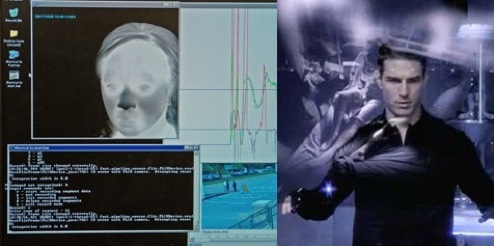
It was a mere ten years ago that Steven Spielberg’s action film Minority Report, based on a short story by Philip K. Dick, offered movie audiences a special effect-laden techno-vision of a futuristic world in which the government is all-seeing, all-knowing and all-powerful. And if you dare to step out of line, dark-clad police SWAT teams will bring you under control.

The year is 2054. The place is Washington, DC. Working in a city in which there has been no murder committed in six years—due in large part to his efforts combining widespread surveillance with behavior prediction technologies—John Anderton (played by Tom Cruise), Chief of the Department of Pre-Crime in Washington, DC, uses precognitive technology to capture would-be criminals before they can do any damage—that is, to prevent crimes before they happen. Unfortunately for Anderton, the technology, which proves to be fallible, identifies him as the next would-be criminal, and he flees. In the ensuing chase, Anderton finds himself not only attempting to prove his innocence but forced to take drastic measures in order to avoid capture in a surveillance state that uses biometric data and sophisticated computer networks to track its citizens.

Seemingly taking its cue from science fiction, technology has moved so Read more…

Cispa approved by House but critics urge Senate to block ‘horrible’ bill

April 27, 2012 Comments off

guardian

cispa wikipedia

Cispa has undergone several amendments, but Michelle Richardson of the ACLU said: ‘Cispa goes too far for little reason’. Photograph: Rex Features

Free speech advocates are calling for the Senate to block controversial cybersecurity legislation they claim will give the US authorities unprecedented access to online communications.

The House of Representatives on Thursday ignored the threat of a White House veto to pass the Cyber Intelligence Sharing and Protection Act (Cispa). The bill aims to make it easier for companies to share information collected on the internet with the federal government in order to help prevent electronic attacks from cybercriminals, foreign governments and terrorists.

Sponsors of the bill have made several amendments to Cispa in the past week, but critics say the bill still threatens to overrule existing privacy protections for citizens, and hands the National Security Agency too much power to access and use people’s private information.

The Center for Democracy and Technology said it was “disappointed that Cispa passed Read more…

‘Internet Doomsday’: FBI Gives New Deadline to Disinfect Computer of Malicious Malware by July 9 or Else

April 24, 2012 Comments off

theblaze.com

Earlier this year, we reported that any computer infected with a nasty piece of malware could be shunned from using the Internet by the feds. The deadline for that was March 8 but an extension was ordered to provide users with more time to clean up computers. Now, Federal Bureau of Investigation has said all must be virus free by July 9 or be subject to was PC World calls “Internet doomsday.”

The malware is a piece called DNS Changer Trojan that was the work of six men from Estonia who were arrested and charged in 2011. The malware infected more than 4 million computers in 100 countries and is relatively easy to spread, hence why the government is ready to stop those with the virus from accessing the Internet.

(Related: Seven charged for infecting 4 million computers with ‘false advertising’ malware)

Individuals and companies have been working to scrub the malware from their systems but as of March at least one computer in half of all Fortune 500 companies was infected and more than two dozen government agencies had a carrier as well. PC world reports that estimates are more than 350,000 computers are still infected. Read more…

Categories: Computers Tags: , ,

Even worse than SOPA: New CISPA cybersecurity bill will censor the Web

April 4, 2012 1 comment

rt.com

An onrush of condemnation and criticism kept the SOPA and PIPA acts from passing earlier this year, but US lawmakers have already authored another authoritarian bill that could give them free reign to creep the Web in the name of cybersecurity.

As congressmen in Washington consider how to handle the ongoing issue of cyberattacks, some legislators have lent their support to a new act that, if passed, would let the government pry into the personal correspondence of anyone of their choosing.

H.R. 3523, a piece of legislation dubbed the Cyber Intelligence Sharing and Protection Act (or CISPA for short), has been created under the guise of being a necessary implement in Read more…

Exposed… Google Spying On Laptops Using Microphone!

March 23, 2012 Comments off

knowthelies.com

internet-spy

I like to bring in this article a confirmed surveillance attempt by Google of my laptop microphone around April of 2011. Note… Also before I am writing this my laptop was attacked by hackers again. Now I have to restore my laptop again right around when I am suppose to interview Dr. Michael Coffman via Webcam and Microphone. ~ Brian D Hill

It was even admitted on The Register in Sep 2006 that Google was developing eavesdropping software, that uses Audio ‘fingerprint’ for content-relevant ads, and that as I quote from their news website “to use the existing PC microphone to listen to whatever is heard in the background, be it music, your phone going off or the TV turned down.

The PC then identifies it, using fingerprinting, and then shows you relevant content, whether that’s adverts or Read more…

Internet providers to start policing the web July 12

March 16, 2012 Comments off

rt.com

AFP Photo / Samantha Sin

AFP Photo / Samantha Sin

Some of the biggest Internet service providers in America plan to adopt policies that will punish customers for copyright infringement, and one of the top trade groups in the music biz announced this week that it could begin as soon as this summer.

The chief executive officer of the Recording Industry Association of America told an audience of publishers on Wednesday that a plan carved out last year to help thwart piracy is expected to prevail and be put in place by this summer. RIAA CEO Cary Sherman was one of the guest speakers among a New York panel this week and he confirmed that, at this rate, some of the most powerful Internet providers in America should have their new policies on the books by July 12, 2012.

Last year, Time Warner, Verizon, AT&T, Comcast, Cablevision Systems and other Internet service providers proposed best practice recommendations that they suggested would

Read more…