Archive
India Worried About Pakistani Nuke Arsenal Defenses
 India’s defense chief on Wednesday voiced worries about the defenses of nuclear weapons in rival Pakistan following a militant siege this week of a naval base in Karachi, Reuters reported (see GSN, May 24).
“Naturally it is a concern not only for us but for everybody,” Defense Minister A.K. Antony said on the question of whether the assault by a minimum of six Pakistani Taliban fighters on the Mehran Naval Station had raised doubts about the security of the Pakistani nuclear arsenal, the Press Trust of India reported.
“Our services are taking all precautions and are ready round-the-clock. But at the same time we don’t want to overreact,” Antony said.
Though estimates vary, recent analyses indicate Islamabad could hold more than 110 nuclear weapons. The country’s is viewed as having the world’s fastest growing nuclear arsenal.
Some defense authorities have said the Sunday siege could have involved insiders at the base, renewing worries about Pakistani military personnel who might have extremist affinities (see GSN, Jan. 11; Reuters, May 25).
Separately, not long before he became Pakistan’s president, Asif Ali Zardari in 2008 told U.S. envoys he supported providing U.N. investigators access to nuclear scientist and proliferator Abdul Qadeer Khan, Asian News International reported on Wednesday (see GSN, May 25).
The United States has long pressed for access to Khan, Pakistan’s former top nuclear weapons scientist who in 2004 confessed to exporting nuclear technology and information to Iran, Libya and Read more…
Iran’s largest lake turning to salt

OROUMIEH LAKE, Iran – From a hillside, Kamal Saadat looked forlornly at hundreds of potential customers, knowing he could not take them for trips in his boat to enjoy a spring weekend on picturesque Oroumieh Lake, the third largest saltwater lake on earth.
“Look, the boat is stuck… It cannot move anymore,” said Saadat, gesturing to where it lay encased by solidifying salt and lamenting that he could not understand why the lake was fading away.
The long popular lake, home to migrating flamingos, pelicans and gulls, has shrunken by 60 percent and could disappear entirely in just a few years, experts say — drained by drought, misguided Read more…
Iran to Display New Ballistic Missiles
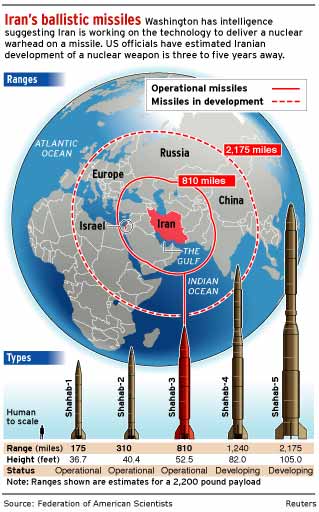 Iran plans next Tuesday to show off a new set of ballistic missiles built recently within its borders, the country’s Fars News Agency reported (see GSN, March 1).
Military equipment “including some vessels, ballistic missiles and new ammunitions will come into use on the occasion of Khorramshahr Liberation Anniversary,” Iranian Defense Minister Ahmad Vahidi said on Wednesday, referring to Iran’s 1982 victory against Iraq in a southern coastal city.
The nation’s military would soon formally receive the new missiles, Vahidi said.
Iran’s missile manufacturing systems have advanced significantly over the past 10 years, according to the media report. The Middle Eastern nation tested an antiship ballistic missile in February (see GSN, Feb. 10).
Iran’s Revolutionary Guard last October received the third variant of the Fateh 110 ballistic missile, and another version of the weapon was due for testing soon, Fars reported. The Fateh 110 is a short-range, solid-fuel weapon suited for firing from a mobile launcher. The missile has sophisticated command and guidance mechanisms, the news report said (see GSN, Sept. 22, 2010; Fars News Agency, May 18).
Iran’s Shahab 3 ballistic missile is the greatest source of worry for Western countries, Deutsche Presse-Agentur reported. The weapon has a 1,240-mile range and could strike any point in Israel (Deutsche Presse-Agentur/Monsters and Critics, May 18).
Iran Moving Ahead on Venezuelan Missile Bases that Bring Miami Well Within Range
unsettling similarities to 1962 Cuba…
except this time facing advanced air defenses

Iran, North Korea Partnering on Ballistic Missiles, U.N. Says

(May. 16) - An Iranian Shahab 3 ballistic missile lifts off in a 2009 test. The Shahab 3's warhead appears comparable in design to a North Korean warhead unveiled last year, according to a U.N. report that says the countries seem to have exchanged ballistic missile technology (Shaiegan/Getty Images). Iran and North Korea seem to routinely be swapping ballistic missile equipment in breach of U.N. Security Council directives, a classified expert report to the international body stated on Friday (see GSN, Dec. 1, 2010).
Illegal trades of missile technology had “transshipment through a neighboring third country,” the report states. Multiple envoys told Reuters the nation in question is China.
The report by the Panel of Experts assigned to oversee adherence to U.N. sanctions levied against North Korea was sent to the Security Council on Friday and viewed by Reuters on Saturday.
The document is expected to increase apprehension over Pyongyang’s collaboration with Tehran and to bolster worries about Beijing’s willingness to implement sanctions targeting North Korea and Iran’s nuclear activities, diplomats said.
The Security Council sanctions forbid commerce in atomic and missile systems with the North.
“Prohibited ballistic missile-related items are suspected to have been transferred between the Democratic People’s Republic of Korea and the Islamic Republic of Iran on regular scheduled flights of Air Koryo and Iran Air,” the experts stated.
“For the shipment of cargo, like arms and related materiel, whose illicit nature would become apparent on any cursory physical inspection, (North) Korea seems to prefer chartered cargo flights,” the document says.
Chartered cargo flights typically travel “from or to air cargo hubs which lack the kind of monitoring and security to which passenger terminals and flights are now subject,” according to the report.
A number of envoys to the Security Council said Beijing was not pleased with Read more…
Egypt and Israel Headed for Crisis
 Israeli officials have expressed alarm at a succession of moves by the interim Egyptian government that they fear signal an impending crisis in relations with Cairo.
The widening rift was underscored yesterday when leaders of the rival Palestinian factions Hamas and Fatah signed a reconciliation pact in the Egyptian capital. Egypt’s secret role in brokering the agreement last week caught both Israel and the United States by surprise.
The Israeli prime minister, Benjamin Netanyahu, called the deal “a tremendous blow to peace and a great victory for terrorism”.
Several other developments have added to Israeli concerns about its relations with Egypt, including signs that Cairo hopes to renew ties with Iran and renegotiate a long-standing contract to supply Israel with natural gas.
More worrying still to Israeli officials are reported plans by Egyptian authorities to open the Rafah crossing into Gaza, closed for the Read more…
Global Press Freedom at Lowest Level in More Than Decade

Photo: Reuters
Journalists and activists participate in a rally calling for press freedom in central Ankara, Turkey, March 19, 2011 (file photo)
Freedom House, a U.S.-based group that monitors human rights around the world says the number of people with access to free and independent media has declined to its lowest level in more than a decade. In its newly released annual survey, the group says several key countries saw significant declines last year and that only one-in-six people live in countries with a press designated as free.
In this year’s annual index of global media freedom of 196 countries and territories, Freedom House says it rated 68 as “free” and the remaining two thirds as “partly free” or “not free.”
Freedom House Senior Editor Karin Karlekar says this is roughly an even breakdown, but a closer look reveals a different picture. “If you look at the population statistics, they are much bleaker, only Read more…
U.S. Worried by Potential Chinese CW Tech Sales to Iran

A leaked diplomatic cable indicates that the U.S. State Department believed in 2009 that a Chinese firm was providing Iran with equipment that could be used in producing chemical weapons agents, Haaretz reported on Thursday (see GSN, Feb. 3).
“We have new information indicating that Zibo Chemet transferred technology for the production of glass-lined reactor equipment to Iranian customers, significantly enhancing Iran’s ability to produce indigenously chemical equipment suitable for a chemical warfare program,” Secretary of State Hillary Clinton stated in a message to the U.S. Embassy in Beijing.
The Obama administration’s top diplomat requested that the embassy inform the Chinese government of the situation and press Beijing to put an end to the exports, according to the July 24, 2009, dispatch obtained by the transparency group WikiLeaks.
Zibo Chemet is suspected of providing sensitive technology to Iran, North Korea and Syria, and was sanctioned by Washington in 2007, according to the cable. Beijing subsequently took unspecified “limited punitive action” against the firm, it states.
Nonetheless, Zibo Chemet “recently transferred Australia Group-controlled technology to manufacture glass-lined chemical reactor vessels to the Iranian entity Shimi Azarjaam. This glass-lining plant is located in Shokoohieh Industrial Park, Qum,” Clinton stated.
Such reactor vessels are produced to withstand chemicals they hold, which can include precursors for nerve agents, according to Haaretz.
China is not a member of the Australia Group, a multinational organization that seeks to prevent exports of materials intended for use in biological or chemical weapons programs.
The United States and other nations have accused Tehran of developing chemical-warfare capabilities. Iran, whose troops and citizens were subjected to chemical weapons attacks during the nation’s 1980s war with Iraq, denies operating such a program (Yossi Melman, Haaretz, April 21).
Disease hits wheat crops in Africa, Mideast
 PARIS — Aggressive new strains of wheat rust disease have decimated up to 40 percent of harvests in some regions of north Africa, the Middle East, Central Asia and the Caucasus, researchers said Wednesday.
The countries most affected are Syria and Uzbekistan, with Egypt, Yemen, Turkey, Iran, Morocco, Ethiopia and Kenya also hit hard, they reported at a scientific conference in Aleppo, Syria.
“These epidemics increase the price of food and pose a real threat to rural livelihoods and regional food security,” Mahmoud Solh, director general of the International Center for Agricultural Research in the Dry Areas (ICARDA), said in a statement.
In some nations hit by the blight, wheat accounts for 50 percent of calorie intake, and 20 percent of protein nutrition.
“Wheat is the cornerstone for food security in many of these countries,” said Hans Braun, director of the International Maize and Wheat Improvement Center (CIMMYT), near Mexico City, singling out Syria.
“Looking at the political and social situation, what they don’t need is a food crisis,” he told AFP by phone.
Wheat rust is a fungal disease that attacks the stems, grains and especially the Read more…
China-Russia relations and the United States: At a turning point?
 By Dr. Richard Weitz
Since the end of the Cold War, the improved political and economic relationship between Beijing and Moscow has affected a range of international security issues. China and Russia have expanded their bilateral economic and security cooperation. In addition, they have pursued distinct, yet parallel, policies regarding many global and regional issues.
Yet, Chinese and Russian approaches to a range of significant subjects are still largely uncoordinated and at times in conflict. Economic exchanges between China and Russia remain minimal compared to those found between most friendly countries, let alone allies.
Although stronger Chinese-Russian ties could present greater challenges to other countries (e.g., the establishment of a Moscow-Beijing condominium over Central Asia), several factors make it unlikely that the two countries will form such a bloc.
The relationship between the Chinese and Russian governments is perhaps the best it has ever been. The leaders of both countries engage in numerous high-level exchanges, make many mutually supportive statements, and manifest other displays of Russian-Chinese cooperation in what both governments refer to as their developing strategic partnership.
The current benign situation is due less to common values and shared interests than to the fact that Chinese and Russian security concerns are Read more…


![[Most Recent Quotes from www.kitco.com]](https://i0.wp.com/www.kitconet.com/charts/metals/gold/t24_au_en_usoz_2.gif)
![[Most Recent Quotes from www.kitco.com]](https://i0.wp.com/www.kitconet.com/charts/metals/silver/t24_ag_en_usoz_2.gif)

 crisisboom
 CRISISBOOM
You must be logged in to post a comment.