Archive
The Power of the Supermoon?
As I have mentioned here, on ABCnews.com (see the story by clicking here) and to people I had talked with about the supermoon, I was neutral, not a believer or non-believer in the power of the supermoon. Notice I say Read more…
E. Asia, S. America under tsunami warning after Japan quake
03/11/2011 10:45
Biggest earthquake to hit Japan in 140 years triggers 10-meter tsunami, kills at least 6 people; 4 million homes without power; hotel collapses in city of Sendai, people feared buried in rubble; UN rescue teams on standby.
SINGAPORE – A tsunami warning has been issued for areas across East Asia and the western coast of South America following a huge earthquake that hit Japan on Friday, the Pacific Tsunami Warning Center said.
Among the countries for which a tsunami warning is in effect are: Read more…
Avian influenza continues to spread across Asian countries
 Across Japan a total of 22 cases of avian flu have been reported as the infection continues to spread. On Sunday, 33,000 more chickens were culled in the Miyazaki Prefecture, bringing the total chickens culled to around 990,000 birds since the first infection was reported on Jan 22, 2011.
In India, further cases have been confirmed on a Tripura farm where the culling process has started to take place. This is the second time bird flu has been detected in the state following an outbreak in February this year. Health and veterinary workers had then culled more than 4,000 chickens.
South Korea has also had 12,400 birds test positive for avian flu last week, marking the 49th outbreak since December 29. The latest outbreak is a poultry farm in Cheonan, 92 km south of Seoul, the National Veterinary Research and Quarantine Service (NVRQS) said. All ducks on the farm will be culled with quarantine authorities asking nearby farms to be vigilant and protect their birds.
This is the second case of the highly pathogenic avian influenza reported in the country this month although the number of AI cases has started to fall off in recent weeks. The government has culled more than 6.04 million birds in six provinces across the country.
People Of Earth: Prepare For Economic Disaster
 It is not just the United States that is headed for an economic collapse. The truth is that the entire world is heading for a massive economic meltdown and the people of earth need to be warned about the coming economic disaster that is going to sweep the globe. The current world financial system is based on debt, and there are alarming signs that the gigantic global debt bubble is getting ready to burst. In addition, global prices for the key resources that the major economies of the planet depend on are rising very rapidly. Despite all of our advanced technology, the truth is that human civilization simply cannot function without oil and food. But now the price of oil and the price of food are both increasing dramatically. So how is the current global economy supposed to keep functioning properly if it soon costs much more to ship products between continents? How are the billions of people that are just barely surviving today supposed to feed themselves if the price of food goes up another 30 or 40 percent? For decades, most of the major economies around the globe have been able to Read more…
Quake Shakes Northeast Japan

A hefty earthquake jolted northeastern Japan shortly before noon on Wednesday, providing an unwelcome reminder of just how prone to seismic activity the country is 2 weeks after the Christchurch disaster.
While the 7.2 magnitude quake was centered 160 kilometers off the coast and was about 14 kilometers underwater, according to the U.S. Geological Survey, it was felt all the way down to central Tokyo’s Otemachi business district – 416 kilometers to the south.
Though there weren’t immediate reports of damage, the Japan Meteorological Agency immediately issued a tsunami alert for parts of the northeastern coast of Japan, predicting modest waves of up to 50 centimeters.
Who has the fastest warplane? Russia tests another supersonic T-50 fighter.
Russia today tested a second prototype of its Sukhoi T-50 fighter, a fifth-generation warplane that is said to be comparable to the US F-22Raptor.

Russian Prime Minister Vladimir Putin walks after inspecting a new Russian fighter jet after its test flight in Zhukovksy, outside Moscow, June 17, 2010. The new jet, Sukhoi T-50 fighter, is Russia’s response to the US F-22 Raptor.
Russia successfully tested a second prototype of its revolutionary new “fifth-generation” fighter plane Thursday, a futuristic, ultrafast, and stealthy warbird that may be in the possession of the Russian Air Force by 2013.
If Russian claims about the Sukhoi T-50 multirole fighter are true, then Read more…
China Takes Giant Step Towards Making the Yuan the World’s Reserve Currency
 For years, I’ve been writing about the long-term decline of the Dollar, and the rise of the Chinese Yuan … and it’s potential to become the world’s next reserve currency.
As I pointed out in 2007, many countries have started moving out of the Dollar as the basis for international trade settlements, including:
-
Venezuela and 12 other Latin American countries as well as Cuba
-
Many other countries
In 2008, I wrote: Read more…
IMF says weaker dollar would help global growth

AFP – The International Monetary Fund called for a weaker dollar to help the United States reduce its deficits with the rest of the world and rebalance the global economy, in a report released Wednesday.
In the report prepared for a Group of 20 finance chiefs meeting last week, the IMF said that its calculations showed the dollar remains “on the strong side” of medium-term fundamentals, while the euro and the Japanese yen were “broadly in line” and several Asian currencies, including China, were undervalued.
To address global imbalances, the G20 should allow the dollar to Read more…
Zardari to seek nuclear technology cooperation with Japan

TOKYO: President Asif Ali Zardari said Monday that since Japan was negotiating a deal with India to cooperate on peaceful uses of nuclear energy, the similar cooperation should be extended to his country.
“If Japan is willing to cooperate with India in nuclear technology and (is) giving nuclear technology for peaceful purposes, I do not see any reason why we should not deserve the same,” Zardari said in an interview with the Japanese media in Islamabad ahead of his departure for a three-day visit to Japan, published in leading Read more…
The Fed is Wrong About Commodity Prices
Author: David Weinstein
I imagine he has to say it, but Bernanke is wrong when he says US monetary policy has nothing to do with international commodity prices. At the height of the Egyptian crisis, which was partly driven by rising food prices, Bernanke couldn’t say, “Oh yea, US policy economic policy is part of the problem in Egypt.” This attitude, however, is both prevalent and respected, and it’s largely wrong.
First of all, commodities as a group are not commoditized – they are not all the same. For instance, the amount of gold in the world is largely fixed relative to annual gold production. Along with its historical position as a store a value, Gold’s consistent volume about ground is a primary reason for its currency-like quality; i.e. almost entirely driven by overall liquidity. Corn production, on the other hand can vary greatly from year to year given the amount of land devoted to it and the weather. Oil is somewhere in the middle because production can vary, but the worlds known reserves are relatively fixed. The resulting differences in price volatility have been studied ad nauseam and are most simply articulated by the so-called ‘cob-web model’ (see chart below).
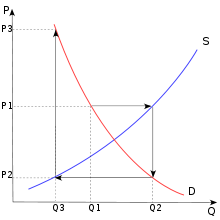
Very simply put: Read more…


![[Most Recent Quotes from www.kitco.com]](https://i0.wp.com/www.kitconet.com/charts/metals/gold/t24_au_en_usoz_2.gif)
![[Most Recent Quotes from www.kitco.com]](https://i0.wp.com/www.kitconet.com/charts/metals/silver/t24_ag_en_usoz_2.gif)

 crisisboom
 CRISISBOOM
You must be logged in to post a comment.