Archive
The Federal Reserve Must Implement QE3
 Gold prices surged today to a new all time high of $1,463.70 per ounce, while silver prices soared to a new 31-year high of $39.785 per ounce. Silver is now up 129% since NIA declared silver the best investment for the next decade on December 11th, 2009, at $17.40 per ounce. The gold/silver ratio is now down to 37, compared to a gold/silver ratio of 66 when NIA declared silver the best investment for the next decade. This means that not only is silver up 129% in terms of dollars since December 11th, 2009, but silver has also increased in purchasing power by 1.78X in terms of gold.
Gold is the world’s most stable asset and the best gauge of inflation. This brand new breakout in the price of gold leads us to believe that the Federal Reserve is getting ready to unleash QE3 at the end of June. The Fed will surely not call it QE3, but NIA can pretty much guarantee that the Fed will continue on with their purchases of U.S. treasuries. If the Fed pauses after QE2, it will mean that treasury bond yields will need to surge to a level where they attract enough private sector and foreign central bank Read more…
Confidential U.S. document reveals “new threats” at Fukushima: Risk of explosions inside containment structures… “Likely no water” in No. 1 reactor core — “Could persist indefinitely”
U.S. Sees Array of New Threats at Japan’s Nuclear Plant, New York Times by James Glanz and William J. Broad, April 5, 2011:
[Emphasis Added]
United States government engineers sent to help with the crisis in Japan are warning that the troubled nuclear plant there is facing a wide array of fresh threats that could persist indefinitely, and that in some cases are expected to increase as a result of the very measures being taken to keep the plant stable, according to a confidential assessment [dated March 26] prepared by the Nuclear Regulatory Commission. …
The Times’ article spotlighted several items of extreme importance:
- “Semimolten” fuel rods and salt are “impeding the flow of fresh water meant to cool the nuclear cores” in ALL THREE REACTORS
- The water flow in reactor No. 1 “is severely restricted and likely blocked“
- Similar problems exist in No. 2 and No. 3, although the blockage is probably less severe
- “There is likely no water level” inside the core of reactor No. 1
- There is a possibility of “explosions inside the containment structures”
Read the article here.
Japan stops leaks from nuclear plant
TOKYO (Reuters) – Engineers have stopped highly radioactive water leaking into the sea from a crippled Japanese nuclear power plant, the facility’s operator said on Wednesday, a breakthrough in the battle to contain the worst nuclear crisis since Chernobyl.
However, Tokyo Electric Power (TEPCO) still needs to pump contaminated water into the sea because of a lack of storage space at the facility.
“The leaks were slowed yesterday after we injected a mixture of liquid glass and a hardening agent and it has now stopped,” a TEPCO spokesman told Reuters.
Desperate engineers had been struggling to stop the leaks and had used sawdust, newspapers and concrete as well as liquid glass to try to stem the flow of the highly-contaminated water.
Japan is facing its worst crisis since World War Two after a 9.0 magnitude earthquake and tsunami hit its northeast coast, leaving Read more…
U.S. Will Build Five New Nuclear Reactors by 2020, New Energy Finance Says
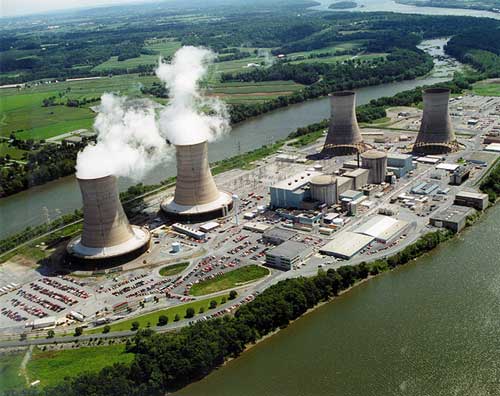 The U.S. will build five new nuclear reactors by 2020 and ignore calls to scale back plans in the wake of Japan’s nuclear accident, said Chris Gadomski, an analyst at Bloomberg New Energy Finance.
“We’ll see a reassessment and reevaluation and then stay the course,” Gadomski said today at a conference in New York today. Plans to build the five reactors are already underway, he said, and “We don’t see that changing.”
No new nuclear plants have been built in the U.S. since the 1979 near-meltdown at Three Mile Island. Interest in atomic energy has gained as a way to curb greenhouse gas emissions that contribute to global warming, and the Obama administration has offered loan guarantees to developers of reactors, which account for a fifth of total U.S. electricity.
“We are looking first and foremost at keeping our current fleet operating safely,” said Andrea Sterdis, senior manager of nuclear expansion at Tennessee Valley Authority, a federal power supplier that operates four reactors in the U.S. South. She spoke at the conference hosted by New Energy Finance.
The biggest threat to new nuclear power plants may be the low cost of natural gas, which can be used to fuel power stations that are quicker and cheaper to build than atomic- fueled facilities, said said Edward Kee, vice president of NERA Economic Consulting.
“Everything in the U.S. is challenged by cheap natural gas,” Kee said at the conference.
Astronomers: Comet Elenin may produce greatest meteor showers in history
 The unusual Comet Elenin is expected to pass within 21 million miles of Earth on October 16, 2011 and speeding by at more than 85,000 mph—so fast it could travel from Earth to the Moon in less than five hours.
Discovered by amateur Russian astronomer Leonid Elenin in Lyubertsy, Russia on December 10, 2010—who accessed the International Scientific Optical Network’s robotic observatory near Mayhill, New Mexico—the astronomical community has erupted with the excited possibility the celestial traveller could generate the most spectacular meteor showers ever recorded.
Although the comet’s path is expected to change as it draws closer to the sun, astronomical calculations appear to show Elenin’s perihelion occurring well inside Earth’s orbit by September 5th.
Astronomers believe the comet will be visible with a good pair of field binoculars about the middle of August. After then it should become visible in the Northern hemisphere’s predawn Read more…
1,000 corpses from Japanese quake left uncollected because of fear of radiation
The mother of one of the workers who are battling to stop a meltdown at the Fukushima nuclear plant said today that they all expect to die from radiation sickness ‘within weeks’.
The so-called Fukushima 50 are all repeatedly being exposed to dangerously high radioactive levels as they attempt to restore vital cooling systems following the earthquake and tsunami on March 11.
And speaking tearfully through an interpreter by phone, the mother of a 32-year-old worker told Fox News: ‘My son and his colleagues have discussed it at length and they have committed themselves to die if necessary to save the nation.
 Too dangerous: This aerial photograph of the Fukushima plant shows the damaged reactors three and four at the which will now be entombed in concrete after the battle to contain radiation was lost
‘He told me they have accepted they will all probably die from radiation sickness in the short term or cancer in the long-term.’
‘They have concluded between themselves that it is inevitable some of them may die within weeks or Read more…
IAEA finds high radiation levels outside Japan evacuation zone

Tokyo (CNN) — Radiation levels in a Japanese town outside a government-ordered evacuation zone have exceeded one of the criteria for evacuation, the International Atomic Energy Agency said Wednesday.
The agency said it advised Japan “to carefully assess the situation.”
The elevated levels were found in Iitate, a town of 7,000 residents about 40 kilometers (25 miles) northwest of the earthquake- and tsunami-damaged Fukushima Daiichi nuclear power plant, the agency said. The evacuation zone covers a 20-kilometer (13-mile) radius around the plant.
The agency did not say what levels it found in Iitate, but the environmental group Greenpeace said Sunday it had found radiation levels in the town that were more than 50 times above normal.
Though that is far below the level that would cause radiation sickness, it does pose a risk of cancer to residents in the long term, Greenpeace said.
12 Warning Signs of U.S. Hyperinflation
 One of the most frequently asked questions we receive at the National Inflation Association (NIA) is what warning signs will there be when hyperinflation is imminent. In our opinion, the majority of the warning signs that hyperinflation is imminent are already here today, but most Americans are failing to properly recognize them. NIA believes that there is a serious risk of hyperinflation breaking out as soon as the second half of this calendar year and that hyperinflation is almost guaranteed to occur by the end of this decade.
In our estimation, the most likely time frame for a full-fledged outbreak of hyperinflation is between the years 2013 and 2015. Americans who wait until 2013 to prepare, will most likely see the majority of their purchasing power wiped out. It is essential that all Americans begin preparing for hyperinflation immediately.
Here are NIA’s top 12 warning signs that hyperinflation is about to occur: Read more…
30 Million in Tokyo Told NOT to Drink or Shower in Tap Water (Video)
MELTDOWN: Plutonium Found In Soil At Fukushima As Cover Up Continues
Steve Watson
infowars.com
Japanese news is reporting that most highly radioactive isotope known to man, plutonium, has been discovered in the soil in multiple different locations at the ailing Fukushima Daiichi nuclear power plant. Even so, the Japanese government and the plant operators maintain there is no risk to human health.
Authorities have confirmed that three different kinds of plutonium have been discovered.
From Kyodo news:
Plutonium has been detected in soil at five locations at the crippled Fukushima Daiichi nuclear power plant, Tokyo Electric Power Co. said Monday.
The operator of the nuclear complex said that the plutonium is believed to have been discharged from nuclear fuel at the plant, which was damaged by the devastating March 11 earthquake and tsunami.
While noting that the concentration level does not pose a risk to human health, the utility firm said it will strengthen monitoring on the environment in and around the nuclear plant.
Further details suggest that this information has been known for some time and has been kept Read more…


![[Most Recent Quotes from www.kitco.com]](https://i0.wp.com/www.kitconet.com/charts/metals/gold/t24_au_en_usoz_2.gif)
![[Most Recent Quotes from www.kitco.com]](https://i0.wp.com/www.kitconet.com/charts/metals/silver/t24_ag_en_usoz_2.gif)

 crisisboom
 CRISISBOOM
You must be logged in to post a comment.