Archive
Thousands of protesters demand “A New Morocco”
CASABLANCA, Morocco, Apr. 24, 2011 (Reuters) — Thousands took to the streets of Morocco on Sunday in peaceful demonstrations to demand sweeping reforms and an end to political detention, the third day of mass protests since they began in February.

Desperate to avoid the turmoil that toppled leaders in Tunisia and Egypt, authorities have already announced some changes to placate demands that King Mohammed cede more powers and limit the monarchy’s extensive business influence.
Some 10,000 people joined the protest in Casablanca, the largest city in one of the West’s staunchest Arab allies. Marchers in the capital Rabat also denounced corruption and torture as well as unemployment, very high among youths.
Policing has been low-key for protests by the February 20 Movement, named after the date of its first march, particularly compared to the turmoil elsewhere in North Africa.
“This is more about the young ones than it is about us,” said Redouane Mellouk, who had brought his 8 year-old son Mohamed Amine, carrying a placard demanding “A New Morocco.”
“Our parents could not talk to us about political issues. They were too afraid. This must change,” said Mellouk.
Although levels of popular anger have risen, ratings agencies assess Morocco as the country in the region least likely to become embroiled in the type of unrest that toppled Tunisian and Egyptian regimes and led to the conflict in Libya.
In Rabat, several thousand people marched through poor districts with high levels of unemployment and away from the center, where the previous monthly demonstrations have been held. There was no sign of trouble.
DISAFFECTED YOUTH
A 74 year-old man in Casablanca who gave his name only as Ahmed said Morocco’s youths were right to protest. Read more…
Gas prices surge toward $4, threaten economic recovery
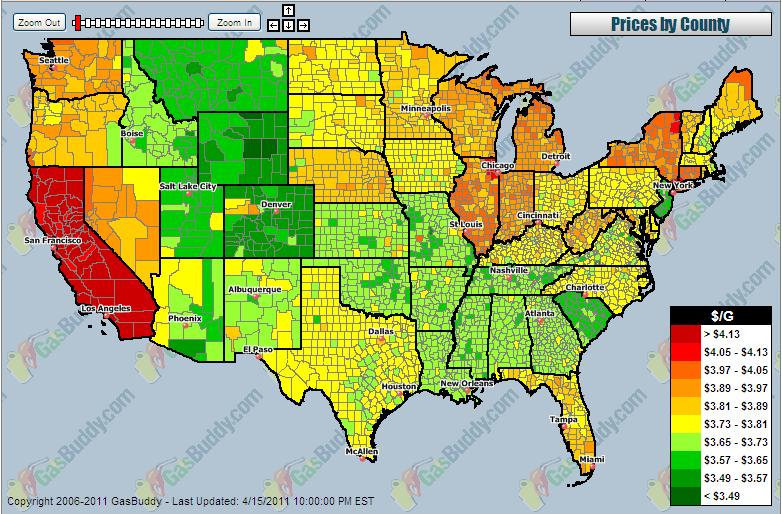
Click Map to enlarge
Gas prices continued to gallop toward $4 a gallon early this week, both in the area and across the state, as prices in Minocqua and Rhinelander hit $3.99 on Tuesday, even as prices for crude oil eased, at least temporarily.
Across the nation, according to GasBuddy.com on Wednesday morning, the national average price for a gallon of regular gasoline stood at $3.79; in Wisconsin, the average was $3.87. Four states, including Illinois, have seen prices already surpass $4.
Crude oil prices moved downward Tuesday from $113 a barrel – the highest price since September 2008 – to $106, a Read more…
China-Russia relations and the United States: At a turning point?
 By Dr. Richard Weitz
Since the end of the Cold War, the improved political and economic relationship between Beijing and Moscow has affected a range of international security issues. China and Russia have expanded their bilateral economic and security cooperation. In addition, they have pursued distinct, yet parallel, policies regarding many global and regional issues.
Yet, Chinese and Russian approaches to a range of significant subjects are still largely uncoordinated and at times in conflict. Economic exchanges between China and Russia remain minimal compared to those found between most friendly countries, let alone allies.
Although stronger Chinese-Russian ties could present greater challenges to other countries (e.g., the establishment of a Moscow-Beijing condominium over Central Asia), several factors make it unlikely that the two countries will form such a bloc.
The relationship between the Chinese and Russian governments is perhaps the best it has ever been. The leaders of both countries engage in numerous high-level exchanges, make many mutually supportive statements, and manifest other displays of Russian-Chinese cooperation in what both governments refer to as their developing strategic partnership.
The current benign situation is due less to common values and shared interests than to the fact that Chinese and Russian security concerns are Read more…
Cost of Libya war for US at $608 million: Pentagon
AFP

WASHINGTON – The cost of the air war in Libya for the US military has reached $608 million, a US defense official said Monday.
The cost estimate covers the period from the start of international air strikes in Libya on March 19 to April 4, the official, who spoke on condition of anonymity, told reporters.
US officials previously had said the operation had cost $550 million through March 28.
The Pentagon has estimated the air campaign will cost the United States about $40 million a month, even after NATO allies took the lead in the UN-mandated operation designed to protect civilians against Moamer Kadhafi’s forces.
For the US Air Force alone, the war costs about $4 million a day, the top civilian in the air force told reporters last week.
But Air Force Secretary Michael Donley said he expected that figure to come down with European allies carrying out bombing raids while US aircraft play a support role.
Look Out Above for Gold and Silver Prices
 By Greg Hunter’s
Gold hit another all-time high yesterday, closing well over $1,450 per ounce. Silver’s closing price of more than $39 per ounce is the highest it has been in 31 years. Why the big jump in gold and silver prices? The answer is pretty scary because there are many reasons precious metals are heading higher. Let’s start with the most obvious —inflation. Kitco.com reported yesterday, “The precious yellow metal got a fresh influx of investment buying based upon heightened inflationary expectations, safe-haven demand and a weakening U.S. dollar index.” (Click here for the complete Kitco.com story.) You can give the same reasons for rising silver prices.
In the case of silver, many experts say it is way undervalued and will outperform gold as Read more…
The Federal Reserve Must Implement QE3
 Gold prices surged today to a new all time high of $1,463.70 per ounce, while silver prices soared to a new 31-year high of $39.785 per ounce. Silver is now up 129% since NIA declared silver the best investment for the next decade on December 11th, 2009, at $17.40 per ounce. The gold/silver ratio is now down to 37, compared to a gold/silver ratio of 66 when NIA declared silver the best investment for the next decade. This means that not only is silver up 129% in terms of dollars since December 11th, 2009, but silver has also increased in purchasing power by 1.78X in terms of gold.
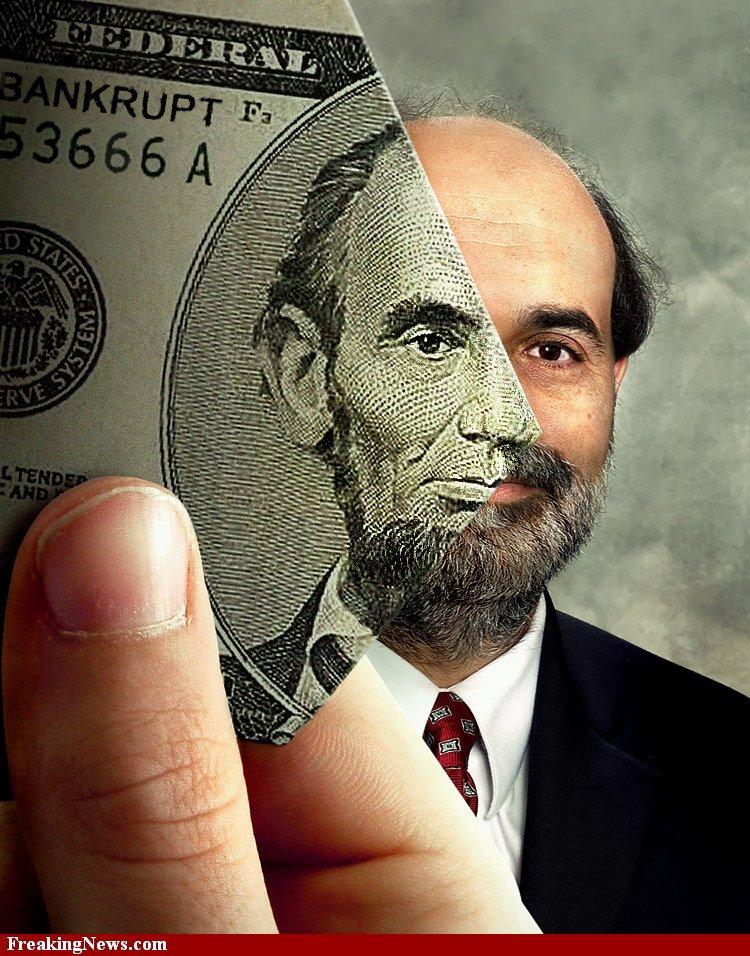
Gold is the world’s most stable asset and the best gauge of inflation. This brand new breakout in the price of gold leads us to believe that the Federal Reserve is getting ready to unleash QE3 at the end of June. The Fed will surely not call it QE3, but NIA can pretty much guarantee that the Fed will continue on with their purchases of U.S. treasuries. If the Fed pauses after QE2, it will mean that treasury bond yields will need to surge to a level where they attract enough private sector and foreign central bank Read more…
The Deadly Effect of Fiat Currency
 Many of the world’s woes can be attributed to our global fiat currency system—price inflation, food shortages, political instability, and speculative booms and busts. But perhaps the most devastating and horrible of the consequences of our fiat currency system is the terrible and unceasing prevalence of war. Today, we wince as we watch the U.S. enter into a third current foreign conflict, under the guise of a multi-national, humanitarian Libyan intervention. Yet, with the amount of excess currency flooding the global economy and the U.S. Federal Reserve’s seemingly limitless willingness to create more, history tells us it is practically inevitable that the result would be more war.
It is no coincidence that, even in ancient societies, the invention of fiat currency—currency Read more…
Libya’s rebels: NATO isn’t doing enough for us
It’s just a matter of time before foreign ground troops arrive…
-

Libyan rebels prepare to tow a vehicle, belonging to pro-Qaddafi forces, that rebels claim were targeted by a NATO strike along the front line near Brega, Libya, on Tuesday, April 5. Libya's rebel forces are looking more effective on the front and even scrapping back some of the territory lost to Muammar Qaddafi's army, but the rag tag fighters are still a long way from being able to march to Tripoli. Altaf Qadri/AP
Libyan rebels retreating from their positions outside the oil town of Brega and facing heavy fighting elsewhere in the country have accused NATO forces of not providing enough air support and failing to protect civilians.
The complaint comes as international players involved in Libya increase their efforts to resolve the situation through diplomatic means. Many rebels say the coalition’s shift to negotiations has led to a decline in NATO’s military campaign, a move that rebels say is costing lives.
Gen. Abdul Fattah Younis, Libya’s rebel commander and Col. Muammar Qaddafi’s former interior minister, said NATO forces were “not doing anything.” He complained that an overly bureaucratic process has created a system that keeps NATO jets from responding to developing situations for hours. He also faulted NATO for limited actions in Misratah, the only large city in western Libya still under the control of antigovernment forces, which he said were at risk for “extermination.”
“If NATO should wait another week, there will be no more Misratah,” said General Younis in an article by BBC. “You will not find anyone.”
Younis’s sentiments run deep amid the rank and file of the Libyan rebels. After suffering their first major territorial loss to government forces in almost a week, many rebels say they felt let down by NATO, reports The Wall Street Journal. Rebels had held Read more…
China Sees New Emerging Markets Bloc Consensus
An upcoming meeting of the leaders of the world’s leading emerging economies should boost consensus and cooperation among them, although members of the group have yet to decide on whether to establish a permanent secretariat, a Chinese diplomat said Saturday.
 The April 14 meeting in the southern Chinese resort of Sanya will include the heads of Brazil, Russia, India, China and — for the first time — South Africa. The five make up the grouping known as the BRIC countries, whose members account for 40 percent of the world’s population and 15 percent of global trade.
Discussions in Sanya will cover trade and finance, as well as major political issues, with areas of agreement to be laid out in a final statement, Assistant Chinese Foreign Minister Wu Hailong told reporters at a briefing.
“We hope through the concerted efforts of all parties that this meeting will be an important Read more…


![[Most Recent Quotes from www.kitco.com]](https://i0.wp.com/www.kitconet.com/charts/metals/gold/t24_au_en_usoz_2.gif)
![[Most Recent Quotes from www.kitco.com]](https://i0.wp.com/www.kitconet.com/charts/metals/silver/t24_ag_en_usoz_2.gif)

 crisisboom
 CRISISBOOM
You must be logged in to post a comment.