Archive
Collision With Huge Asteroid Caused 17 Kilometer Diameter Crater Found in Congo
Scientists have newly confirmed the Luizi impact structure, Democratic Republic of Congo– and provide insights into central uplift formation and post-impact erosion
Ludovic Ferriere of the Austria’s Natural History Museum and colleagues report on the large, ~17-km-diameter Luizi structure, located in the remote and politically tumultuous Democratic Republic of Congo.
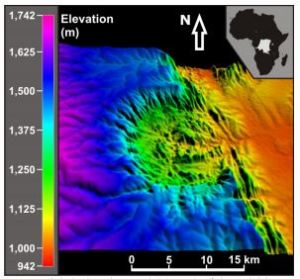 Credit: 42nd Lunar and Planetary Science Conferenc
Giant Meteorite Discovered in China
 |
| A group of researchers led by Baolin Zhang, a meteorite specialist at the Beijing Planetarium, study a giant meteorite that was found in a remote, mountainous region in northwest China. CREDIT: China Central Television |
This story was updated at 5:36 p.m. EDT.
A massive space rock – one that could rank as one of the largest meteorites ever recovered – has been found in a remote and mountainous region in northwest China, according to news reports.
The huge and oddly-shaped rock was found in the Altai mountains in China’s Xinjiang Uygur province, according to Sky and Telescope magazine. Earlier this month, Baolin Zhang, a meteorite specialist at the Beijing Planetarium, led a small team up a 9,500-foot (2,900-meter) summit to investigate reports of the supposed meteorite.
“This is a huge iron meteorite,” Zhang said in footage from China Central Television. “It may be the second largest iron meteorite, which can cause a sensation in China and also attract attention from [the] world’s meteorite fields. It comes from outside solar system and it is of great appreciating value and of more scientific Read more…
New Mineral (Wassonite)Found in Antarctic Meteorite
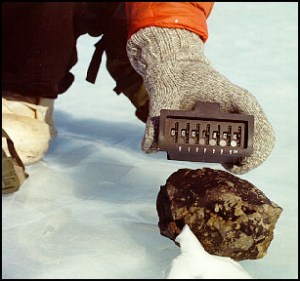 A meteorite discovered in Antarctica in 1969 has just divulged a modern secret: a new mineral, now called Wassonite.
The new mineral found in the 4.5-billion-year-old meteorite was tiny — less than one-hundredth as wide as a human hair. Still, that was enough to excite the researchers who announced the discovery Tuesday (April 5).
“Wassonite is a mineral formed from only two elements, sulfur and titanium, yet it possesses a unique crystal structure that has not been previously observed in nature,” NASA space scientist Keiko Nakamura-Messenger said in a statement.
The mineral’s name, approved by the International Mineralogical Association, honors John T. Wasson, a UCLA professor known for his achievements across a broad swath of meteorite and impact research.
Grains of Wassonite were analyzed from the meteorite that has been officially designated Yamato 691 enstatite chondrite. Chondrites are primitive meteorites that scientists think Read more…
NASA scientist finds evidence of alien life

Aliens exist, and we have proof.
That astonishingly awesome claim comes from Dr. Richard B. Hoover, an astrobiologist at NASA’s Marshall Space Flight Center, who says he has found conclusive evidence of alien life — fossils of bacteria found in an extremely rare class of meteorite called CI1 carbonaceous chondrites. (There are only nine such meteorites on planet Earth.) Hoover’s findings were published late Friday night in the Journal of Cosmology, a peer-reviewed scientific journal.
“I interpret it as indicating that life is more broadly distributed than restricted strictly to the planet earth,” Hoover, who has spent more than 10 years studying meteorites around the world, told FoxNews.com in an interview. “This field of study has just barely been touched — because quite frankly, a great many scientist [sic] would say that this is impossible.”
Hoover discovered the fossils by breaking apart the CI1 meteorite, and analyzing the exposed rock with a Read more…


![[Most Recent Quotes from www.kitco.com]](https://i0.wp.com/www.kitconet.com/charts/metals/gold/t24_au_en_usoz_2.gif)
![[Most Recent Quotes from www.kitco.com]](https://i0.wp.com/www.kitconet.com/charts/metals/silver/t24_ag_en_usoz_2.gif)

 crisisboom
 CRISISBOOM