Archive
Osama bin Laden dead: hi-tech secret may end up in China
There are growing fears that top-secret stealth technology taken from the helicopter that crashed during the raid on the home of Osama bin Laden could be smuggled into China and cause a diplomatic row.

The American troops used thermite grenades to destroy the helicopter’s main body but its rear section was left intact and taken away by the Pakistani military soon after the night raid on Monday. It is feared that if Islamabad refuses a request from Washington for the return of the tail section that the issue could turn into a diplomatic rift Read more…
Pictures of China’s new submarines, tanks, stealth planes and railgun development

Here is a picture that compares the Chinese J20, the US F22 and the Russian T50 stealth fighter planes from the side and from the top

China-Russia relations and the United States: At a turning point?
 By Dr. Richard Weitz
Since the end of the Cold War, the improved political and economic relationship between Beijing and Moscow has affected a range of international security issues. China and Russia have expanded their bilateral economic and security cooperation. In addition, they have pursued distinct, yet parallel, policies regarding many global and regional issues.
Yet, Chinese and Russian approaches to a range of significant subjects are still largely uncoordinated and at times in conflict. Economic exchanges between China and Russia remain minimal compared to those found between most friendly countries, let alone allies.
Although stronger Chinese-Russian ties could present greater challenges to other countries (e.g., the establishment of a Moscow-Beijing condominium over Central Asia), several factors make it unlikely that the two countries will form such a bloc.
The relationship between the Chinese and Russian governments is perhaps the best it has ever been. The leaders of both countries engage in numerous high-level exchanges, make many mutually supportive statements, and manifest other displays of Russian-Chinese cooperation in what both governments refer to as their developing strategic partnership.
The current benign situation is due less to common values and shared interests than to the fact that Chinese and Russian security concerns are Read more…
Cost of Libya war for US at $608 million: Pentagon
AFP

WASHINGTON – The cost of the air war in Libya for the US military has reached $608 million, a US defense official said Monday.
The cost estimate covers the period from the start of international air strikes in Libya on March 19 to April 4, the official, who spoke on condition of anonymity, told reporters.
US officials previously had said the operation had cost $550 million through March 28.
The Pentagon has estimated the air campaign will cost the United States about $40 million a month, even after NATO allies took the lead in the UN-mandated operation designed to protect civilians against Moamer Kadhafi’s forces.
For the US Air Force alone, the war costs about $4 million a day, the top civilian in the air force told reporters last week.
But Air Force Secretary Michael Donley said he expected that figure to come down with European allies carrying out bombing raids while US aircraft play a support role.
U.S. wants to use India in missile shield against Russia, China
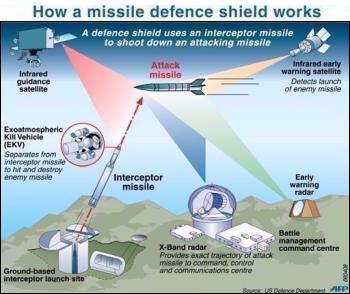 The United States has been trying to rope in India for its plans to build a global missile defence system threatening Russia and China, the Komsomoloskaya Pravda, a popular Russian daily published from Moscow reported on Thursday.
In a story based on the WikiLeaks releases, the report said the U.S. has not only been planning to deploy a missile shield against Russia in Europe, but had also been negotiating with countries along Russia’s borders, such as Japan and India, to jointly build missile defences that would also target Russia.
“The noose [around Russia] is tightening,” the newspaper said. “Thanks to WikiLeaks, it has become known that Washington has been simultaneously conducting talks with countries in other parts of the world for building U.S. missile defences on their territories. Those are different countries, but they form a chain around Russia.”
A 2007 confidential cable from the U.S. embassy in New Delhi carried by the daily refuted media reports that India had abruptly turned its back on a 2005 agreement with the U.S. to cooperate on missile defences. The cable said the Indian media had misinterpreted remarks by External Affairs Minister Pranab Mukherjee after the Russia-India-China trilateral meeting in Harbin, China, on October 24, 2007. Mr. Mukherjee had dismissed as “groundless” the idea that India was going to join a U.S.-led missile defence system.
Misconstrued
“MEA contacts confirm this did not mean India was not interested in continuing to cooperate with the U.S. on missile defence technology and that there has been no change from the current level of bilateral missile defence cooperation,” the U.S. embassy cable said.
The “MEA contacts” explained that Mr. Mukherjee’s comments were “misconstrued” by the Indian press. When Mr. Mukherjee said that “India does not take part in such military arrangements,” the officials said, he had had in mind the U.S. plan to install a missile-detection system in Europe, which his Russian and Chinese counterparts referred to in the same press interaction. Read more…
U.S. military considers mandatory evacuations in Yokosuka, Japan

Washington (CNN) — The U.S. military is considering the mandatory evacuation of thousands of American troops and their families in Japan out of concern over rising radiation levels, a senior defense official tells CNN.
The official, who did not want to be on the record talking about ongoing deliberations, says there are no discussions to evacuate all U.S. troops across the country. The talks have focused exclusively on U.S. troops in Yokosuka, just south of Tokyo, the official said. Yokosuka is home to America’s largest naval base in Japan. The military is monitoring radiation levels on a constant basis.
As of Monday, the U.S. Navy had no more warships Read more…
India watchful of threat from China
 NEW DELHI: “India is conscious and watchful of the implication of China’s evolving military profile in the immediate and extended neighborhood,” says Indian Defence Ministry’s Annual Report for 2010-11.
Even as the report says that the country’s relation with China are of “crucial importance” and its policy is to engage Beijing is based on principles of “mutual trust and respect and sensitivity for each other” it has made it obvious that Chinese specific military preparations by India are under consolidation and will gain momentum in future.
Indian military formations, till now have been mostly field formations capable of undertaking operations in plains and not high altitude mountainous terrain which comprises country’s borders with China.
The rising military budget has enabled India to raise mountain divisions and shop for weapon systems that can help her conduct operations against China. India has already raised two mountain divisions comprising 25,000 to 30, 000 troops for deployment along the Chinese borders in Arunachal Pradesh and has started deploying IAF Squadrons closer to Chinese borders. The IAF has Read more…
Russia to spend $700 bln on new weapons
(AP)
 MOSCOW (AP) — President Dmitry Medvedev said Friday that Russia will spend the equivalent of $700 billion by 2020 to modernize the military’s aging arsenals, but sternly warned arms industries against jacking up prices.
Medvedev said the new plan should re-equip the armed forces, which have mostly relied on Soviet-built weapons, but some analysts say that the ambitious program that envisages procurement of 600 new warplanes, 100 ships and 1,000 helicopters is unfeasible because of a steady decline of the nation’s once-proud arms industry.
Medvedev, speaking at a meeting with the top military brass, harshly criticized domestic arms makers for failing to meet Russia’s weapons orders last year and said that the culprits will be punished.
Medvedev didn’t give details, but deputy prime minister Sergei Ivanov said Read more…
Russia warns of “full-scale military action” following Security Council vote on Libya

AFP Photo / Adek Berry
Following a decision by the UN Security Council to take “all necessary measures” against Libyan leader Muammar Gaddafi, Russian politicians and experts are warning of further destabilization in the region.
The UN Security Council voted on Thursday to impose a no-fly zone, which includes the possible use of military force, against pro-Gaddafi forces.
Presently, the Libyan strongman’s military is successfully beating back a large anti-government uprising, and is in the process of consolidating his forces around Benghazi, a city to the north where the “interim Libyan government” is penned in.
Diplomats said the resolution, which was written in the eleventh hour of the Libyan conflict, allows for a wide range of actions, including strikes on air-defense systems and missile attacks from ships.
Indeed, full-blown military activity could commence “within hours,” they said.
Russia and four other council members – China, Germany, Brazil and India – abstained from Read more…
DHS to gain real-time access to DoD biometrics
 The Homeland Security Department hopes to soon have real-time access to the military’s biometrics database letting them better sort out who’s who at U.S. points of entry.
The capability will be similar to what DHS is already doing with the FBI, and through it, local law enforcement agencies around the country, said Bob Mocny, director of the Homeland Security Department’s U.S. VISIT program. U.S. VISIT, the office responsible for screening foreign visitors to the U.S.-is the main repository for DHS’ biometric data. That information, mainly fingerprint data, can be shared between DHS and the criminal record system that the FBI holds at its Criminal Justice Information Services division in West Virginia.
Mocny said DHS had already proven the value of biometric information sharing through the Secure Communities program, which lets participating local law enforcement see data Read more…


![[Most Recent Quotes from www.kitco.com]](https://i0.wp.com/www.kitconet.com/charts/metals/gold/t24_au_en_usoz_2.gif)
![[Most Recent Quotes from www.kitco.com]](https://i0.wp.com/www.kitconet.com/charts/metals/silver/t24_ag_en_usoz_2.gif)

 crisisboom
 CRISISBOOM
You must be logged in to post a comment.