Archive
Obama authorizes secret help for Libya rebels
An ammunition belt hangs over a car door painted in the colours of the rebel Kingdom of Libya flag near Brega in eastern Libya March 30, 2011.
Credit: Reuters/Finbarr O’Reilly
WASHINGTON (Reuters) – President Barack Obama has signed a secret order authorizing covert U.S. government support for rebel forces seeking to oust Libyan leader Muammar Gaddafi, government officials told Reuters on Wednesday.
Obama signed the order, known as a presidential “finding”, within the last two or three weeks, according to government sources familiar with the matter.
Such findings are a principal form of presidential directive used to authorize secret operations by the Central Intelligence Agency. This is a necessary legal step before such action can take place but does not mean that it will.
As is common practice for this and all administrations, I am not going to comment on intelligence matters,” White House spokesman Jay Carney said in a statement. “I will reiterate what the president said yesterday — no decision has been made about providing arms to the opposition or to any group in Libya.”
The CIA declined comment. Read more…
World powers agree to set up contact group to map out Libya’s future
“Participants of the conference agreed to establish the Libya Contact Group,” said a statement issued by Mr Hague, who chaired Tuesday’s meeting of more than 35 countries plus the UN and Nato.
“Qatar has agreed to convene the first meeting of the group as soon as possible,” the statement said.
The group will provide “leadership and overall political direction to the international effort in close co-ordination with the UN (United Nations), AU (African Union), Arab League, OIC (Organisation of the Islamic Conference) and EU (European Union) to support Libya.”
The London conference was called to map out Libya’s future following the fighting between forces loyal to the country’s leader, Muammar Gaddafi, and rebels opposed to his four-decade rule.
Britain, France and the United States had launched military strikes on Libya ten days ago to Read more…
US NATO Commander Admits Al-Qaeda Linked To Libyan Rebels
Steve Watson
Infowars.com
March 29, 2011
A top ranking NATO Commander has admitted that intelligence has uncovered elements of “al qaeda” amongst Libyan rebel fighters currently receiving tactical military support from US and European led operations inside the country.
The admission serves as yet more confirmation that radical Islamic fundamentalists are part of the opposition groups attempting to oust the nationalist dictatorship of Muammar Gaddafi, with the help of the US and its NATO allies.
“We are examining very closely the content, composition, the personalities, who are the leaders of these opposition forces,” Admiral James Stavridis, NATO’s Supreme Allied Commander, Europe, and also the commander of U.S. European Command, said during testimony at the U.S. Senate.
“…we have seen flickers in the intelligence of potential al Qaeda, Hezbollah, we’ve seen different things.” Stavridis said, while adding that the rebels leadership appeared to be comprised also of “responsible men and women”.
Officials: Yemen a Bigger Security Threat Than Libya
WASHINGTON — As the United States spearheads the attack against Libyan leader Muammar Qadhafi’s military assets, key former officials said an even bigger threat to U.S. national security comes from Yemen, a country that hosts many militants and is now enmeshed in a civil uprising that is threatening to unseat U.S.-backed President Ali Abdullah Saleh (see GSN, Feb. 10).

(Mar. 28) - Protesters on Tuesday chant slogans during a demonstration calling for an end to Yemeni President Ali Abdullah Saleh's 32-year rule. Unrest in Yemen could threaten U.S. efforts to fight extremism in the country, key former officials said (Ahmad Gharabli/Getty Images).


Saleh has been a crucial American ally in combating al-Qaeda in the Arabian Peninsula, a group that chief U.S. counterterrorism analyst Michael Leiter recently called the “most significant risk to the U.S. homeland” and the most poised to successfully attack American cities (see GSN, Dec. 21, 2010). Former Homeland Security Secretary Michael Chertoff and government officials said the current instability in Yemen appears likely to threaten already strained U.S. counterterrorism efforts and could provide new opportunities for AQAP to launch attacks.
“From a security standpoint, our interest in what happens in Yemen is much more significant than our interest in Libya,” Chertoff told National Journal. “In Libya it’s a humanitarian issue — there’s some security issue, but really, Yemen is a critical issue.”
Saleh’s three-decade rule appears to be hanging by a thread, as reports late on Thursday suggested that Saleh could resign “within days,” which would, albeit belatedly, meet protesters’ demands that he step down immediately.
Facing a public outcry, Saleh already promised that he would not seek another term in 2013. With the recent violence, he had reportedly been trying to time his Read more…
Nato takes over Libya no-fly zone
 Nato has agreed to take command of enforcing the no-fly zone over Libya from the US.
But Secretary General Anders Fogh Rasmussen made clear that other aspects of the operation would remain in the hands of the current coalition for now.
Nato has been locked in dispute about whether to take charge of the mission to enforce a UN resolution.
It is believed there are differences of opinion whether attacks on ground troops should form part of the action.
Coalition raids on Libya are meanwhile continuing for a sixth consecutive night.
Mr Rasmussen has insisted there is no split on the military handover, saying Nato is still considering whether to take on the “broader responsibility”.
The handover of the no-fly mission could come as early as this weekend.
Mr Rasmussen said all Nato members had agreed to the move, including Turkey, which had expressed Read more…
Libya no-fly zone cost could hit $1 bln in months
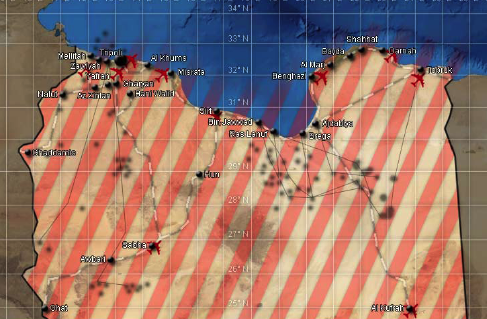 WASHINGTON, March 22 (Reuters) – The no-fly zone over Libya could end up costing the Western coalition more than $1 billion if the operation drags on more than a couple of months, defense analysts say.
Zack Cooper, a senior analyst at the Center for Strategic and Budgetary Assessments, said the initial cost of eliminating Libyan leader Muammar Gaddafi’s air defenses was likely to be between $400 million and $800 million.
The expense of patrolling the no-fly zone once it is established is likely to be $30 million to $100 million a week, he said.
The U.S. military has no official cost figures yet for the operation, which has been going on less Read more…
Look who’s in line to replace Gadhafi
 Anjem Choudary |
British cleric Anjem Choudary says al-Qaida and the Muslim Brotherhood have assets on the ground in Libya and are ready to take control if Moammar Gadhafi is removed from power.
The top Muslim cleric accuses the U. S. and French-led coalition trying to topple Gadhafi of working to install a puppet regime, but he says there are al-Qaida operatives in Libya who will stop the West from installing a friendly government.
“Al-Qaida has their own agents and their own people in the region who are propagating their own Islamic ideas and their agenda. At the right time they will make the move, and we will see the emergence of Islam and Shariah in that particular region,” Choudary said.
“The power vacuum is very useful for anyone who has an agenda and an alternative Read more…
Concern about mission creep grows as more bombs fall on Libya
Barely 48 hours into the Libyan war, the American general running the air strikes came under fire about mission creep even while insisting that allied warplanes won’t hunt Moammar Gadhafi or back the rebels seeking to oust him.
“I have no mission to attack that person. And we are not doing so. We are not seeking his whereabouts or anything like that,” said General Carter Ham, U.S. regional commander for all of Africa.
Concerns over mission creep continue to be raised around the world – including in Canada – as a new set of strikes hit Triopoli late Monday. On a day in which Canadian CF-18s flew their first missions over Libya and Defence Minister Peter MacKay said Canada had a “moral duty” to participate, all four opposition parties endorsed Canadian involvement in the mission but pressed for details over how long the mission would last, what it would cost, and how it would Read more…
Libya: missile destroys Gaddafi building

Libyan officials claimed that the strike on his Bab al-Azizia leadership compound amounted to an attempt to assassinate the long serving leader.
A huge plume of smoke rose from the site of an three-storey administrative building just 100 yards from the tent in the compound used by Col Gaddafi for media interviews and high level visits.
There were no reported casualties but the front of the building had collasped.
A crowd of loyalists gathered near the collapsed building to denounce the first attack on the Libyan leader’s personal citadel
Officials said the building was an administrative bloc not connected with the military. Shrapnel was Read more…
Arab League criticizes Western strikes on Libya
AFP

CAIRO – The Arab League on Sunday criticized Western military strikes on Libya, a week after urging the United Nations to slap a no-fly zone on the oil-rich North African state.
“What has happened in Libya differs from the goal of imposing a no-fly zone and what we want is the protection of civilians and not bombing other civilians,” Arab League secretary general Amr Mussa told reporters.
On March 12, the Arab League urged the United Nations to impose a no-fly zone on Libya and said Moammar Gadhafi’s regime had “lost legitimacy” as it sought to snuff out a rebellion designed to oust him from power.
In the West’s biggest intervention in the Arab world since the 2003 US-led invasion of Iraq, US warships and a British submarine fired more than 120 Tomahawk cruise missiles into Libya on Saturday, the US military said.
French warplanes also carried out strikes.
The UN Security Council passed Resolution 1973 on Thursday authorising military action to prevent Gadhafi’s forces from attacking civilians.


![[Most Recent Quotes from www.kitco.com]](https://i0.wp.com/www.kitconet.com/charts/metals/gold/t24_au_en_usoz_2.gif)
![[Most Recent Quotes from www.kitco.com]](https://i0.wp.com/www.kitconet.com/charts/metals/silver/t24_ag_en_usoz_2.gif)

 crisisboom
 CRISISBOOM
You must be logged in to post a comment.