Archive
Hubble Telescope Finds Adorably Tiny Fourth Moon Orbiting Pluto

Peering at Pluto in preparations for a satellite visit in 2015, the Hubble Space Telescope has spotted a fourth moon orbiting the dwarf planet. The wee moon doesn’t even have a name yet — it’s called P4 for now — and its estimated diameter is between 8 and 21 miles.
That’s right, Hubble spotted something the size of a city from a distance of more than 3 billion miles away.
Pluto’s new moon is smaller than the dwarf planet’s other companions; the big one, Charon, is 648 miles across, and the other moons, Nix and Hydra, are in the range of 20 to 70 miles in diameter, according to NASA. Hubble discovered those moons back in 2005.
P4 is located between the orbits of Nix and Hydra. Hubble’s Wide Field Camera 3 ultraviolet visible instrument, which was installed on the telescope’s final servicing missiontwo years ago, first picked it up on June 28, and then confirmed it in follow-up pictures taken July 3 and July 18. It may appear as a faint smudge in images from 2006, NASA reports, but no one noticed because it was too obscured. This recent set of Read more…
Comet’s Death by Sun Photographed for First Time
 |
| The Solar Dynamics Observatory AIA imager (observing in extreme ultraviolet light) actually spotted a sun-grazing comet as it disintegrated over about a 15 minute period (July 6, 2011), something never observed before. The angle of the comet’s orbit brought it across the front half of the Sun. Given the intense heat and radiation, the comet simply evaporated away completely. The comet was probably a member of the Kreutz sun-grazer family. CREDIT: NASA/SDO/AIA |
The death of a comet that plunged into the sun was captured on camera this month for the first time in history, scientists say.
The comet met its fiery demise on July 6 when it zoomed in from behind the sun and melted into oblivion as it crashed into the star. It was NASA’s Solar Dynamics Observatory (SDO), a satellite orbiting Earth that studies the sun, which witnessed the comet’s death-blow.
One of the SDO spacecraft’s high-definition imagers “actually spotted a sun-grazing comet as it disintegrated over about a 15 minute period (July 6, 2011), something never observed Read more…
NASA Eyes Dominican Republic Lake’s Mysterious Growth
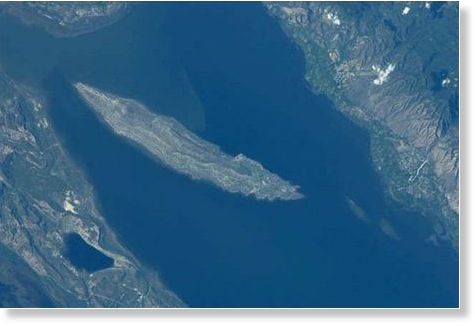
Enriquillo, Cabrito island within. Photo nasa.gov.
Santo Domingo.- Enriquillo Lake has grown around 9,000 hectares from February 26, 2009, to April 15, 2011, a NASA sensor measurement reveals from space, while the Santo Domingo State University’s (UASD) Marine Research Center suggests that two underground currents at the Haiti-Dominican border as the possible cause.
The UASD hypothesis that the subsurface currents from Tierra Nueva and Las Lajas, towns adjacent to Haitian territory, spill their waters into Enriquillo and Azuey lakes, could turn out to be the cause behind the as yet unexplained flooding in both bodies of water.
“That amount of water is still draining towards Enriquillo lake from high territories” in the Dominican Republic, NASA said on its Website, and affirms that the lake’s surroundings “have been flooded even more than the floods brought about by the rain sequel caused by Hurricane Noel and Tropical Storm Olga in 2007.”
NASA’s measurements of Enriquillo’s underflow level were done with Landsat and Modis type sensors, which also provided satellite imagery in the study.
Enriquillo received 400 millimeters of water during those rains, and surpass 700 millimeters in the last two years, without any rain in the zone, which reveals the magnitude of the flooding that affects the Caribbean region’s biggest lake since 2009.
NASA Releases Spectacular Images of Mysterious ‘Hole Punch’ Clouds
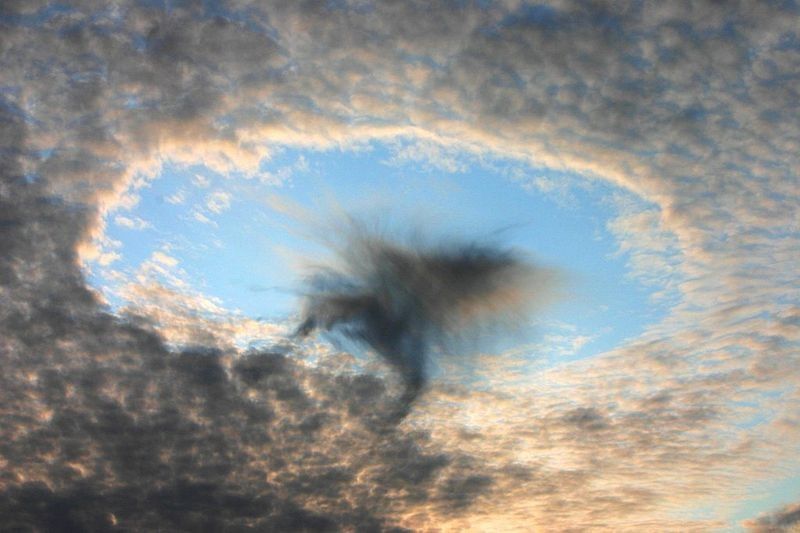
For decades, the mystery behind “hole punch” clouds have puzzled scientists and on-lookers as they continue to witness giant, open spaces in otherwise continuous cloud cover.
For decades, the mystery behind “hole punch” clouds have puzzled scientists and on-lookers as they continue to witness giant, open spaces in otherwise continuous cloud cover.
However, a new research paper published recently in the journal Science has revealed that the main culprit behind this unusual phenomenon is airplane.
“It appears to be a rather widespread effect for aircraft to inadvertently cause some Read more…
Solar Activity Intensifying
Dr. Mark Sircus, Contributing Writer
Activist Post
On June 7th, Dr. C. Alex Young from the NASA Goddard Space Flight Center woke to an email from a friend saying, “I have never seen anything like this before.” There are many things happening around us that we have not seen before, but when it happens on the sun certain people take notice. On the 7th the sun produced a prominence eruption and Dr. Young had never seen such a spectacular event, which luckily did not affect the Read more…
Solar Threat: We’ll Have Minutes to Respond; Government Plans Controlled Blackouts; Elite Contingency Plans
 While many will claim that solar storms are an unrealistic threat to our world, the governments of the United States and the United Kingdom aren’t taking any chances.
According to a report put together by Alex Thomas of The Intel Hub, the threat is not only real, but very likely, and could change the world as we know it from one day to the next:
In a stunning announcement, The United States and United Kingdom are likely set to began “controlled” power cuts in preparation of a giant solar storm.
The announcement by Thomas Bogdan, the director of the US Space Weather Prediction Centre, comes a week after a large scale solar flare released a massive amount of radiation and threatened to cause moderate disruption.
The solar flare on June 7th, 2011 was luckily pointed away from Earth but caused Read more…
Spacecraft Captures Video Of Giant Asteroid Approach
Scientists working with NASA’s Dawn spacecraft have created a new video showing the giant asteroid Vesta as the spacecraft approaches this unexplored world in the main asteroid belt.
The video loops 20 images obtained for navigation purposes on June 1. The images show a dark feature near Vesta’s equator moving from left to right across the field of view as Vesta rotates. Images also show Vesta’s jagged, irregular shape, hinting at the enormous crater known to exist at Vesta’s south pole.
Scientists working with NASA’s Dawn spacecraft have created a new video showing the giant asteroid Vesta as the spacecraft approaches this unexplored world in the main asteroid belt.
The video loops 20 images obtained for navigation purposes on June 1. The images show a dark feature near Vesta’s equator moving from left to right across the field of view as Vesta rotates. Images also show Vesta’s jagged, irregular shape, hinting at the enormous crater known to exist at Vesta’s south pole.
This movie shows surface details beginning to resolve as NASA’s Dawn spacecraft closes in on the giant asteroid Vesta. The framing camera aboard NASA’s Dawn spacecraft obtained the images used for this animation on June 1, 2011, from a distance of about 300,000 miles (483,000 kilometers).
To see the video, visit: Read more…
‘Dramatic’ solar flare could disrupt Earth communications
Handout photo released by NASA Earth Observatory on June 7, 2011 and taken from NASA’s Solar Dynamics Observatory (SDO), sunspot complex 1226-1227, shows the Sun unleashing an M-2 (medium-sized) solar flare.
WASHINGTON – An unusual solar flare observed by a NASA space observatory on Tuesday could cause some disruptions to satellite communications and power on Earth over the next day or so, officials said.
The potent blast from the Sun unleashed a firestorm of radiation on a level not witnessed since 2006, and will likely lead to moderate geomagnetic storm activity by Wednesday, according to the National Weather Service.
“This one was rather dramatic,” said Bill Murtagh, program coordinator at the NWS’s Space Weather Prediction Center, describing the M-2 (medium-sized) solar flare that peaked at 1:41 a.m. Eastern time in North America, or 0541 GMT.
“We saw the initial flare occurring and Read more…
Claim: NASA Hiding Approaching Doomsday Space Event

Super solar flare [Photo courtesy of NASA]
NASA and the European Space Agency have been warning the world for two years about the approaching catastrophes that may unfold during late 2011 through 2012.
Few have been listening.
Calling it a “once in a lifetime super solar storm event,” NASA warns that killer solar flares can slam the Earth knocking out the Northern Hemisphere’s technological infrastructure and kicking everything back to the level of the late 1800s.
Russia too has voiced concern. And now the eminent astrophysicist, Alexey Demetriev [“PLANETOPHYSICAL STATE OF
THE EARTH AND LIFE“], claims what is happening is worse—much worse—than what NASA and the ESA have admitted: Read more…
Comet Chunk Slams Into Earth’s Atmosphere
Residents of Atlanta, Ga., were treated to a rare event on Friday night: a 2-meter wide chunk of cometary material entered the atmosphere right above their heads. The result? Nothing short of spectacular.
The fireball exploded and disintegrated like the Read more…


![[Most Recent Quotes from www.kitco.com]](https://i0.wp.com/www.kitconet.com/charts/metals/gold/t24_au_en_usoz_2.gif)
![[Most Recent Quotes from www.kitco.com]](https://i0.wp.com/www.kitconet.com/charts/metals/silver/t24_ag_en_usoz_2.gif)

 crisisboom
 CRISISBOOM
You must be logged in to post a comment.