Archive
Russian Lawmakers to Warn Against Space-Based WMD

The KS battle station. Stripped surplus Buran test articles are docked to the core. They would act as nuclear weapon dispensers.
The lower house of Russia’s parliament was set on Monday to back a decree opposing any deployment of weapons of mass destruction in outer space, Interfax quoted the body’s executive service as saying on Saturday (see GSN, Aug. 11, 2009).
The State Duma decree, titled “In Connection with the 50th Anniversary of the First Manned Space Flight,” was slated for consideration before a Tuesday celebration of the April 12, 1961, flight of cosmonaut Yuri Gagarin.
“Russia takes consistent action to prevent the deployment of offensive armaments and an arms race in space,” though space systems are key to Russia’s defense, the preliminary document says.
“It is impossible to give a modern image to the armed forces of the Russian Federation and achieve high battle readiness and effectiveness for them without space systems of satellite intelligence, communications, targeting, navigation, missile attack warning and means of space missile defense,” the statement says (Interfax, April 9).
U.S. wants to use India in missile shield against Russia, China
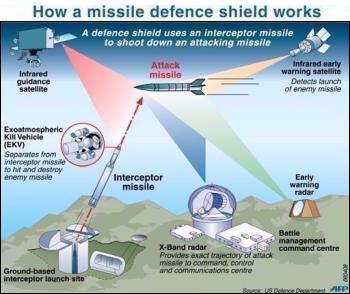 The United States has been trying to rope in India for its plans to build a global missile defence system threatening Russia and China, the Komsomoloskaya Pravda, a popular Russian daily published from Moscow reported on Thursday.
In a story based on the WikiLeaks releases, the report said the U.S. has not only been planning to deploy a missile shield against Russia in Europe, but had also been negotiating with countries along Russia’s borders, such as Japan and India, to jointly build missile defences that would also target Russia.
“The noose [around Russia] is tightening,” the newspaper said. “Thanks to WikiLeaks, it has become known that Washington has been simultaneously conducting talks with countries in other parts of the world for building U.S. missile defences on their territories. Those are different countries, but they form a chain around Russia.”
A 2007 confidential cable from the U.S. embassy in New Delhi carried by the daily refuted media reports that India had abruptly turned its back on a 2005 agreement with the U.S. to cooperate on missile defences. The cable said the Indian media had misinterpreted remarks by External Affairs Minister Pranab Mukherjee after the Russia-India-China trilateral meeting in Harbin, China, on October 24, 2007. Mr. Mukherjee had dismissed as “groundless” the idea that India was going to join a U.S.-led missile defence system.
Misconstrued
“MEA contacts confirm this did not mean India was not interested in continuing to cooperate with the U.S. on missile defence technology and that there has been no change from the current level of bilateral missile defence cooperation,” the U.S. embassy cable said.
The “MEA contacts” explained that Mr. Mukherjee’s comments were “misconstrued” by the Indian press. When Mr. Mukherjee said that “India does not take part in such military arrangements,” the officials said, he had had in mind the U.S. plan to install a missile-detection system in Europe, which his Russian and Chinese counterparts referred to in the same press interaction. Read more…
China Sees New Emerging Markets Bloc Consensus
An upcoming meeting of the leaders of the world’s leading emerging economies should boost consensus and cooperation among them, although members of the group have yet to decide on whether to establish a permanent secretariat, a Chinese diplomat said Saturday.
 The April 14 meeting in the southern Chinese resort of Sanya will include the heads of Brazil, Russia, India, China and — for the first time — South Africa. The five make up the grouping known as the BRIC countries, whose members account for 40 percent of the world’s population and 15 percent of global trade.
Discussions in Sanya will cover trade and finance, as well as major political issues, with areas of agreement to be laid out in a final statement, Assistant Chinese Foreign Minister Wu Hailong told reporters at a briefing.
“We hope through the concerted efforts of all parties that this meeting will be an important Read more…
Astronomers: Comet Elenin may produce greatest meteor showers in history
 The unusual Comet Elenin is expected to pass within 21 million miles of Earth on October 16, 2011 and speeding by at more than 85,000 mph—so fast it could travel from Earth to the Moon in less than five hours.
Discovered by amateur Russian astronomer Leonid Elenin in Lyubertsy, Russia on December 10, 2010—who accessed the International Scientific Optical Network’s robotic observatory near Mayhill, New Mexico—the astronomical community has erupted with the excited possibility the celestial traveller could generate the most spectacular meteor showers ever recorded.
Although the comet’s path is expected to change as it draws closer to the sun, astronomical calculations appear to show Elenin’s perihelion occurring well inside Earth’s orbit by September 5th.
Astronomers believe the comet will be visible with a good pair of field binoculars about the middle of August. After then it should become visible in the Northern hemisphere’s predawn Read more…
Why Do These Breathtaking Russian Images of Earth Look So Different from NASA’s?

While this morning’s orbital image of Mercury is historic, these two images are the ones that have truly left me in complete awe today. Even more so than the most accurate, highest resolution view of Earth to date.
But unlike Blue Marble, these images are not by NASA. In fact, they look a lot different from NASA’s Earth imagery. Much better and crisper, some may say. But are they really better? Are they more accurate? NASA has explained to us why they look so different compared to their own.
The russians are back in the space race
It was taken by a Russian spacecraft, a new weather satellite called Elektro-L. It’s now orbiting Earth on a geostationary orbit 36,000 kilometers above the equator, after being launched on January 20 from the Baikonur Cosmodrome, on board a Zenit rocket.
This is the first major spacecraft fully developed in post-Soviet Russia, developed by NPO Lavochkin for the Russian Federal Space Agency. This is a major step in the country’s aerospace industry, after two decades of Read more…
Mongolia Might Store Foreign Spent Nuclear Fuel, Senior U.S. Official Says
WASHINGTON — The Obama administration has held informal talks with Mongolia about the possibility that the Central Asian nation might host an international repository for its region’s spent nuclear fuel, a senior U.S. diplomat said yesterday (see GSN, March 9, 2010).

(Mar. 30) - A herder last year guides cattle through a frozen area in Mongolia's Tuv province. The United States and Mongolia have informally discussed the possibility of the Asian nation hosting a spent nuclear-fuel repository for the region, a high-level U.S. diplomat said yesterday (Paula Bronstein/Getty Images).
U.S. Energy Department officials and their counterparts in Ulaanbaatar, the Mongolian capital, are in the early stages of discussion and there has been no determination yet about whether to proceed with the idea, according to Richard Stratford, who directs the State Department’s Nuclear Energy, Safety and Security Office.
Speaking at the biennial Carnegie International Nuclear Policy Conference, Stratford said a spent-fuel depot in the region could be of particular value to Taiwan and South Korea, which use nuclear power but have few options when it comes to disposing of atomic waste.
“If Mongolia were to do that, I think that would be a very positive step forward in terms of internationalizing spent-fuel storage,” he said during a panel discussion on nuclear cooperation agreements. “My Taiwan and South Korean colleagues have a really difficult time with spent fuel. And if there really was an international storage depot, which I have always supported, then that would help to solve their problem.”
Stratford is Washington’s lead envoy for nuclear trade pacts, which are sometimes called “123 agreements” after the section of the Atomic Energy Act that governs them.
The United States provides fresh uranium rods to selected trade partners in Asia, including South Korea and Read more…
Is the European Union on the brink of Collapse?

Foto: THOMAS BORBERG (arkivfoto)
A real risk of disintegration if the EU does not soon display solid internal and external cooperation.
Europe’s external divisions on Libya are as great as its internal divisions on the new Europact.
Over the past few days, EU countries have faced historically difficult decisions without being able to reach agreement.
The indecision has seriously questioned the determination that European countries are able to muster, both in NATO and in the European Union.
The countries seem to have reached agreement on handing over the responsibility for the Libya operation to NATO. The breakthrough has, however, come so late that credibility has already been lost.
For once, Denmark has stood out in a positive light by both sending fighter aircraft to Read more…
Russia, U.S. begin data exchange under New START

The right to begin conducting on-site inspections officially begins 60 days after the treaty’s entry into force, which is April 6.
The United States and Russia have begun exchanging information on their nuclear stockpiles under a new U.S.-Russian arms reduction treaty, a senior U.S. official said.
“With entry into force of the Treaty, we have begun implementing an extensive regime of mutual monitoring and information exchange,” Rose Gottemoeller, the Assistant Secretary of State for Arms Control, Verification and Compliance, said.
“Our Nuclear Risk Reduction Center transmitted the U.S. database to Russia over this Read more…
Concern about mission creep grows as more bombs fall on Libya
Barely 48 hours into the Libyan war, the American general running the air strikes came under fire about mission creep even while insisting that allied warplanes won’t hunt Moammar Gadhafi or back the rebels seeking to oust him.
“I have no mission to attack that person. And we are not doing so. We are not seeking his whereabouts or anything like that,” said General Carter Ham, U.S. regional commander for all of Africa.
Concerns over mission creep continue to be raised around the world – including in Canada – as a new set of strikes hit Triopoli late Monday. On a day in which Canadian CF-18s flew their first missions over Libya and Defence Minister Peter MacKay said Canada had a “moral duty” to participate, all four opposition parties endorsed Canadian involvement in the mission but pressed for details over how long the mission would last, what it would cost, and how it would Read more…


![[Most Recent Quotes from www.kitco.com]](https://i0.wp.com/www.kitconet.com/charts/metals/gold/t24_au_en_usoz_2.gif)
![[Most Recent Quotes from www.kitco.com]](https://i0.wp.com/www.kitconet.com/charts/metals/silver/t24_ag_en_usoz_2.gif)

 crisisboom
 CRISISBOOM
You must be logged in to post a comment.