Archive
Mysterious Night-Shining Clouds Getting Brighter
 |
| After the sun sets on a summer evening and the sky fades to black, you may be lucky enough to see thin, wavy clouds illuminating the night, such as these seen over Billund, Denmark, on July 15, 2010. Jan Erik Paulsen/ NASA Earth Observatory. |
Clouds bright enough to see at night are not as hard to find as they once were.
These so-called night-shining clouds are still rare — rare enough that Matthew DeLand, who has been studying them for 11 years, has seen them only once. But his odds are increasing. [Related: In Images: Reading the Clouds.]
These mysterious clouds form between 50 and 53 miles (80 and 85 kilometers) up in the atmosphere, altitudes so high that they reflect light long after the sun has dropped below the horizon.
DeLand, an atmospheric scientist with NASA’s Goddard Space Flight Center in Greenbelt, Md., has found that night-shining clouds — technically known as polar mesospheric or noctilucent clouds — are forming more frequently and becoming brighter. He has been observing the clouds in data from instruments that have been flown on satellites since 1978.
For reasons not fully understood, the clouds’ Read more…
Eruption Of Colima Volcano

A light colored plume, probably the result of rockfall on the dome, extends to the east (right) of the summit. The summit crater is the remnant of an explosive eruption in 1913 which knocked 100 meters (300 feet) off the top of the mountain. For a larger version of this image please go here. by Staff Writers
Washington DC (SPX) Jan 28, 2011
Colima Volcano, Mexico’s most active, has been erupting since 1998. The eruption began with several months of earthquakes beneath the volcano, followed by explosions and rockfalls at the summit lava dome as it began to grow.
Dome growth was accompanied months later by a series of lava flows which cascaded down the southwestern flank of the mountain, stretching up to 3,100 meters (10,000 feet) from the summit.
Since then dome growth has continued, with a few periods of actively flowing lava. As of March 2010, the dome was growing about 2,000 cubic meters (70,000) cubic feet a day, leading to frequent small rockfalls and occasional ash plumes. In January 2011, local newspapers reported “dust plumes” rising over Colima, likely pulverized lava stirred up by landslides at the summit dome. Read more…
Classified Spy satellite launched from California base
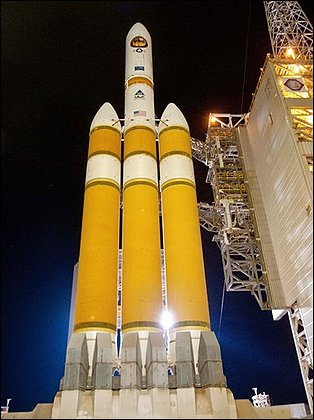 VANDENBERG AIR FORCE BASE, Calif. — The largest rocket ever launched from the West Coast blasted off Thursday with a classified defense satellite on board.
The 235-foot-tall Delta IV Heavy Launch Vehicle lifted off at 1:10 p.m. carrying a payload for the National Reconnaissance Office.
The booster rose into the sky over California’s central coast and arced over the Pacific Ocean, a spectacle visible over a wide area.
United Launch Alliance, the joint venture of rocket builders Lockheed Martin Corp. and Boeing Co., said in a statement that the launch was a success.
The launch was pushed back two minutes to avoid an object in space that could have been in the path of the rocket, said Michael J. Rein, a ULA spokesman.
No payload details were released. The NRO operates satellites that provide information to the Central Intelligence Agency and Department of Defense.
This was the fifth launch of a Delta IV but the first from the West Coast. The other four launches were at Cape Canaveral, Fla.
Capable of generating nearly 2 million pounds of thrust, the liquid-fuel rocket has a central core booster and two strap-on boosters that make the assembly 50 feet wide. An upper second stage takes over when the first stage is exhausted.
Preparing for the launch took three years and $100 million in infrastructure upgrades at Vandenberg, 130 miles northwest of Los Angeles.
The launch director, Lt. Col. Brady Hauboldt, said in a statement before the liftoff that the launch would mark a milestone by restoring heavy lift capability in the nation’s western range. The last heavy lift Titan IV-B was launched at Vandenberg in 2005.
In its past, the launch complex was once configured for West Coast space shuttle launches, which were canceled after the 1986 Challenger disaster, and the Air Force’s Manned Orbiting Laboratory program, which was canceled in 1969. It was last used in 2006.
Huge ring appears over Australia, is HAARP involved?
After receiving an urgent e-mail from a contact in Australia informing me of bizarre weather on the weather satellite imagery, I checked out the data and just hours later more strangeness. I am waiting to hear from the Australian Government’s weather bureau for their own explanation.
“There is very strange weather happening here – please check”

Written at 2230 Hrs (US Eastern) 15th January 2010.
A contact in Australia just alerted me to what he describes as “very strange weather taking place over the south west of Australia”. He told me to go to the national weather satellite images if I could not open the images he attached (See left). By the time I had discovered the e-mail and checked, the large clearly defined ring had mostly dissipated but still was just visible on a time loop which was spiraling counter clockwise (Low Pressure system). Read more…
Iran announces new satellite launch plan
 Iran is planning to launch a new satellite into orbit by the end of March, according to the country’s semi-official Fars News Agency.
Wednesday’s announcement for the planned launch of the Fajr — or “Dawn” — satellite follows a recent statement by Iranian President Mahmoud Ahmadinejad on strengthening the country’s space-based presence.
The satellite “will be launched into space from an Iranian launch-pad and will have an Iranian exchange station and control station,” Ahmadinejad said, according to Fars.
Iran’s first research satellite — named “Omid,” or “Hope” — completed 700 orbits over seven weeks before reentering the Earth’s atmosphere last April, Fars noted.
Ahmadinejad asserted that Iran now plans to send astronauts into space by 2019 as opposed an earlier announced timeline of 2024, Fars reported.


![[Most Recent Quotes from www.kitco.com]](https://i0.wp.com/www.kitconet.com/charts/metals/gold/t24_au_en_usoz_2.gif)
![[Most Recent Quotes from www.kitco.com]](https://i0.wp.com/www.kitconet.com/charts/metals/silver/t24_ag_en_usoz_2.gif)

 crisisboom
 CRISISBOOM

You must be logged in to post a comment.