Archive
Earth-Sized Tornado on the Surface of the Sun (VIDEO)
beforeitsnews.com geekosystem.com

In early February, NASA’s Solar Dynamics Observatory captured footage of whirling tornado-like storm on the surface of the sun. This enormous mass of plasma raged for over a day and was estimated to be larger than the Earth. Of course, it’s not a tornado in the same way that we understand them here on Earth. It’s obviously way bigger, way more terrifying, and way weirder.
While terrestrial tornadoes are the result of competing pressure fronts and the cooling of air, events on the sun are governed by gravity and magnetism. “The particles are being pulled this way and that by competing magnetic forces,” writes NASA on the SDO website. “They are tracking along strands of magnetic field lines.”
The particles of plasma in the storm are relatively cooler, a mere 15,000 degrees Fahrenheit compared to the 2 million degree sun. This makes the solar prominence, which is what the “tornado” is classified as, appear darker than the bright background. The pull between those competing magnetic forces whip the
How the Spike in Solar Flares May Affect Earth in 2012
 According to NASA, A solar flare is defined as a “sudden, rapid, and intense variation in brightness”, which occurs when “magnetic energy that has built up in the solar atmosphere is suddenly released.”
For centuries, solar flares have caused various calamities on Earth, such as disrupted communications, blackouts and unusual lights appearing in the sky.
In 1859, the most powerful solar flare in recorded history hit Earth and was observed by the English amateur astronomer Richard Christopher Carrington. It became known as the “Carrington Event”, or as the “Carrington Super Flare”.
The event occurred during solar cycle 10, the tenth solar cycle since 1755.
The powerful solar storm not only created auroras across the world, but also interrupted telegraphs for weeks. That was back in the mid-nineteenth century.
Can you imagine, with the modern reliance on satellites, how devastating such a Read more…
Coronal Mass Ejections (CMEs) Sept 4 to Sept 8
Shape-shifting sunspot 1271 harbors energy for M-class solar flares
Every time you look, sunspot 1271 has a new outline. For the past two days the active region has been in a constant state of change, altering its shape on an hourly basis. Click on the image for 48 hours of shape-shifting:

These rapid changes have caused the sunspot’s magnetic field to criss-cross and tangle. The magnetic field now has a “beta-gamma” configuration that harbors energy for M-class solar flares. Any such flares today would be approximately Read more…
Two sunspots on the Sun currently pose a threat for x-class solar flares
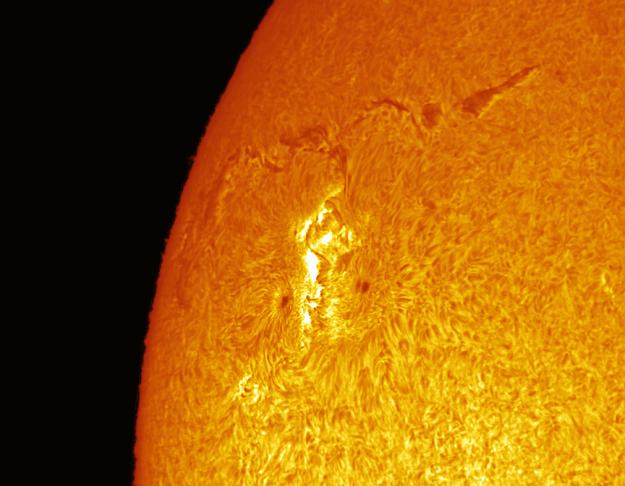 Here we go again, this time two spots on the Sun turning toward our planet now that are capable of producing powerful X-Class flares.
Two sunspots are now rotating toward the planet over the face of the Sun. Sunspots 1271 and 1272 remain quiet but pose a threat for X-class solar flares.
X-class solar flares are the most powerful solar flare the Sun can produce, according to our planetary scale. These could produce radio and electrical blackouts as well as a brilliant display of aurora if they unleash powerful Earth-directed flares.
The last solar storms a week ago were from sunspots on the farside of the Sun now. They are still together and out of our view, Venus was seen in the same field of view as one blasted toward the planet on the far side of the Sun.
Stay tuned to the sunspots, it could ‘pop’ at anytime.
Solar Storms Building Toward Peak in 2013, NASA Predicts
 |
| This image from the Solar Dynamics Observatory shows the X6.9 solar flare of Aug. 9, 2011 near the western limb (right edge) of the sun. CREDIT: NASA/SDO/Weather.com |
Solar flares like the huge one that erupted on the sun early today (Aug. 9) will only become more common as our sun nears its maximum level of activity in 2013, scientists say.
Tuesday’s flare was the most powerful sun storm since 2006, and was rated an X6.9 on the three-class scale for solar storms (X-Class is strongest, with M-Class in the middle and C-Class being the weakest).
Flares such as this one could become the norm soon, though, as our sun’s 11-year cycle of magnetic Read more…
Powerful Solar Flare Could Have Caused Serious Damage: Earth ‘Lucked Out’
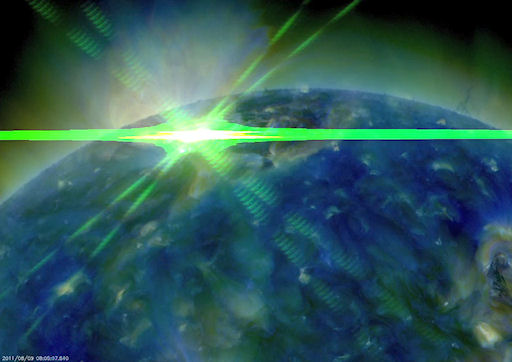 The sun unleashed its most powerful solar flare in four years Tuesday — an eruption that could have had serious consequences on Earth if it had taken place on the side of the sun facing the planet.
“We lucked out because the site of the eruption at the sun was not facing the Earth, so we will probably feel no ill effects,” Joe Kunches, a space scientist with the National Oceanic and Atmospheric Administration’s Space Weather Prediction Center, told MSNBC.
So far, it appears that any consequence felt on the Earth will not cause human injury. A minor proton storm currently on the Earth’s surface could affect satellites in high-altitude orbits, and radiation briefly disrupted Read more…
A Strong M-class solar flare headed for Earth
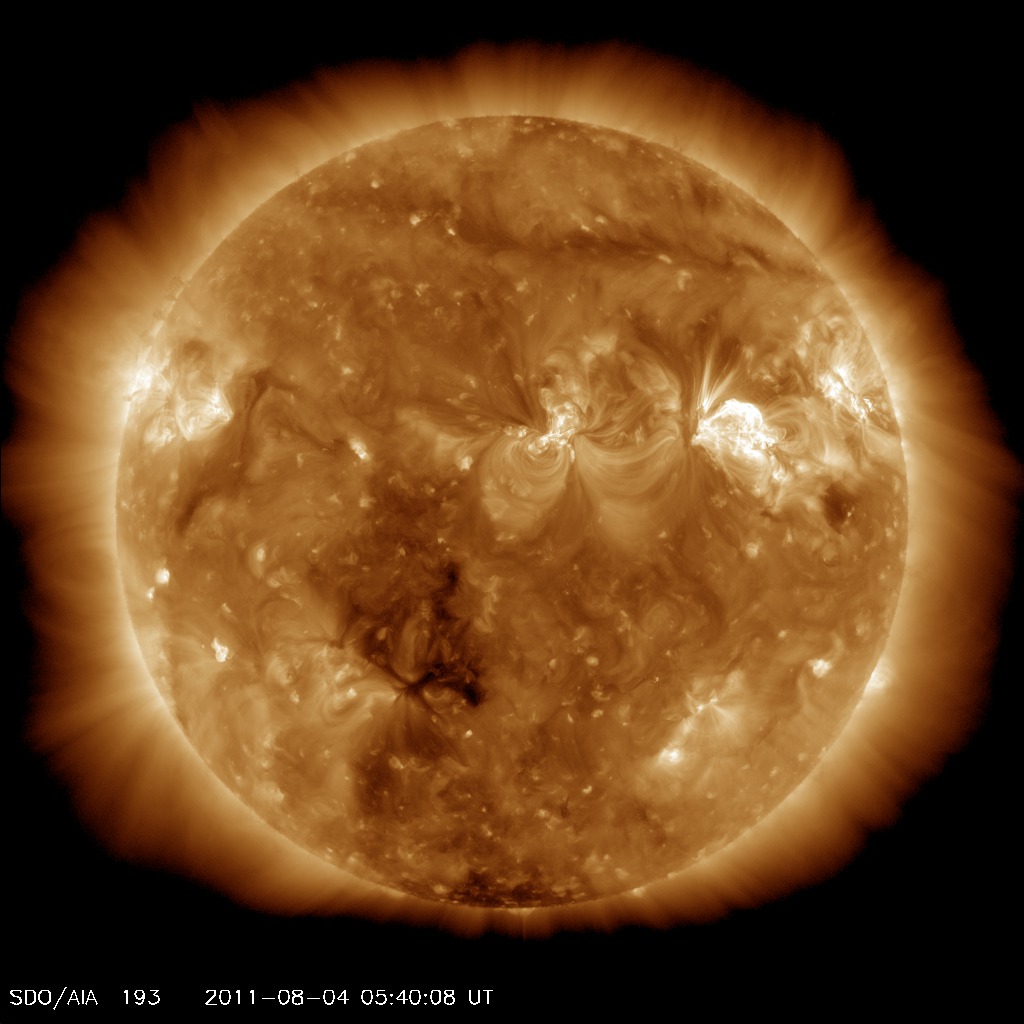
A solar wind stream flowing from the indicated coronal hole should reach Earth on Aug. 7th or 8th. Credit: SDO/AIA.
STRONG SOLAR ACTIVITY: For the third day in a row, active sunspot 1261 has unleashed a strong M-class solar flare. The latest blast at 0357 UT on August 4th registered M9.3 on the Richter Scale of Flares, almost crossing the threshold into X-territory (X-flares are the most powerful kind). The number of energetic protons around Earth has jumped nearly 100-fold as a result of this event. Stay tuned for updates.
INCOMING CLOUDS: At least two coronal mass ejections (CMEs) are now en route to Earth, propelled toward us by eruptions in the magnetic canopy of sunspot 1261 on August 2nd and 3rd. Analysts at the GSFC Space Weather Lab have just produced a new 3-D model of the advancing CMEs. Click on the image to set the clouds in motion below:
Massive Sunspot 1263 Forms-Wider than the Earth!
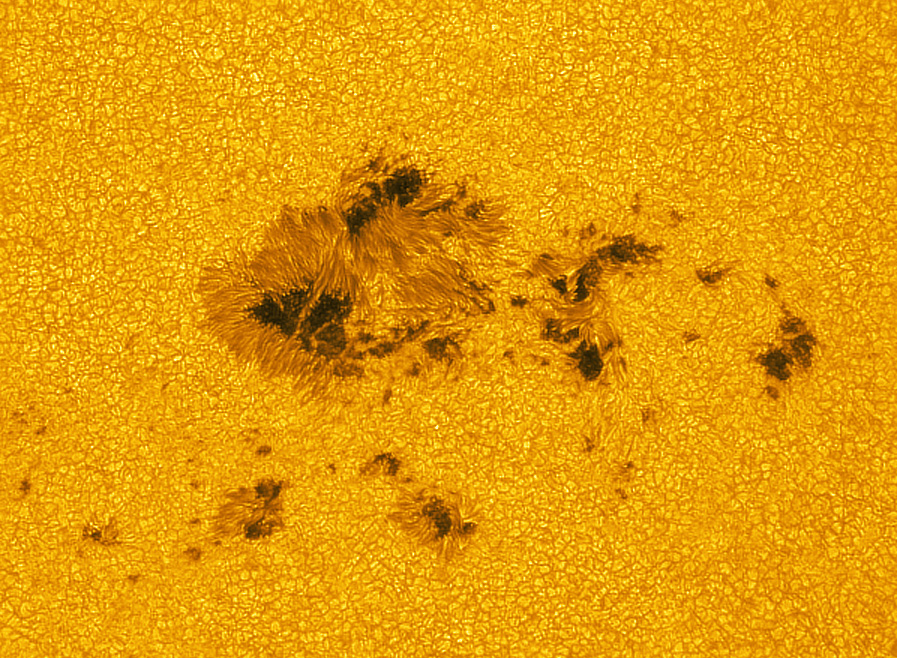
 Double sunspot 1263 is a whopper. Its two dark cores are each wider than Earth, and the entire region stretches more than 65,000 km from end to end. Yesterday in the Netherlands, Emil Kraaikamp took advantage of a break in the clouds and “a few moments of steady air” to capture this magnificent photo:
“To image this monster, I used a 10-inch Newtonian telescope capped by a white light solar filter,” says Kraaikamp. He used the same setup to photograph nearby sunspot 1261. The clarity of both images is impressive. Note the granulation of the stellar surface surrounding the main dark cores. Those are Texas-sized bubbles of plasma rising and falling like water boiling on top of a hot stove.
The magnetic field of sunspot 1263 harbors energy for powerful X-class solar flares. Because the sunspot is turning to face Earth, any such eruptions in the days ahead would likely be geo-effective
Intense Solar Flare Erupts From the Sun
 |
| A powerful M9-class solar flare erupted from the sun at 10:09 p.m. EDT on July 29 (0209 GMT July 30). CREDIT: NASA/SDO |
A powerful flare erupted from the sun this past weekend, but while the storm was not aimed directly at Earth, it was nearly the most powerful type of solar storm there is, scientists say.
The brief but strong solar flare occurred late Friday (July 29) at 10:09 p.m. EDT (0209 GMT July 30), and grew in intensity. The flare was followed by an unrelated geomagnetic storm, which was triggered by fluctuations in the solar wind, according to Spaceweather.com, a website that monitors space weather events.
As a result of the solar storm, skywatchers at high latitudes, particularly in the southern Read more…


![[Most Recent Quotes from www.kitco.com]](https://i0.wp.com/www.kitconet.com/charts/metals/gold/t24_au_en_usoz_2.gif)
![[Most Recent Quotes from www.kitco.com]](https://i0.wp.com/www.kitconet.com/charts/metals/silver/t24_ag_en_usoz_2.gif)

 crisisboom
 CRISISBOOM
You must be logged in to post a comment.