Archive
Coronal Mass Ejections (CMEs) Sept 4 to Sept 8
9/4/2011 PROOF that the 7.0 magnitude earthquake solar flare 9/2/2011
Major NASA Solar Flare News Conference: New Observations On Solar Storm Impact On Earth
nanopatentsandinnovations.blogspot

Credit: SOHO/NASA
JPL: Brown Dwarfs Closer Than First Thought
 Artist’s rendering of size comparisons.
Astronomers have hunted the skies for Y dwarfs, the coldest members of the brown dwarf family, without success until data from NASA’s Wide-field Infrared Survey Explorer revealed the faint glow of six such orbs within a distance of 40 light years from our sun. Unlike stars that burn steadily for billions of years, Y dwarfs fade and cool due to their low mass and inability to fuse atoms at their cores. These dwarfs hold a temperature about the same as a human body.
Astronomers study brown dwarfs in order to Read more…
New, convincing evidence indicates global warming is caused by cosmic rays and the sun — not humans
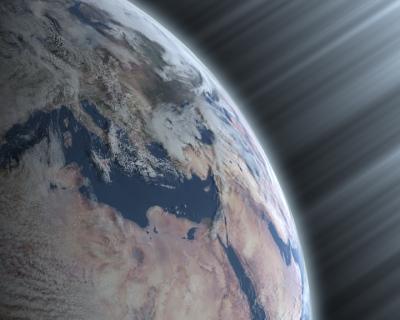 The science is now all-but-settled on global warming, convincing new evidence demonstrates, but Al Gore, the IPCC and other global warming doomsayers won’t be celebrating. The new findings point to cosmic rays and the sun — not human activities — as the dominant controller of climate on Earth.
The research, published with little fanfare this week in the prestigious journal Nature, comes from über-prestigious CERN, the European Organization for Nuclear Research, one of the world’s largest centres for scientific research involving 60 countries and 8,000 scientists at more than 600 universities and national laboratories. CERN is the organization that invented the Read more…
Moon-Sun Alignment Increases Irene’s Destructive Power Say Scientists
nanopatentsandinnovations.blogspot.com
While residents along the New Jersey and New York coasts rush to the store for batteries and bottled water, scientists at Stevens Institute of Technology are heading to the laboratory to help predict the impact of Hurricane Irene.

At the Stevens Center for Maritime Systems (CMS), ocean researchers manage a large network of submerged sensors throughout the New York Harbor region, from the South Jersey shore to the eastern end of Long Island and north up the Hudson River. This Urban Ocean Observatory combines real-time and historic data with advanced understanding of Read more…
Shape-shifting sunspot 1271 harbors energy for M-class solar flares
Every time you look, sunspot 1271 has a new outline. For the past two days the active region has been in a constant state of change, altering its shape on an hourly basis. Click on the image for 48 hours of shape-shifting:

These rapid changes have caused the sunspot’s magnetic field to criss-cross and tangle. The magnetic field now has a “beta-gamma” configuration that harbors energy for M-class solar flares. Any such flares today would be approximately Read more…
New method detects emerging sunspots deep inside the sun, provides warning of dangerous solar flares news
Sunspots spawn solar flares that can cause billions of dollars in damage to satellites, communications networks and power grids.
But Stanford researchers have developed a way to detect incipient sunspots as deep as 65,000 kilometers inside the sun, providing up to two days’ advance warning of a damaging solar flare.
Viewed from the technological perspective of modern humans, the sun is a seething Read more…
Two sunspots on the Sun currently pose a threat for x-class solar flares
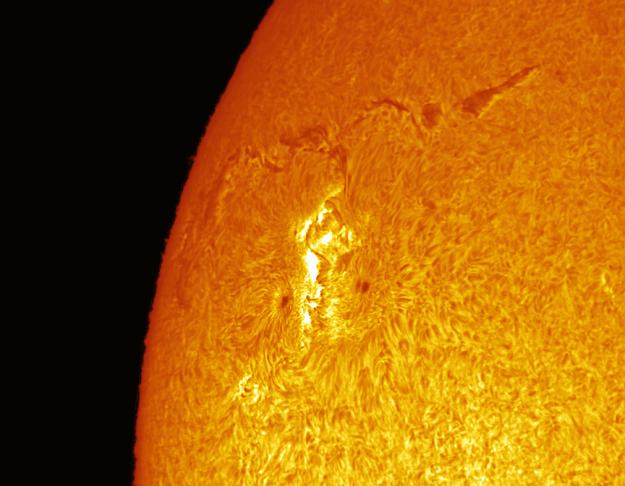 Here we go again, this time two spots on the Sun turning toward our planet now that are capable of producing powerful X-Class flares.
Two sunspots are now rotating toward the planet over the face of the Sun. Sunspots 1271 and 1272 remain quiet but pose a threat for X-class solar flares.
X-class solar flares are the most powerful solar flare the Sun can produce, according to our planetary scale. These could produce radio and electrical blackouts as well as a brilliant display of aurora if they unleash powerful Earth-directed flares.
The last solar storms a week ago were from sunspots on the farside of the Sun now. They are still together and out of our view, Venus was seen in the same field of view as one blasted toward the planet on the far side of the Sun.
Stay tuned to the sunspots, it could ‘pop’ at anytime.
New Sunspot AR1271 Emerges
A big new sunspot is emerging over the sun’s northeastern limb. AR1271 has at least four dark cores and it is crackling with small flares. The sunspot’s entrance was captured in this 24-hour movie from the Solar Dynamics Observatory:

NOAA forecasters estimate a 60% chance of M-class solar flares during the next 24 hours. Because of its location near the sun’s limb, AR1271 does not yet pose a threat for Earth-directed eruptions. This could change in the days ahead, however, as the sunspot turns to face our planet. Readers with solar telescopes are encouraged to monitor developments.


![[Most Recent Quotes from www.kitco.com]](https://i0.wp.com/www.kitconet.com/charts/metals/gold/t24_au_en_usoz_2.gif)
![[Most Recent Quotes from www.kitco.com]](https://i0.wp.com/www.kitconet.com/charts/metals/silver/t24_ag_en_usoz_2.gif)

 crisisboom
 CRISISBOOM
You must be logged in to post a comment.