Archive
Over 50,000 TONS Of Deadly Radioactive Fukushima Water
Work to dispose of highly radioactive water at the crippled Fukushima Daiichi nuclear power plant is not proceeding smoothly as more time is needed for preparations. Read more…
India objects to ‘smuggling’ superbug samples out to UK
 NEW DELHI: India on Thursday seriously objected to biological samples in the form of “swabs of seepage water and tap water” being carried out of the country “on the sly” by British scientists to test the presence of the multi-drug resistant superbug.
India said it was a signatory to World Health Organization’s International Materiel Transfer Agreement as per which permission is required to carry out any biological material from the country.
“The way scientists carried out samples from India to be tested in UK does not point to a good scientific motive. It is illegal,” said Dr V M Katoch, director general of Indian Council for Medical Research. “Some people want to keep the heat on India,” he added.
According to him, such multi-drug resistant bacteria — like what is being called a superbug caused by the NDM1 gene — exists in environment across the world. “To keep on pressing India as a hotbed of such superbugs is unfair, and its motive is questionable,” Dr Katoch added.
The scientists had collected 171 swabs of seepage water and 50 public tap water samples Read more…
Billion-plus people to lack water in 2050: study
(AFP)

WASHINGTON – More than one billion urban residents will face serious water shortages by 2050 as climate change worsens effects of urbanization, with Indian cities among the worst hit, a study said Monday.
The shortage threatens sanitation in some of the world’s fastest-growing cities but also poses risks for wildlife if cities pump in water from outside, said the article in the Proceedings of the National Academy of Sciences.
The study found that under current urbanization trends, by mid-century some 993 million city dwellers will live with less than 100 liters (26 gallons) each day of water each — roughly the amount that fills a personal bathtub — which authors considered the daily minimum.
Adding on the impact of climate change, an additional 100 million people will lack what they Read more…
China’s Drinking Water Crisis
 The quality of China’s tap water was raised on World Water Day. Reports and statements by professionals all point to a drinking water crisis.
Despite a five-year period given water companies to comply with higher governmental sanitary standards for drinking water running out on July 1, 2012, pollution of drinking water and drinking water sources remain a serious issue in China.
Li Wei, secretary of China’s Environmental Protection Foundation (EPF), said that in 2007, 27.6 percent of China’s surface water quality fell into class 5, the lowest according to the Water Quality Index, making it basically unusable.
Li said the overall pollution level of China’s seven natural hydraulic systems was “medium,” based on the EPF’s River Pollution Index’s four categories–none, slight, medium, and serious.
According to China’s 2nd National Water Assessment report, 35.6 percent of drinking water in China is not drinkable. Read more…
Currency Meltdown Coming
 By Greg Hunter’s USAWatchdog.com
The situation in Japan is getting worse, not better. There are shortages in food, fuel and warm dry shelter. To make matters exponentially worse, nuclear power plants there continue to burn out of control and emit high levels of radiation. Japan is a stark reminder of how fast a modern technologically advanced society can be brought to its knees by an unforeseen calamity.
On the other side of the Pacific, the devastating pictures from that island nation are taking the attention away from our own, much more predictable, calamity coming from a tsunami of debt. As the U.S. and other world governments continue to print money to keep the banks and system solvent, a ball of debt is growing. It is on course to Read more…
California water future called ‘bleak’
 |
by Staff Writers
Sacramento (UPI) Feb 24, 2011
Scientists say the water situation in California is “bleak” and the state needs to act to bolster its entire aquatic ecosystem.
“Our assessment of the current water situation [in California] is bleak,” says Ellen Hanak, a Public Policy Institute of California economist. “California has essentially run out of cheap, new water sources.”
The institute has released its findings in a publication written by a team of scientists, engineers, economists and legal experts from three University of California campuses and Stanford University, AAA ScienceMag.org reported Thursday.
Their report says water quality is deteriorating, pollution from agricultural runoff is increasing, and efforts to manage water and species recovery are Read more…
Global warming could increase diseases originating from water sources

WASHINGTON (AFP) – Climate change could increase exposure to water-borne diseases originating in oceans, lakes and coastal ecosystems, and the impact could be felt within 10 years, US scientists told a conference in Washington on Saturday.
Several studies have shown that shifts brought about by climate change make ocean and freshwater environments more susceptible to toxic algae blooms and allow harmful microbes and bacteria to proliferate, researchers from the National Oceanic and Atmospheric Administration said.
In one study, NOAA scientists modeled future ocean and weather patterns to predict the effect on blooms of Alexandrium catenella, or the toxic “red tide,” which can accumulate in shellfish and cause symptoms, including paralysis, and can sometimes be deadly to humans who eat the Read more…
The Food Bubble is About to Burst
We’re fast draining the fresh water resources our farms rely on, warns Lester Brown, president of the Earth Policy Institute
What is a food bubble?
 That’s when food production is inflated through the unsustainable use of water and land. It’s the water bubble we need to worry about now. The World Bank says that 15 per cent of Indians (175 million people) are fed by grain produced through over-pumping – when water is pumped out of aquifers faster than they can be replenished. In China, the figure could be 130 million.
Has this bubble already burst anywhere?
Saudi Arabia made itself self-sufficient in wheat by using water from a fossil aquifer, which doesn’t refill. It has harvested close to 3 million tonnes a year, but in Read more…
China spends $1 billion to tackle drought
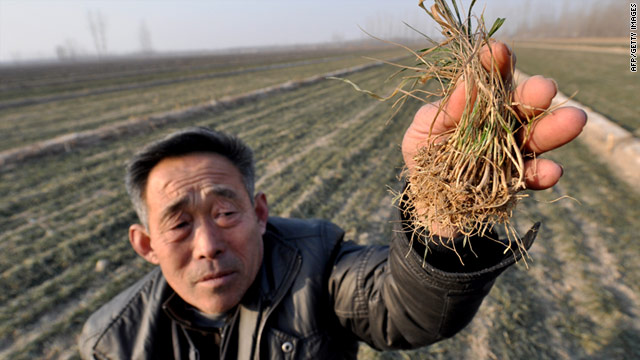
Beijing (CNN) — China’s government will invest $1 billion to combat a three month drought crippling the country’s north.
The worst drought in six decades threatens to ruin China’s winter harvest, the world’s largest producer of wheat.
To combat it, China’s government plans to spend around 6.7 billion yuan ($1.02 billion) to divert water to affected areas and irrigation facilities according to the state news agency, Xinhua.
Some 2.57 million people and 2.79 million livestock are suffering from drinking water shortages, Xinhua said.
The main affected provinces include Shandong, Jiangsu, Henan, Hebei and Shanxi, which together account for about 60% of the wheat planted this winter.
The United Nation’s Food and Agriculture Organization (FAO) issued an alert Tuesday, warning of severe wheat shortages, saying “the ongoing drought is potentially a serious problem.”
According to the FAO the drought is now affecting an area of around 5.16 million hectares, representing two-thirds of China’s wheat production.
Meanwhile the country’s capital Beijing got it first snowfall in more than three months overnight on Wednesday. But the precipitation is unlikely to end the area’s drought, reported Xinhua.
The precipitation followed cloud seeding by the municipal artificial weather intervention office, the agency said.
Deadly Fluoride in Baby Food, Beer, Large Number of Food Products
Infowars.com
I was looking for a picture for this story and ran into this story:Here is the link> Why is Fluoride Bad for You?

Fluoride isn’t just in your drinking water. It is in a variety of food and beverage products, including baby food and beer.
Here is an excerpt from a USDA database:
2004 USDA National Fluoride Database of
Selected Beverages and Foods
For Full Report on USDA Website
CLICK HERE
Intended goal of fluoridation: Delivery of 1 milligram of fluoride per day
1 milligram/liter = 1ppm (parts per million)


![[Most Recent Quotes from www.kitco.com]](https://i0.wp.com/www.kitconet.com/charts/metals/gold/t24_au_en_usoz_2.gif)
![[Most Recent Quotes from www.kitco.com]](https://i0.wp.com/www.kitconet.com/charts/metals/silver/t24_ag_en_usoz_2.gif)

 crisisboom
 CRISISBOOM
You must be logged in to post a comment.