Archive
THE POWER OF HAARP
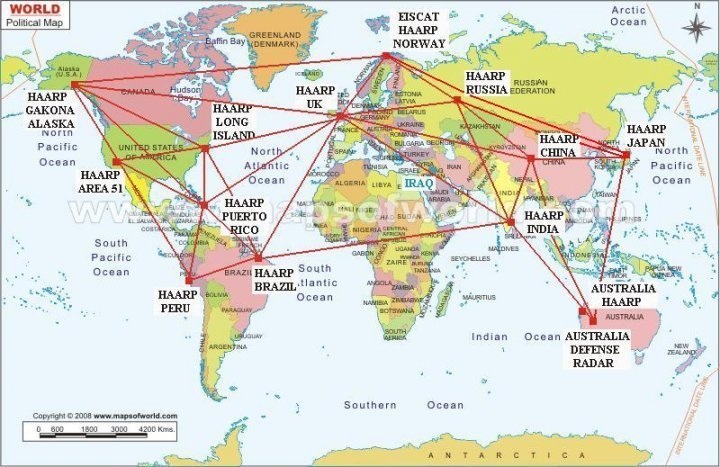
THE HAARP SITES ARE LOCATED GLOBALLY WHERE THE RICHEST MINERAL BELTS ARE LOCATED. SUBSURFACE MINERAL EXPLORATION HAS BEEN DONE FROM SATELLITES BY RADIOTOMOGRAPHY THAT IS 100% ACCURATE.
The High Frequency Active Auroral Research Program (HAARP) is an ionospheric research program jointly funded by the US Air Force, the US Navy, the University of Alaska and the Defense Advanced Research Projects Agency (DARPA)


Although Russia has accused the US of holding such a type of weapon, a Georgia Green Party leader claimed that Moscow, allegedly possessing similar weapons, caused an earthquake on Georgian territory several years ago.”
I wonder if Wikileaks will have a leak on this…
Global Seed Vault in Depth

About the Seed Vault:
The Svalbard Global Seed Vault is designed to safeguard more than 2 billion seeds in case of natural or man-made disaster.
Located on a Norwegian island in the Arctic Ocean near the village of Longyearbyen, the vault is built into permafrost deep inside a mountain. It opened Tuesday, with 75 boxes of seeds.
Norway owns the facility — nicknamed the “Doomsday Vault” — and the Global Crop Diversity Trust is funding the seed collection.
Cary Fowler, the group’s executive director, says the world is losing a significant amount of diversity “on a daily basis.”
“When a crop variety becomes extinct, we lose the ability to use any unique trait that it might have in the future. So if it turns out that one of those crop varieties held the key to resistance to a particular insect pest or disease, or was really heat tolerant and could be used in the future to help us adapt to climate change, then it’s sort of tough luck,” Fowler tells Melissa Block.
The three storage rooms inside the vault are sealed behind air-tight doors and kept at a temperature below zero. Each one can hold about 1.5 million small packages of seeds.
The seeds that are viable for the shortest amount of time — lettuce, for example — can stay healthy for about 50 years, Fowler says.
But at the other extreme, experimental results suggest that other seeds — such as sorghum — could be safely stored in these conditions for nearly 20,000 years.
Monitoring of the seed vault will take place electronically — and no one will work at the site physically on a day-to-day basis.
Fowler says the seed vault’s annual operating cost will be about $150,000.
“We think that’s about the cheapest insurance policy anybody can imagine for the world’s most valuable natural resource,” he says.
The true meaning behind the Seed Vault : Read more…
Food Stamp Usage Hits New High Of 43.2 Million
Ever wonder where all the money for equity inflows came from? Here’s the answer: with all the money saved from participating in the Supplemental Nutrition Assistance Program, better known as foodstamps, which in October hit a brand new record, 43.2 million Americans decided to join in on this “wealth effect” they had been hearing so much about and buy Apple stock. After all 190 hedge funds are doing it: and there is no way that 190 hedge funds can possibly be wrong. As a result, the chart below shows our nation’s pending wealth effect in its full glory. Just think: 43.2 millionaire in waiting. Just consider the guaranteed explosion to money velocity…

Utah’s $1.5 billion cyber-security center under way
CAMP WILLIAMS — Thursday’s groundbreaking for a $1.5 billion National Security Agency data center is being billed as important in the short term for construction jobs and important in the long term for Utah’s reputation as a technology center.
“This will bring 5,000 to 10,000 new jobs during its construction and development phase,” Sen. Orrin Hatch, R-Utah, said on Wednesday. “Once completed, it will support 100 to 200 permanent high-paid employees.”

- Utah’s NSA spy center will house data, not analysts – Jan. 7, 2011
- Utah firm to work on NSA data center – Sept. 27, 2010
- National Security Agency data center at Camp Williams drawing huge interest in Utah – Jan. 13, 2010
Officially named the Utah Data Center, the facility’s role in aggregating and verifying dizzying volumes of data for the intelligence community has already earned it the nickname “Spy Center.” Its really long moniker is the Community Comprehensive National Cyber-security Initiative Data Center — the first in the nation’s intelligence community.
A White House document identifies the Comprehensive National Cyber-security Initiative as addressing “one of the most serious economic and national security challenges we face as a nation, but one that we as a government or as a country are not adequately prepared to counter.” The document details a number of technology-related countermeasures to the security threat.
Hatch said Utah was chosen for the project over 37 other locations. He characterized the cyber-security center as the “largest military construction project in recent memory.”
Hatch said he promoted Utah’s favorable energy costs, Internet infrastructure, thriving software industry and proximity to the Salt Lake City International Airport in the bid process that ended up with Camp Williams earning the data center.
The Army Corps of Engineers is overseeing the project that is under contract to a joint venture between Big-D Construction in Salt Lake City, U.K.-based Balfour Beatty Construction and DPR Construction out of California.
“This project is going to give an opportunity for an awful lot of Utahns” who have seen construction jobs in Utah drop from 100,000 in 2008 to about 66,000 today, said Rob Moore, president and COO of Big-D and chairman of the Associated General Contractors in Utah. “My subcontractors, suppliers and vendors are very appreciative of the work that will be available on this project.”
Grading work is already under way for the complex, which is scheduled to include 100,000 square feet for the data center and 900,000 square feet for technical support and administrative space. The center is designed to be capable of generating all of its own power through backup electrical generators and will have both fuel and water storage. Construction is designed to achieve environmentally significant LEED Silver certification.
“It is so unique and so intensive,” Hatch said. “This will establish our state as one of the leading states for technology.”
One in four Germans wants microchip under skin: Poll
 Raw Story | It sounds like something from a sci-fi film, but one in four Germans would be happy to have a microchip implanted in their body if they derived concrete benefits from it, a poll Monday showed.
The survey, by German IT industry lobby group BITKOM, was intended to show how the division between real life and the virtual world is increasingly coming down, one of the main themes of the CeBIT trade fair that kicks off Tuesday.
In all, 23 percent of around 1,000 respondents in the survey said they would be prepared to have a chip inserted under their skin “for certain benefits.”
Around one in six (16 percent) said they would wear an implant to allow emergency services to rescue them more quickly in the event of a fire or accident.
And five percent of people said they would be prepared to have an implant to make their shopping go more smoothly.
But 72 percent said they would not “under any circumstances” allow electronics in their body.
The results appeared to surprise even the high-tech sector.
“This is of course an extreme example of how far people can imagine networks going,” said BITKOM chief August-Wilhelm Scheer.
The CeBIT, the world’s biggest high-tech fair, throws its doors open to the public on Tuesday, with Spain, the current EU president, this year’s guest of honour.
German Chancellor Angela Merkel and Spanish Prime Minister Jose Luis Rodriguez Zapatero were due to speak later Monday in an official opening ceremony before touring the exhibition early Tuesday.
A total of 4,157 firms from 68 countries are to unveil their latest gadgets, a decline of three percent on last year as many high-tech firms stay away amid strong competition from other events.
Bumblebee Species Decline 96 Percent
 New research published in the journal Proceedings of the National Academy of Sciences has found that another vitally important pollinator, the bumblebee, is in serious decline. According to the figures, there has been a shocking 96 percent decline in four major species of the bumblebee, and an up to 87 percent decrease in their overall geographic coverage.
“We provide incontrovertible evidence that multiple Bombus species have experienced sharp population declines at the national level,” explained researchers in their report. And in a phone interview with Reuters, study author Sydney Cameron from the University of Illinois, Urbana, explained that these bumblebee species are “one of the most important pollinators of native plants.”
Over the course of three years, the research team evaluated 382 different sites in 40 states, and mulled data from over 73,000 museum records. They determined that bumblebees are needed to pollinate various fruits and vegetables, and that they accomplish this task in a very unique way.
“The 50 species (of bumblebees) in the United States are traditionally associated with prairies and with high alpine vegetations,” said Cameron. “Just as important — they land on a flower and they have this behavior called buzz pollination that enables them to cause pollen to fly off the flower.”
In other words, without bumblebees and the special way in which they pollinate, entire segments of agriculture are threatened with extinction. Like honeybees and bats, bumblebees are vital in order to grow food. Without them, humanity will starve to death.
Misleadingly, many experts largely blame various pathogens, fungi and viruses for the die-offs of these pollinators, while giving only a brief mention — if any at all — to the toxic pesticides and herbicides that are increasingly being linked to things like colony collapse disorder (CCD), the name given to the mass bee die-off phenomenon. A recently leaked report, for instance, has revealed that a popular Bayer herbicide is responsible for killing off bees.
The 10 Leading Theories For Dead Birds And Fish
Nicholas West and Zen Gardner
As the mainstream media attempts to downplay the latest die-off event, which has now gone global, it is worthwhile to keep track of the story lines.
Mainstream Explanations:Lightning, hail, mid-air collision, power lines, and New Year fireworks for the birds . . . but disease for the fish. This is even rolling eyes in the mainstream media. Birds are incredibly sensitive to their environment (think Canary in the coal mine), and the thought that they were caught by surprise, or that they “fowled” up their flight pattern is patently ridiculous. And where are the roasted birds from this lightning strike? And what about fish dying in the same region? Just a “disease” coincidence. One mainstream headline has to be enshrined as the saddest attempt at sensationalism, while revealing an obvious natural conclusion Falling Birds Likely Died From Massive Trauma. Really?
Meteor showers: We are in a period of intense seasonal meteor showers, and several perennial YouTubers reported hearing sonic booms in the area that could have indicated a local shock wave. This would be one non-conspiratorial, natural cause that actually makes sense, but it is hard to connect to both birds and fish, unless it produced a disabling frequency. There were indeed other sound anomalies according to the report highlighted above.
New Madrid Fault Line: An excellent article by The American Dream collated data about the recent earthquake activity along this fault line that runs along the mid-eastern section of the U.S. Combined with gas fracking, the immense geological activity in the region, and the BP oil drilling disaster, which off-gassed the dispersant, Corexit, into the atmosphere, and we should be wondering about any mass deaths in the region. Nevertheless, this has turned into a global event, so the above could be a side effect of something larger, or a direct contributing factor.
Government testing: The long history of government testing has been exposed by manyresearchers. The strange component to this die-off is that only certain species have been affected, but within the entire region. And some reports have indicated that the organs of these birds were liquefied, which could indicate a possible virus. Could this implicate species-specific bio-weapons? It is on record that discussions have taken place about race-specific bio-weapons; perhaps this is a test of delivery capability?
GMO mutation: Mike Adams of Natural News sets forth an interesting theory: this latest event is local, but the die-offs are happening across species as bee populations and bats are also declining. Adams points out that Monsanto has a corporate office in Arkansas. Just wondering. Read more…
Food Shortages Will Become A Global Crisis: 7 Reasons

Food inflation is here and it’s here to stay. We can see it getting worse every time we buy groceries. Basic food commodities like wheat, corn, soybeans, and rice have been skyrocketing since July, 2010 to record highs. These sustained price increases are only expected to continue as food production shortfalls really begin to take their toll this year and beyond.
This summer Russia banned exports of wheat to ensure their nation’s supply, which sparked complaints of protectionism. The U.S. agriculture community is already talking about rationing corn over ethanol mandates versus supply concerns. We’ve seen nothing yet in terms of food protectionism.
Global food shortages have forced emergency meetings at the U.N. Food and Agriculture Organization where they claim “urgent action” is needed. They point to extreme weather as the main contributing factor to the growing food shortages. However, commodity speculation has also been targeted as one of the culprits.
It seems that the crisis would also present the perfect opportunity and the justification for the large GMO food companies to force their products into skeptical markets like in Europe and Japan, as recently leaked cables suggest. One thing is for sure; food shortages will likely continue to get worse and eventually become a full-scale global food crisis.
Here are seven reasons why food shortages are here to stay on a worldwide scale:
1. Extreme Weather: Extreme weather has been a major problem for global food; from summer droughts and heat waves that devastated Russia’s wheat crop to the ongoing catastrophes from ‘biblical flooding’ in Australia and Pakistan. And it doesn’t end there. An extreme winter cold snap and snow has struck the whole of Europe and the United States. Staple crops are failing in all of these regions making an already fragile harvest in 2010 even more critical into 2011. Based on the recent past, extreme weather conditions are only likely to continue and perhaps worsen in the coming years.
2. Bee Colony Collapse: The Guardian reported this week on the USDA’s study on bee colony decline in the United States: “The abundance of four common species of bumblebee in the US has dropped by 96% in just the past few decades.” It is generally understood that bees pollinate around 90% of the world’s commercial crops. Obviously, if these numbers are remotely close to accurate, then our natural food supply is in serious trouble. Luckily for us, the GMO giants have seeds that don’t require open pollination to bear fruit.

3. Collapsing Dollar: Commodity speculation has resulted in massive food inflation that is already creating crisis levels in poor regions in the world. Food commodity prices have soared to record highs mainly because they trade in the ever-weakening dollar. Traders will point to the circumstances described in this article to justify their gambles, but also that food represents a tangible investment in an era of worthless paper. Because the debt problems in the United States are only getting worse, and nations such as China and Russia are dropping the dollar as their trade vehicle, the dollar will continue to weaken, further driving all commodity prices higher.
4. Regulatory Crackdown: Even before the FDA was given broad new powers to regulate food in the recent Food Safety Modernization Act, small farms were being raided and regulated out of business. Now, the new food bill essentially puts food safety under the direction of the Department of Homeland Security where the food cartel uses the government to further consolidate their control over the industry. Militant police action is taken against farmers suspected of falling short on quality regulations. It is the power to intimidate innocent small farmers out of the business.
 5. Rising oil prices: In 2008, record oil prices that topped $147 per barrel drove food prices to new highs. Rice tripled in 6 months during the surge of oil prices, along with other food commodities. The price of oil affects food on multiple levels; from plowing fields, fertilizers and pesticides, to harvesting and hauling. Flash forward to 2011: many experts are predicting that oil may reach upwards of $150-$200 per barrel in the months ahead. As oil closed out 2010 at its 2-year highs of $95/bbl, it is likely on pace to continue climbing. Again, a weakening dollar will also play its part in driving oil prices, and consequently, food prices to crisis levels.
6. Increased Soil Pollution: Geo-engineering has been taking place on a grand scale in the United States for decades now. Previously known in conspiracy circles as ‘chemtrailing,’ the government has now admitted to these experiments claiming they are plan “B” to combat global warming. The patents involved in this spraying are heavy in aluminum. This mass aluminum contamination is killing plants and trees and making the soil sterile to most crops. In an astonishing coincidence, GMO companies have patented aluminum-resistant seeds to save the day.
The equation is actually quite simple: food is a relatively inelastic commodity in terms of demand. In other words, people need to eat no matter how bad the economy gets. Thus, demand can be basically measured by the size of the population. Therefore, as demand remains steady while the 7 supply pressures outlined above continue to worsen, food prices will have only one place to go — up, up, and up.
As international agencies scramble to find “solutions,” their energy may be just as well spent on questioning if this famine scenario is being purposely manipulated for profits. Regardless, the average person would be very wise to stock up on food staples as an investment, and frankly to survive the worsening food crisis
Future Of Food For 9 Billion? Edible Insects
Insects produce much smaller quantities of greenhouse gases per kilogram of meat than cattle and pigs. This is the conclusion of scientists at Wageningen University who have joined forces with government and industry to investigate whether the rearing of insects could contribute to more sustainable protein production. Insect meat could therefore form an alternative to more conventional types of meat.
Credit: Wageningen University and Research Centre
Cattle farming worldwide is a major producer of greenhouse gases. For the assessment of the sustainability of insect meat, the researchers at Wageningen University quantified the production of greenhouse gases of several edible insect species. The results of the study were published in the renowned online journal PLoS ONE on 29 December.
The research team has for the first time quantified the greenhouse gases produced per kilogram of insect product. The gases concerned were methane (CH4) and nitrous oxide (N2O). The results demonstrate that insects produce much smaller quantities of greenhouse gases than conventional livestock such as cattle and pigs. For example, a pig produces between ten and a hundred times as much greenhouse gases per kilogram compared with mealworms.
Emissions of ammonia (which causes the acidification and eutrophication of groundwater) also appear to be significantly lower. A pig produces between eight and twelve times as much ammonia per kilogram of growth compared to crickets, and up to fifty times more than locusts. An additional advantage of insects over mammals is that they convert their food into meat quicker.
Alternative
The study indicates that proteins originating from insects in principle form an environmentally-friendly alternative to proteins from meat originating from conventional livestock. Further research is required to ascertain whether the production of a kilogram of insect protein is also more environmentally friendly than conventional animal protein when the entire production chain is taken into account.
Contacts and sources:
Wageningen University and Research Centre
Full bibliographic information
Dennis Oonincx, Joost van Itterbeeck, Marcel Heetkamp, Henry van den Brand, Joop van Loon, Arnold van Huis. An Exploration on Greenhouse Gas and Ammonia Production by Insect Species Suitable for Animal or Human Consumption. PLoS ONE 29 December 2010. See http://www.plosone.org/article/info%3Adoi%2F10.1371%2Fjournal.pone.0014445
Vaccine/ Autism Link is Not Fraud
Do You Know What You’re Injecting into Your Child?
Takeaways
- Not all vaccines are thimerosal-free.
- The ingredients may concern pro-lifers, vegetarians, and vegans.
- Vaccines contain chemicals recognized as hazardous and poisonous.
 Are you thinking about vaccination? The debate over childhood vaccinations rages on parenting forums everywhere. Should you vax, or shouldn’t you? We all have our own opinions on whether to inoculate babies and children. When making the decision, it is important that you educate yourself rather than relying on the doctors and nurses to take the time to do it. There is so much to consider when choosing whether to vaccinate your child or not. It is surprising how little those who are for inoculations know about their ingredients. When I did my research on the ingredients of vaccines, what I found was shocking!

![[Most Recent Quotes from www.kitco.com]](https://i0.wp.com/www.kitconet.com/charts/metals/gold/t24_au_en_usoz_2.gif)
![[Most Recent Quotes from www.kitco.com]](https://i0.wp.com/www.kitconet.com/charts/metals/silver/t24_ag_en_usoz_2.gif)

 crisisboom
 CRISISBOOM
You must be logged in to post a comment.