Libya no-fly zone cost could hit $1 bln in months
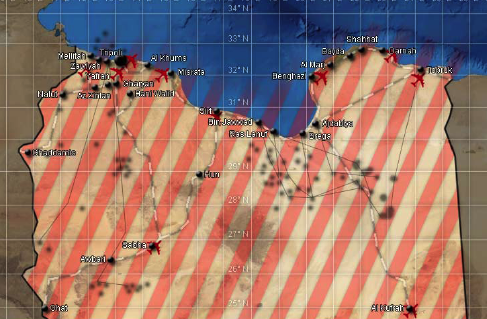 WASHINGTON, March 22 (Reuters) – The no-fly zone over Libya could end up costing the Western coalition more than $1 billion if the operation drags on more than a couple of months, defense analysts say.
Zack Cooper, a senior analyst at the Center for Strategic and Budgetary Assessments, said the initial cost of eliminating Libyan leader Muammar Gaddafi’s air defenses was likely to be between $400 million and $800 million.
The expense of patrolling the no-fly zone once it is established is likely to be $30 million to $100 million a week, he said.
The U.S. military has no official cost figures yet for the operation, which has been going on less than a week. By comparison, the much more extensive Afghan war costs more than $9 billion a month.
Some U.S. lawmakers and critics of President Barack Obama’s decision to join allies in the Libya bombing campaign have argued the United States cannot afford the operation while Congress wrangles over spending cuts and the country’s $1.48 trillion deficit.
The Pentagon already has plans to cut $78 billion in defense spending over five years and is delaying weapons programs and putting off maintenance to reduce costs.
The operation unfolding in Libya resembles a scenario for a limited no-fly zone analyzed by Cooper and his colleague Todd Harrison. The scenario assumed a limited no-fly zone covering Libya north of the 29th parallel, not the entire country.
They made their projections by computing the cost per square mile of previous no-fly zones and applying that to the situation in Libya. The price of munitions, jet fuel and maintenance were the primary cost drivers. Their figures reflected the cost over and above regular operations.
One thing Cooper and Harrison had not anticipated was significant coalition support, with allies bearing part of the expense. Cooper said it appeared the United States had flown more than half of the sorties and fired most of the Tomahawks.
“In our analysis, we assumed that the U.S. would be picking up the bulk of the cost,” he said. “So even though the U.S. has picked up more than a majority of the cost, I assume, so far, it probably hasn’t picked up as much as we estimated.”
Cooper said the Tomahawk cruise missiles fired so far by Britain and the United States cost about $200 million, putting the price for taking out Gaddafi’s air defenses on target to hit their projection.
“We estimated $400 million to $800 million. Between the Tomahawks and other munitions and flight hours and fuel, it’s probably going to be somewhere in that … range for the initial cost of suppressing the air defenses,” he said.
The crash of a U.S. F-15 warplane was an unexpected cost. Cooper said the Pentagon was unlikely to buy another F-15 and probably would replace it with a joint strike fighter, with an estimated price tag of between $100 million and $150 million.
NO ‘ROBUST ESTIMATE’
The main European countries enforcing the no-fly zone downplayed the cost of the operation. British Finance Minister George Osborne, whose government has staked its reputation on eliminating the country’s budget deficit, told Parliament to expect the cost to be in the tens of millions of pounds.
While saying it was too early for a “robust estimate” of the price of the Libya operations, Osborn projected the costs would be “modest” compared with operations like Afghanistan.
“The Ministry of Defence’s initial view is that this will be in the order of the tens of millions not the hundreds of millions of pounds,” Osborne said.
But defense analysts warned that British expenses for even a limited operation like Libya could quickly add up. Analyst Francis Tusa told BBC Radio 4 the missions flown so far cost Britain about 200,000 pounds ($325,000) per aircraft, with missiles running 800,000 pounds ($1.3 million) apiece.
With Britain flying 10 Typhoon fighters to patrol the no-fly zone, “you’ll be looking at potentially 2, 3 million pounds a day ($3.25 million to $5 million),” he said.
French analysts also attempted to downplay the expense, saying the intervention was likely to cost Britain and the United States much more since they used pricier weapons.
“It’s peanuts,” said Jean Dominique Merchet, editor of blog secretdefense on military affairs. It costs about 30,000 euros ($45,000) per hour to operate a Rafaele fighter, he said, but most would have been in the air at least an hour a day anyway.
But Pierre Tran, Paris bureau chief for specialist weekly Defense News, said even though France was using less expensive munitions, the costs would quickly begin to add up.
“If this campaign goes on for very much longer, it would be costly in terms of fuel consumed, flying hours for the pilots, and eventually munitions used,” he said. (Additional reporting by Michelle Martin and Sven Egenter in Britain and Daniel Flynn in France; Editing by Eric Walsh and Peter Cooney)


![[Most Recent Quotes from www.kitco.com]](https://i0.wp.com/www.kitconet.com/charts/metals/gold/t24_au_en_usoz_2.gif)
![[Most Recent Quotes from www.kitco.com]](https://i0.wp.com/www.kitconet.com/charts/metals/silver/t24_ag_en_usoz_2.gif)

 crisisboom
 CRISISBOOM
I think that the US should not worry about putting troops on the ground to go after Muammar Gaddafi because after his military is neutralized, the rebels will gain more confidence and be able to take him out themselves. Also, the blood of his assasination will not be on our hands even if it is a just cause. It would be much better if his own people did it. I do not believe in arming them with our weapons, but arming them with seized weapons would be ok. That includes tanks and other military vehicles recovered from Muammar Gaddafi’s military.