Archive
US raised debt ceiling 102 times – economist
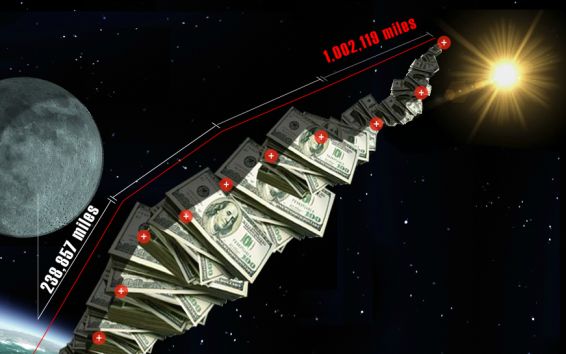 President Obama has warned the US is running out of time to deal with its financial troubles – the Congress must raise the current $14.3-trillion debt ceiling again. And as Professor Rodrigue Tremblay told RT, this has become a tradition in the US.
The US repeatedly gets away with raising the debt ceiling, Rodrigue Tremblay told RT.
“This system that the US has, has been in place since 1917. They raise the debt ceiling each year, they have done it 102 times; eight times under George W. Bush alone. Most countries do not run their Read more…
The World Says China Will Overtake America
 In the past decade, anti-Americanism grew around the world. This was in response to concerns about the unchecked global power of the U.S., when it invaded Iraq in the face of very wide international opposition. In sharp contrast, today America is seen as on its way to losing its status as the dominant global superpower.
Pentagon declares the Internet a war domain
 The Pentagon released a long-promised cybersecurity plan Thursday that declares the Internet a domain of war but does not spell out how the U.S. military would use the Web for offensive strikes.
The Defense Department’s first-ever plan for cyberspace states that DOD will expand its ability to thwart attacks from other nations and groups, beef up its cybersecurity workforce and expand collaboration with the private sector.
Like major corporations and the rest of the federal government, the military “depends on cyberspace to function,” the DOD strategy states. The U.S. military uses cyberspace for everything from carrying out military operations to sharing intelligence data internally to managing personnel assignments.
“The department and the nation have vulnerabilities in cyberspace,” the document states. “Our reliance on cyberspace stands in stark contrast to the inadequacy of our cybersecurity.”
Other nations “are working to exploit DOD unclassified and classified networks, and some foreign intelligence organizations have Read more…
Bastille Day Solar Storm: Anatomy of a Gargantuan Sun Tempest

The "Bastille Day" solar flare as seen by SOHO's EIT instrument in the 195 Å emission line. CREDIT: NASA
One of the most violent sun storms in recorded history erupted 11 years ago today (July 14).
The event was called the Bastille Day Solar Storm, and it registered as an X-class flare, the highest designation possible. (One storm since then, in October 2003, was even more powerful.)
Ever wonder just how a solar storm brews? So do scientists. Here’s a rundown of what happened on July 14, 2000, one of the sun’s most violent days:
A sunspot was born. This occurred when magnetic field lines became tangled by the  churning and shifting of plasma bubbles on the sun’s surface. These twisted magnetic field lines formed a sunspot — an active region that appeared darker than the surrounding area. [Infographic: Anatomy of Solar Storms & Flares]
As the magnetic field lines became more and more twisted, magnetic potential energy built up, similar to how a roller coaster car at the top of the track builds up gravitational potential energy, which is then converted to the kinetic energy of motion as the car zooms downward.

CREDIT: NASA/TRACE
When the magnetic potential energy of the sun finally hit a certain point, it snapped, releasing that energy in the form of heat, light and the motion of particles. Plasma on the sun was heated up to 20 million or 30 million degrees Kelvin (36 million to 54 million degrees Fahrenheit). Plasma particles were accelerated along giant loops that traced magnetic field lines down through successive layers of the sun’s atmosphere.
These loops connected to form large ribbons of superheated plasma.
At the same time, some plasma particles from the sun’s atmosphere were accelerated away from the surface, out into space. Such a release of material is called a coronal mass ejection. Many of these protons and electrons made their way to Earth, where they disrupted satellites and blocked radio communications.
Though scientists understand many aspects of the storm’s process, there are still some pressing questions. One of the biggest is: What sparked the storm in the first place? [Hell Unleashed: Sun Spits Fire in Close-Up]
“The holy grail, which is not solved yet, is, what is the actual trigger mechanism that causes this buildup of energy to be released?” said Phil Chamberlin, a solar scientist at NASA’s Goddard Space Flight Center in Greenbelt, Md.
However, the Bastille Day solar storm did go a long way toward helping scientists piece together a general theory of how eruptions on the sun occur.
“This theory is all based on observations from the Bastille Day flare,” Chamberlin told SPACE.com.
That knowledge will come in especially handy in the coming years, as the sun ramps up toward a peak in its 11-year cycle of activity. Near the end of 2013, we are likely to see storms that rival, or even surpass, the Bastille Day event.
Record heat, drought, and flooding sweeps US; food supply to take a hit
 The year 2011 is shaping up to be one of the most treacherous years in recent history, at least as far as the nation’s weather patterns are concerned. While much of the Midwestern US continues to get drenched by record rainfall and torrential flooding, the Southern US is experiencing tremendous heat and drought conditions that, combined with flood conditions to the north, will have devastating effects on the nation’s food supply.
Extreme heat threatens US agriculture
For several weeks now, extreme heat conditions have afflicted much of the Southern and Midwestern US. According to the National Weather Service, Heat Advisories and Excessive Heat Warnings have been issued in 17 different states, with temperatures soaring over 100 degrees Fahrenheit (F) in many areas, and heat indexes topping 115 degrees F (http://www.examiner.com/weather-in-…).
The 17 states under heat advisories or warnings include Mississippi, Arkansas, Louisiana, Missouri, Oklahoma, Texas, South Carolina, Georgia, Alabama, Illinois, Kansas, Nebraska, Iowa, Indiana, Ohio, Kentucky, and Tennessee. And cities that have reached record highs include Oklahoma City, Okla., at 105 degrees F, Tulsa, Okla., at 107 degrees F, Medicine Lodge, Kan., at 111 degrees F, and Columbus, Miss., at a Read more…
Earthquake-prone Iran moves nuclear enriching facilities underground

By MARY E. STONAKER
Al Arabiya
Following its discovery by US intelligence officers, Tehran has acknowledged the existence of the underground bunker at Fordow, a shelter designed to see uranium enrichment from current claims of 20 percent to the 90 percent purity required of a nuclear weapon.
The bunker is designed to withstand air and missile strikes so the mere acknowledgement of its existence does not necessarily threaten it, which is why Iran has acknowledged it publicly. Nevertheless, some experts claim that up to 90 percent of Iran is covered by fault lines, a safety risk more pronounced after the devastation at Read more…
Rising Oceans – Too Late to Turn the Tide?
(Click to enlarge) If sea levels rose to where they were during the Last Interglacial Period, large parts of the Gulf of Mexico would be under water (red areas), including half of Florida and several Caribbean islands. (Photo illustration by Jeremy Weiss)
Melting ice sheets contributed much more to rising sea levels than thermal expansion of warming ocean waters during the Last Interglacial Period, a UA-led team of researchers has found. The results further suggest that ocean levels continue to rise long after warming of the atmosphere has leveled off.
Thermal expansion of seawater contributed only slightly to rising sea levels compared to melting ice sheets during the Last Interglacial Period, a University of Arizona-led team of researchers has found.
The study combined paleoclimate records with computer simulations of Read more…
Pentagon reveals 24,000 files stolen in cyber-attack
The Pentagon has disclosed that it suffered one of its largest ever losses of sensitive data in March when 24,000 files were stolen in a cyber-attack by a foreign government.

By Nick Allen
William Lynn, the US deputy secretary of defence, said the data was taken from the computers of a corporate defence contractor.
He said the US government had a “pretty good idea” who was responsible but did not elaborate.
Many cyber-attacks in the past have been blamed on China or Russia, and one of the Pentagon’s fears is that eventually a terrorist group will acquire the ability to steal data.
Mr Lynn disclosed the March attack in a speech outlining a new cyber-strategy, which formally declares cyberspace a new warfare domain, much like air, land and sea.
It calls for developing more resilient computer networks so the Read more…
Currencies dropping like stones
 The markets have not yet thought about it, but the biggest threat to the Euro is not Greece, Ireland or Portugal, but the dangers posed by the fourth largest economy in Europe, which is also the third largest in the Eurozone, that of Italy. Italy is passing austerity measures but the measures may not be enough. The problem that the Euro faces is that there is little central control over the EU economy, control that exists affects states within Europe that have not adopted the Euro, as well as those that have.
Eleven years ago when the merits of the Euro were debated I argued against it. I was not fondly wishing to hold on to the pound sterling for sentimental reasons. I felt that there was a Read more…


![[Most Recent Quotes from www.kitco.com]](https://i0.wp.com/www.kitconet.com/charts/metals/gold/t24_au_en_usoz_2.gif)
![[Most Recent Quotes from www.kitco.com]](https://i0.wp.com/www.kitconet.com/charts/metals/silver/t24_ag_en_usoz_2.gif)

 crisisboom
 CRISISBOOM
You must be logged in to post a comment.