Archive

Archive for September, 2012

Why is Putin stockpiling gold?

September 7, 2012 Comments off

Russia is bulking up its gold reserve

By Brett Arends

I can’t imagine it means anything cheerful that Vladimir Putin, the Russian czar, is stockpiling gold as fast as he can get his hands on it.

According to the World Gold Council, Russia has more than doubled its gold reserves in the past five years. Putin has taken advantage of the financial crisis to build the world’s fifth-biggest gold pile in a handful of years, and is buying about half a billion dollars’ worth every month.

It emerged last month that financial gurus George Soros and John Paulson had also increased their bullion exposure, but it’s Putin that’s really caught my eye.

No one else in the world plays global power politics as ruthlessly as Russia’s chilling strongman, the man who effectively stole a Super Bowl ring from Bob Kraft, the owner of the New England Patriots, when they met in Russia some years ago.

Putin’s moves may matter to your finances, because there are two ways to look at gold.

On the one hand, it’s an investment that by most modern standards seems to make no sense. It generates no cash flow and serves no practical purpose. Warren Buffett has pointed out that we Read more…
Series of earthquakes jolt mountainous SW China, killing at least 50 and damaging 20,000 homes

September 7, 2012 Comments off

Associated Press

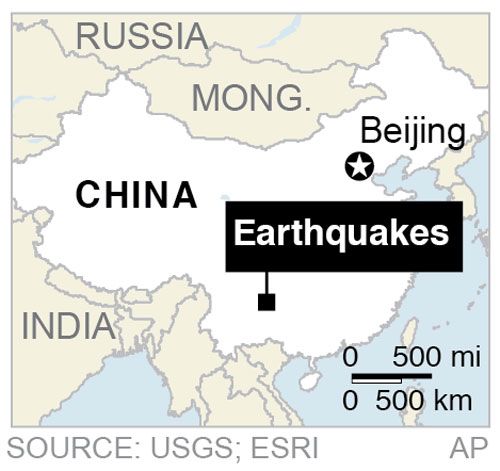
BEIJING — A series of earthquakes collapsed houses and triggered landslides in a remote mountainous part of southwestern China on Friday, killing at least 50 people with the toll expected to rise. Damage was preventing rescuers from reaching some outlying areas, and communications were disrupted.

The quakes started with a 5.6-magnitude shock before 11:30 a.m. along the borders of Guizhou and Yunnan provinces, and another equally big quake struck shortly after noon followed by more than 60 aftershocks, Chinese and U.S. government seismologists said. Though of moderate strength, the quakes were shallow, which often causes more damage.

Hardest hit was Yiliang County, where 49 of the 50 deaths occurred, said Yunnan province government agencies and state media. Another 150 people in the county were injured, said Zhang Junwei, a spokesman for the provincial seismology bureau.

China Central Television showed roads littered with rocks and boulders, and pillars of dust rising over hillcrests — signs of landslides. Footage showed a couple hundred people crowding into what looked like a school athletic field in Yiliang’s county seat, a sizeable city spread along a river in a valley bottom.

With some roads impassable, rescuers had yet to Read more…

Categories: China, Earthquake Tags: ,

Climate Change: How The Wet Will Get Wetter And The Dry Will Get Drier (Video)

September 7, 2012 Comments off

thinkprogress

How much extra energy are we putting in the atmosphere through emission of greenhouse gases? One Australian researcher put it into context: “The radiative forcing of the CO2 we have already put in the atmosphere in the last century is … the equivalent in energy terms to almost half a billion Hiroshima bombs each year.”

With more energy radiating down on the planet rather than back up into space, the planet continues to heat up. As the atmosphere warms, it is able to hold more water vapor — thus strengthening the global hydrological cycle.

With all that extra energy, more water is pulled out of the subtropic regions and moved toward higher-precipitation areas in the subpolar regions, resulting in stronger droughts and stronger storms. Or, as the video below explains, how the wet gets wetter and the dry gets drier.

Through five decades of observations and future climate modeling, the National Oceanic and Atmospheric Administration has put together this educational piece on how a warming planet will make weather more extreme: Read more…

Categories: Climate Change, world Tags:

Alabama to require biometric scans for prison visitors

September 6, 2012 Comments off

biometricupdate

fingerprint-scanning

The Alabama Department of Corrections has implemented a new policy that requires visitors to state prisons to have their fingerprint scanned before entering prison facilities. It is the first state to implement the requirement. Alabama has 29 correctional facilities with approximately 25,500 adult inmates.

Brian Corbett, the Department of Corrections spokesman said: “Our IT department came up with the idea of scanning fingerprints as part of an upgrade. We still require visitors to have a government-issued photo ID, and that requirement will remain in place. But there are times when someone else resembles the photo on an ID. Scanning the fingerprint of visitors verifies they are who they say they are.”

Corbett said scanning fingerprints makes the Read more…

Categories: Biometrics Tags: , ,

Arctic sea ice extent continues to melt below former record lows: data center

September 6, 2012 Comments off

nunatsiaqonline

Every year there's less of the multi-year, blue-tinged sea ice, like this ice seen in the Northwest Passage, in the Arctic. (PHOTO BY JANE GEORGE)
Every year there’s less of the multi-year, blue-tinged sea ice, like this ice seen in the Northwest Passage, in the Arctic. (PHOTO BY JANE GEORGE)
Arctic sea ice extent for August 2012 was 4.72 million sq. km.The magenta line shows the 1979 to 2000 median extent for that month. The black cross indicates the geographic North Pole. (IMAGE COURTESY OF THE NSIDC)

Following the new record low Arctic sea ice extent recorded Aug. 26, ice coverage has continued to drop and has now shrunk to less than four million square kilometres — smaller than the previous low extent of 2007.

Compared to September conditions in the 1980s and 1990s, the Arctic sea ice extent has dropped by 45 per cent, the Colorado-based National Snow and Ice Data Center said Sept. 5.

And that skimpy sea ice cover is likely to get lower yet, because Read more…

DARPA “Emergency Response” Robot Runs Faster Than Usain Bolt

September 6, 2012 1 comment

prisonplanet.com

Machines to be used for “defense missions”

Paul Joseph Watson
Prison Planet.com
Thursday, September 6, 2012

One of the robots under development by DARPA for the purpose of “emergency response” and humanitarian missions has beaten the human world speed record set in 2009 by athlete Usain Bolt.

“The Defense Advanced Research Project’s (DARPA) Cheetah managed to reach 28.3 mph, said the agency on Sept. 5. The speed is a little faster than the fastest human, Usain Bolt, who set the human world speed record when he reached a peak speed of 27.78 mph in 2009 during a100 meter sprint. The Cheetah robot had already attained the record as the fastest robot on earth when it clocked in 18 Mph earlier in its development,” reports Government Security News.

Cheetah’s advantage versus other robots when it comes to emergency response, humanitarian missions and “other defense missions,” is that it legs enable it to Read more…

Categories: Technology Tags: , ,

Statisticians Calculate Probability Of Another 9/11 Attack

September 6, 2012 Comments off

technologyreview

According to the statistics, there is a 50 per cent chance of another catastrophic terrorist attack within the next ten years

Earthquakes are seemingly random events that are hard to predict with any reasonable accuracy. And yet geologists make very specific long term forecasts that can help to dramatically reduce the number of fatalities.

For example, the death toll from earthquakes in the developed world, in places such as Japan and New Zealand, would have been vastly greater were it not for strict building regulations enforced on the back of well-founded predictions that big earthquakes were likely in future.

The problem with earthquakes is that they follow a power law distribution–small earthquakes are common and large earthquakes very rare but the difference in their power is many orders of magnitude.

Humans have a hard time dealing intuitively with these kinds of statistics. But in the last few decades statisticians have learned Read more…

Categories: Coming Events Tags: ,

Seven corporations lobbying against GMO labeling

September 6, 2012 Comments off

thisdishisvegetarian

On Nov. 6 of this year, California voters will have the opportunity to vote on Proposition 37, which would mandate the labeling of genetically-engineered foods. However, mega-corporations such as Monsanto, joined in the fight by several additional key players, are passionately battling this bid for transparency.

Those additional key players include familiar names such as:

1. Naked Juice — owned by PepsiCo — which has donated $1.7 million to Monsanto’s efforts

PepsiCo sodas rely heavily on an ingredient known as high-fructose corn syrup (HFCS), and considering the bulk of corn used in this process is GMO, PepsiCo’s interest in maintaining the status quo makes perfect sense (just imagine the blow to profits PepsiCo would suffer if every can of Pepsi came labeled with a GMO warning).

2. Honest Tea, Odwalla, and Simply Orange — owned by Coca-Coladonated another million dollars

3. Alexia and Lightlife — owned by ConAgradonated more than $1 million

4. Kashi, Gardenburger, and Morningstar Farms — owned by Kelloggdonated more than $600,000

When the Cornucopia Institute tested Kashi’s “Go Lean” cereal, they found that the added soy was 100 percent genetically Read more…

Drought Hits U.S. Midwest Hard

September 6, 2012 Comments off

neiuindependent.com

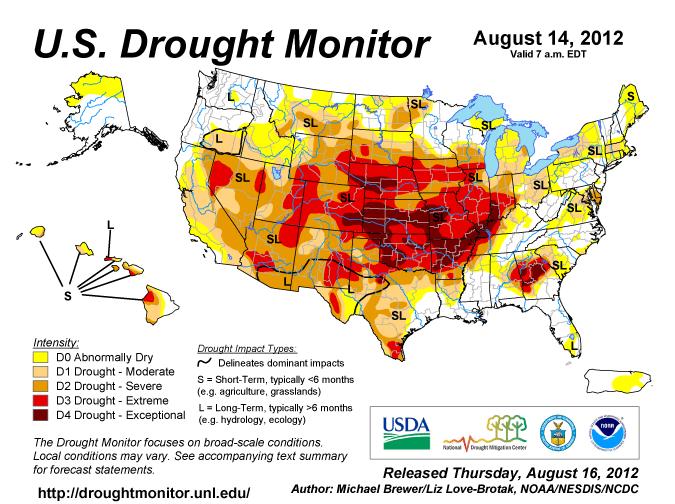
  This summer, the United States experienced one of the worst droughts in history since the dustbowl. Farms went weeks on end without a drop of rain, particularly in the Midwest and, combined with high temperatures, resulted in a significant drop in harvest-ready plants. The drought affected numerous parts of the nation’s industrial sector as well as countries outside of the U.S. The United States has ample agriculture, if one part of the U.S. is experiencing drought and crop loss problems, then the whole food industry suffers as a result. While droughts are not uncommon, this summer the drought conditions were felt all over the United States, leaving almost all farms affected. As the image shows, the majority of the United States experienced at least an abnormal dryness level. The Midwest and Southwestern parts of the United States were particularly hard-hit, experiencing severe to exceptional drought conditions.

The drought conditions were persistent and occurred during the maturing and harvesting periods of the country’s most important crops- corn. The USDA estimated the drought damaged crops enough to lower corn production to by 13 percent when compared to 2011 crop numbers. Corn and its by-products, is used for wheat in food, fertilizer, ethanol, beverages, animal feed and biodegradable plastics. Director of the Agricultural Entrepreneurship Initiative at the University of Iowa and Agricultural Economist Kevin Kimle explained that “corn matures by about Labor Day, but what happens in dry conditions is it Read more…

Cutting Down Rainforests Also Cuts Down on Rainfall

September 6, 2012 2 comments

cientificamerican

As the Amazon rainforest disappears, rainfall falters over a much wider area

By Lauren Morello and ClimateWire

Slash and burn agriculture in the Amazon RAIN MAKER: Cutting down trees in the Amazon rainforest also reduces rainfall over the region. Image: flickr/Threat to Democracy

When Amazon rainforest disappears, so does Amazon rain.

That’s the conclusion of new research that shows deforestation can significantly reduce tropical rainfall far from the area where trees have been cut down.

That’s because air passing over forests picks up moisture given off by trees and plants, fueling rains. When those trees disappear, so does some of that rain.

“What we found was this really strong impact — air that traveled over a lot of forest brought a lot more rain than air that didn’t travel over very much forest,” said lead author Dominick Spracklen of the University of Leeds.

His research, published yesterday in the journal Nature, helps reconcile a situation that has puzzled scientists.

Climate models project that Amazon deforestation would reduce rainfall regionally. But limited observations show that rainfall in deforested areas is higher than in areas where the rainforest is still intact.

(Scientists believe that when trees are cut down, the bare surfaces left behind absorb more Read more…