Archive
Nearby Star May Have 9 Planets
 |
|
Artist’s impression of a planetary system around the star HD 10180. The large crescent is the third world in the system (HD 10180d), which is comparable to the planet Neptune in mass. The two inner planets appear as silhouettes in transit across the bright disc of the star. The outer planets in the system appear in the background sky. Credit: ESO/L. Calçada
|
HD 10180 is a star that’s nearly the Sun’s twin: it’s very close in mass, temperature, brightness, and even chemical content of our friendly neighborhood star. But in this case of stellar sibling rivalry, HD 10180 may have the upper hand: a new analysis of observations of the star indicate it may have nine planets!
In a new report accepted for publication in the journal Astronomy and Astrophysics, an astronomer re-analyzed data of the star taken with the High Accuracy Radial Velocity Planet Searcher (HARPS), an exquisitely high-precision camera mounted on a 3.6 meter telescope in Chile. HARPS has been observing HD 10180 for years; the star is a mere 130 light years away, making it bright and easy to study. The observations look to see if the star exhibits a periodic shift in its light: a Doppler shift as planets circle it, tugging it one way and another.
Six clear Doppler shift signals were found in the original analysis: six planets, five of which have masses ranging from 12 – 25 times that of the Earth (making them more like Neptune than our own comfortable planet), and a sixth that was bigger yet, 65 Read more…
Scientists baffled to discover that Venus’ spin is slowing down
Why is Venus rotating 6.5 minutes slower than it was just 16 years ago?
 Photo: Forsetius/Flickr
Newly discovered asteroid will not ANNIHILATE THE EARTH
A panic-inducing asteroid, catchily named 2012 DA14, will not obliterate all life on Earth when it swings very close by in early 2013 – BUT it might do the next time it pops round.
The European Space Agency said today that although the space rock will miss our planet this time, it won’t be by much, which goes to show how important it is for folks to be watching the sky.

The asteroid is due to whiz by at a distance of just 24,000km, closer than many commercial satellites, and it’ll be back again soon.
“A preliminary orbit calculation shows that 2012 DA14 has a very Earth-like orbit with a period of 366.24 days, just one more day than our terrestrial year, and it ‘jumps’ inside and outside of the path of Earth two times per year,” said Jaime Nomen, one of the discoverers of the rock. The astroid was spotted by the La Sagra Sky Survey observatory in Spain in February this year.
Despite how often 2012 DA14 comes through the neighbourhood, the rock hadn’t been seen before because of its relatively small size – 50m – and unusual orbit.
“Considering its path in the morning sky, its rather
New ‘waterworld’ planet revealed by Hubble

GJ1214b, shown in this artist's view, is a super-Earth orbiting a red dwarf star 40 light-years from Earth. New observations from the NASA/ESA Hubble Space Telescope show that it is a water world enshrouded by a thick, steamy atmosphere. GJ 1214b represents a new type of planet, like nothing seen in the solar system or any other planetary system currently known. (Photo Credit: NASA, ESA, and D. Aguilar (Harvard-Smithsonian Center for Astrophysics))
An international team of astronomers led by Zachory Berta of the Harvard-Smithsonian Center for Astrophysics (CfA) made the observations of the planet GJ 1214b.
“GJ 1214b is like no planet we know of,” Berta said. “A huge fraction of its mass is made up of water.”
The ground-based MEarth Project, led by CfA’s David Charbonneau, discovered GJ 1214b in 2009. This super-Earth is about 2.7 times Earth’s diameter and weighs almost seven times as much. It orbits a red-dwarf star every 38 hours at a distance of 2 million kilometres, giving it an estimated temperature of 230 degrees Celsius.
In 2010, CfA scientist Jacob Bean and colleagues reported that they had measured the atmosphere of GJ 1214b, finding it likely that it was composed mainly of water. However, their observations could also be explained by Read more…
The strange haze of the Milky Way galaxy
New images from the European Space Agency’s Planck mission have revealed previously undiscovered islands of star formation, along with a mysterious haze of microwave emissions in our Milky Way galaxy.
“The images reveal two exciting aspects of the galaxy in which we live,” explained Planck scientist Krzysztof M. Gorski from NASA’s Jet Propulsion Laboratory in Pasadena, Calif., and Warsaw University Observatory in Poland.
 ”They show a haze around the center of the galaxy, and cold gas where we never saw it before.”
To be sure, the new images depict the entire sky, which is dominated by the murky band of our Milky Way galaxy.
One of them shows the unexplained haze of microwave light – which was previously hinted at in measurements by NASA’s Wilkinson Microwave Anisotropy Probe (WMAP).
“The haze [originates] from the region surrounding the center of our galaxy and looks like Read more…
Earth twin discovered 22 light-years away
The Kepler mission initiated to find habitable Earth-like planets near our own has turned up another candidate for places we might visit in the future: GJ 667Cc. This planet has an orbital period of about 28 days regularly and has a mass that’s at least 4.5 larger than Earth. This planet is neither too hot nor too cold for liquid water to exist on the surface, and it sits aside two or three additional planets that may well be similar enough to also be Earth candidates. This newest discovery was made by astronomers from UC Santa Cruz Steven Vogt and Eugenio Rivera, lead by Guillem Anglada-Escudé and Paul Butler of the Carnegie Institution for Science.

The host star in this system is called GJ 667C and is an M-class dwarf star. Two more stars sit in the Read more…
“NASA Satellite Detects Alien Atoms” –Different from Chemical Composition of Our Solar System
NASA’s Interstellar Boundary Explorer, the centerpiece of a $169 million mission mapping the frontier of the sun’s influence, has detected atoms from interstellar space streaming by Earth, that are different from the chemical make-up of the solar system, scientists announced Tuesday.
The IBEX satellite observed hydrogen, oxygen, neon and helium atoms that originated in interstellar space, the vacuous medium between stars in the Milky Way galaxy and found 74 oxygen atoms for every 20 neon atoms in the interstellar material, compared with 111 oxygen atoms for every 20 neon atoms inside the solar system. Most of the interstellar medium is made up of hydrogen and helium. Heavier elements, such as oxygen and neon, are spread by exploding supernovae at the end of a star’s life cycle, according to NASA.
“We’ve directly measured four separate types of atoms from interstellar space and the composition just doesn’t match up with what we see in the solar system,” said Eric Christian, IBEX mission scientist at NASA’s Goddard Space Flight Center in Greenbelt, Md. “IBEX’s observations shed a whole new light on the mysterious Read more…
The Milky Way Contains At Least 100 Billion Planets According to Survey
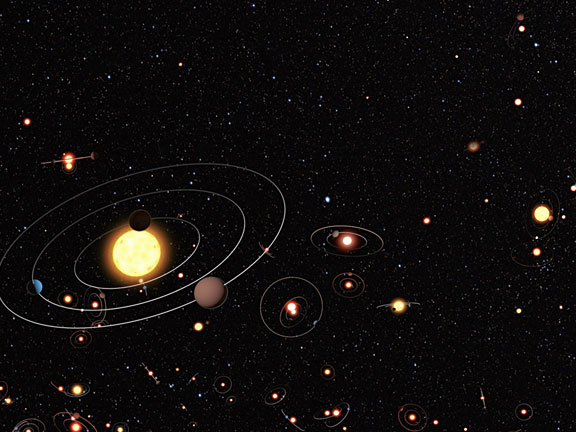 Our Milky Way galaxy contains a minimum of 100 billion planets according to a detailed statistical study based on the detection of three extrasolar planets by an observational technique called microlensing.
Kailash Sahu, of the Space Telescope Science Institute in Baltimore, Md., is part of an international team reporting today that our galaxy contains a minimum of one planet for every star on average. This means that there should be a minimum of 1,500 planets within just 50 light-years of Earth.
The results are based on observations taken over six years by the PLANET (Probing Lensing Anomalies NETwork) collaboration, which Sahu co-founded in 1995. The study concludes that there are far more Earth-sized planets than bloated Jupiter- sized worlds. This is based on calibrating a planetary mass function that shows the number of planets increases for lower mass worlds. A rough estimate from this survey would point to Read more…
Launch of ‘Bullets’ In A Black Hole’s Jet
nanopatentsandinnovations.blogspot.com
Unexplained Object Near Sun Appears To Be Heading Towards Earth
Please view this video full screen so that you can see what I am pointing out. Here is visual proof that there is something in front of our sun between us and it. Everyday it is getting closer and now you can actually see there is seven or more objects orbiting the larger dwarf star.


![[Most Recent Quotes from www.kitco.com]](https://i0.wp.com/www.kitconet.com/charts/metals/gold/t24_au_en_usoz_2.gif)
![[Most Recent Quotes from www.kitco.com]](https://i0.wp.com/www.kitconet.com/charts/metals/silver/t24_ag_en_usoz_2.gif)

 crisisboom
 CRISISBOOM
You must be logged in to post a comment.