Archive
Cosmic Turnaround As Earth Tracks Trojan Asteroid

Astronomers have discovered the first known “Trojan” asteroid orbiting the sun along with Earth.
The 300-metre-wide (1,000 ft) asteroid is located approximately 50 million miles (80 million kilometres) from earth and was discovered by astronomers studying observations taken by NASA’s Wide-field Infrared Survey Explorer (WISE) mission.
The asteroid’s orbit is well-defined and for at least the next 100 years, it will not come closer to Earth than 15 million miles (24 million kilometres).
The findings will be published in the July 28 issue of the journal Nature.
Trojans are asteroids that share an orbit with a planet near stable points in front of or behind the planet. Because they constantly lead or follow in the same orbit as the planet, they never can collide with it. In our solar system, Trojans also share orbits with Neptune, Mars and Jupiter. Two of Saturn’s moons share orbits with Trojans.
Scientists had predicted Earth should have Trojans, but they have been difficult to find because Read more…
Farthest, Largest Water Mass In Universe Discovered

Hubble Telescope Finds Adorably Tiny Fourth Moon Orbiting Pluto

Peering at Pluto in preparations for a satellite visit in 2015, the Hubble Space Telescope has spotted a fourth moon orbiting the dwarf planet. The wee moon doesn’t even have a name yet — it’s called P4 for now — and its estimated diameter is between 8 and 21 miles.
That’s right, Hubble spotted something the size of a city from a distance of more than 3 billion miles away.
Pluto’s new moon is smaller than the dwarf planet’s other companions; the big one, Charon, is 648 miles across, and the other moons, Nix and Hydra, are in the range of 20 to 70 miles in diameter, according to NASA. Hubble discovered those moons back in 2005.
P4 is located between the orbits of Nix and Hydra. Hubble’s Wide Field Camera 3 ultraviolet visible instrument, which was installed on the telescope’s final servicing missiontwo years ago, first picked it up on June 28, and then confirmed it in follow-up pictures taken July 3 and July 18. It may appear as a faint smudge in images from 2006, NASA reports, but no one noticed because it was too obscured. This recent set of Read more…
Comet’s Death by Sun Photographed for First Time
 |
| The Solar Dynamics Observatory AIA imager (observing in extreme ultraviolet light) actually spotted a sun-grazing comet as it disintegrated over about a 15 minute period (July 6, 2011), something never observed before. The angle of the comet’s orbit brought it across the front half of the Sun. Given the intense heat and radiation, the comet simply evaporated away completely. The comet was probably a member of the Kreutz sun-grazer family. CREDIT: NASA/SDO/AIA |
The death of a comet that plunged into the sun was captured on camera this month for the first time in history, scientists say.
The comet met its fiery demise on July 6 when it zoomed in from behind the sun and melted into oblivion as it crashed into the star. It was NASA’s Solar Dynamics Observatory (SDO), a satellite orbiting Earth that studies the sun, which witnessed the comet’s death-blow.
One of the SDO spacecraft’s high-definition imagers “actually spotted a sun-grazing comet as it disintegrated over about a 15 minute period (July 6, 2011), something never observed Read more…
Elenin 7/7/11 Saturn Megastorm
io9.com
 Check out the most intense Saturn storm that the Cassini spacecraft has ever recorded. You can see it overtaking its own tail as it zooms around Saturn’s Northern hemisphere. (The tail is the blue clouds to the South and West.)
The storm started months ago, and is still active today. The storm’s surface area is eight times the surface area of our own planet. And at its most intense, the storm has generated more than 10 lightning flashes per second. It covers 500 times the area of the largest of the Southern hemisphere storms Cassini has observed — there were several storms in the Southern region scientists dubbed “storm alley,” but the hemispheres flipped around August 2009, when the Northern hemisphere began experiencing spring.
Says Georg Fischer, the lead author of a paper about this new storm:
This storm is thrilling because it shows how shifting seasons and solar illumination can dramatically stir up the weather on Saturn. We have been observing storms on Saturn for almost seven years, so tracking a storm so different from the others has put us at the edge of our seats. Read more…
Mars is left behind, Earth is ahead!
 L. Elenin / ISON-NM observatory
At the end of June 2011, Comet Elenin will cross the orbit of the fourth planet of the Solar System – Mars. It must be noted that from April to June, the comet did not come closer to the Earth, but moved “parallel” with it. Right at the beginning of July, the comet will begin to very quickly move toward our planet. I again want to emphasize, the comet will pass 35 million kilometers from the Earth. It is an absolutely safe distance, just a little closer to the Earth than the second planet, Venus, comes.
At left you can see an image of the comet taken June 21th at our observatory. In the earthly sky the comet is quite close to the Sun, and soon it will be impossible to observe – it will be hidden the rays of the setting Sun. C/2010 X1 (Elenin) will not emerge from solar conjunction until the beginning of October, when it will be visible in binoculars and maybe even with the unaided eye.
Unidentified Object @ Antarctica’s Neumayer Station 061811- 062011
These are recent photos from the Antarctica Neumayer Station on 6/18/11 – 6/20/11.
http://www.antarcticconnection.com/antarctic/stations/neumayer.shtml
This object would confirm what we are seeing at 2:57 in this video…
http://www.youtube.com/watch?v=hUiKzdLb7Yc
Please take a look. This video confirms what we are seeing in the Antarctic.
These new photos have me extremely puzzled and concerned. We’ve identified the moon and the location of the Sun, but there is another large Read more…
Britain in list of countries ‘most at risk’ if an asteroid strikes
Britain has been identified among a host of countries scientists believe would be worst affected in the event of an asteroid strike.

Experts at Southampton University have drawn up a league table of countries most likely to suffer severe loss of life or catastrophic damage should a large asteroid hit Earth.
The list is largely made up of developed nations including China, Japan, the United States and Italy, on the basis that the size of their populations would mean millions of deaths.
The US, China, Indonesia, India and Japan are most in danger on this basis. Canada, the US, China, Japan and Sweden are rated most at risk in terms of potential damage to their infrastructure.
The report comes after a rock the size of a house came within 7,500 miles of Earth earlier this Read more…
Scientists discover brightest, earliest quasar
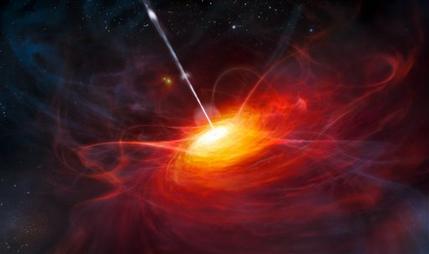
LOS ANGELES (AP) — A team of European astronomers, glimpsing back in time to when the universe was just a youngster, says it has detected the most distant and earliest quasar yet.
Light from this brilliant, starlike object took nearly 13 billion years to reach Earth, meaning the quasar existed when the universe was only 770 million years old – a kid by cosmic standards. The discovery ranks as the brightest object ever found.
To scientists’ surprise, the black hole powering this quasar was 2 billion times more massive than the sun. How it grew so bulky so early in the universe’s history is a mystery. Black holes are known to feed on stars, gas and other matter, but their growth was always thought to be slow.
The discovery was reported in Thursday’s issue of the journal Nature.
Since quasars are so luminous, they guide astronomers studying the conditions of Read more…


![[Most Recent Quotes from www.kitco.com]](https://i0.wp.com/www.kitconet.com/charts/metals/gold/t24_au_en_usoz_2.gif)
![[Most Recent Quotes from www.kitco.com]](https://i0.wp.com/www.kitconet.com/charts/metals/silver/t24_ag_en_usoz_2.gif)

 crisisboom
 CRISISBOOM
You must be logged in to post a comment.