Archive
USDA Wants RFID Tracking Technology To Be Mandatory In US Food Stamp Program
 (NTEB) “And he causeth all, both small and great, rich and poor, free and bond, to receive a mark in their right hand, or in their foreheads: And that no man might buy or sell, save he that had the mark, or the name of the beast, or the number of his name.” (Revelation 13:16-17)
In a little while, the above scene in Revelation 13 will become a global reality. People can no longer buy or sell without the mark of the beast. And sometimes that would mean no longer being able to eat!
The USDA is now considering biometric identification for all individuals who will want to benefit from their Food and Nutrition Services. The RFID chip may just soon be a must for everyone who does Read more…
Ecuador Implements “World’s First” Countrywide Facial- and Voice-Recognition System

Rafael Correa, the president of Ecuador
Photo by ERNESTO BENAVIDES/AFP/Getty Images
The United States is often considered a world leader when it comes to deploying the latest biometric security and surveillance technologies. But it could have an unlikely new competitor: Ecuador.
According to Russian company the Speech Technology Center, the small Latin American country has successfully completed installation of “the world’s first biometric identification platform, at a nation-wide level, that combines voice and face identification capabilities.”
As I reported back in September, Speech Technology Center operates under the name SpeechPro in the United States. The company’s controversial technology enables authorities to build a massive database containing several million “voiceprints” of known criminals, suspects, or persons of interest. When authorities want to ID speakers on an intercepted Read more…
Indonesia advances world’s most ambitious biometric-based national identity card project
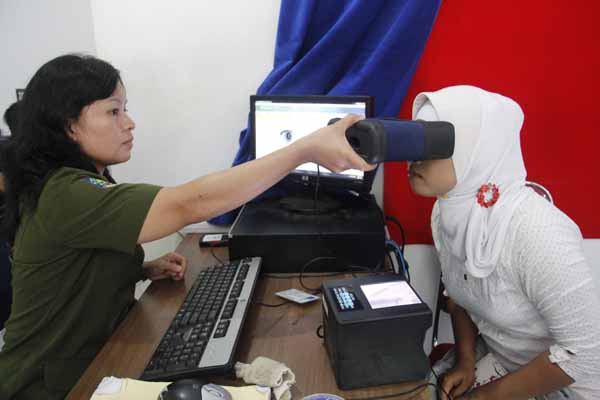 Tampa — You might not guess that Indonesia, a large country that’s basically an archipelago of over 70,000 islands that has infrastructure issues in electricity and limited bandwidth, is the nation rolling out the world’s most ambitious biometrics-based national identity card project for its citizens. But it is.
Indonesia is spending $600 million on a project to give 172 million residents a national identity card that will be used for a wide range of purposes, including proving identity for voter registration, passport issuance, tax and financial matters, and much more. This electronic national identity card , called the e-KTP, is a government effort to get millions of citizens to enroll at registration centers where their fingerprint, iris and face are captured as images through biometric equipment and personal information stored as a record associated with each electronic identity card. According to Dr. Husni Fahmi, who heads up the e-KTP project in Indonesia, the hope is all will be in place before the next election in 2014.
“It’s a national ID and Read more…
Smile, the Government Is Watching: Next Generation Identification
“You had to live—did live, from habit that became instinct—in the assumption that every sound you made was overheard, and, except in darkness, every movement was scrutinized.”—George Orwell, 1984
 Brace yourselves for the next wave in the surveillance state’s steady incursions into our lives. It’s coming at us with a lethal one-two punch.
To start with, there’s the government’s integration of facial recognition software and other biometric markers into its identification data programs. The FBI’s Next Generation Identification (NGI) system is a $1 billion boondoggle that is aimed at dramatically expanding the government’s current ID database from a fingerprint system to a facial recognition system. NGI will use a variety of biometric data, cross-referenced against the nation’s growing network of surveillance cameras to not only track your every move but create a permanent “recognition” file on you within the government’s massive databases.
By the time it’s fully operational in 2014, NGI will serve as a vast data storehouse of “iris scans, photos searchable with face recognition technology, palm prints, and measures of gait and voice recordings alongside records of fingerprints, scars, and tattoos.” One component of NGI, the Universal Face Workstation, already contains some Read more…
Biometric IDs A Step Toward EU – Ukraine Visa Simplicity

Biometric IDs in Ukraine appear to be on the way in. A draft law there providing for the creation of a unified state register of every Ukrainian citizen has passed fist scrutiny there. Reportedly a measure to beef up border security between Ukraine and the EU, citizens traveling abroad may feel a bit like Big Brother is watching via a built-in proximity chip keeping tabs on each citizen.
Officials in favor of the new Biometric IDs claim this document standard will go a long way toward preventing IS fraud, helping out the border control end of travel in the country. Claiming accessibility for all relevant European services and institutions, proponents say the action plan for visa liberalization is the central reason for the new initiative.
With the EU planning to Read more…
FBI launches $1 billion nationwide facial recognition system

The US Federal Bureau of Investigation has begun rolling out its new $1 billion biometric Next Generation Identification (NGI) system. In essence, NGI is a nationwide database of mugshots, iris scans, DNA records, voice samples, and other biometrics, that will help the FBI identify and catch criminals — but it is how this biometric data is captured, through a nationwide network of cameras and photo databases, that is raising the eyebrows of privacy advocates.
Until now, the FBI relied on IAFIS, a national fingerprint database that has long been due an overhaul. Over the last few months, the FBI has been pilot testing a facial recognition system — and soon, detectives will also be able to search the system for other biometrics such as DNA records and iris scans. In theory, this should result in much faster positive identifications of criminals and fewer unsolved cases.
According to New Scientist, facial recognition systems have reached the point where they can Read more…
Alabama to require biometric scans for prison visitors

The Alabama Department of Corrections has implemented a new policy that requires visitors to state prisons to have their fingerprint scanned before entering prison facilities. It is the first state to implement the requirement. Alabama has 29 correctional facilities with approximately 25,500 adult inmates.
Brian Corbett, the Department of Corrections spokesman said: “Our IT department came up with the idea of scanning fingerprints as part of an upgrade. We still require visitors to have a government-issued photo ID, and that requirement will remain in place. But there are times when someone else resembles the photo on an ID. Scanning the fingerprint of visitors verifies they are who they say they are.”
Corbett said scanning fingerprints makes the Read more…
Minority Report: Fiction Has Become Reality
“The Internet is watching us now. If they want to. They can see what sites you visit. In the future, television will be watching us, and customizing itself to what it knows about us. The thrilling thing is, that will make us feel we’re part of the medium. The scary thing is, we’ll lose our right to privacy. An ad will appear in the air around us, talking directly to us.”—Steven Spielberg
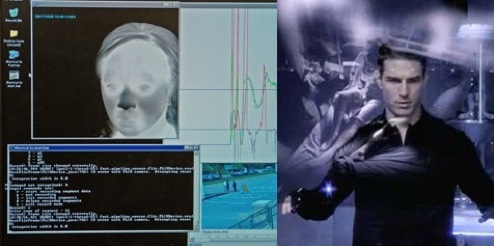 It was a mere ten years ago that Steven Spielberg’s action film Minority Report, based on a short story by Philip K. Dick, offered movie audiences a special effect-laden techno-vision of a futuristic world in which the government is all-seeing, all-knowing and all-powerful. And if you dare to step out of line, dark-clad police SWAT teams will bring you under control.
The year is 2054. The place is Washington, DC. Working in a city in which there has been no murder committed in six years—due in large part to his efforts combining widespread surveillance with behavior prediction technologies—John Anderton (played by Tom Cruise), Chief of the Department of Pre-Crime in Washington, DC, uses precognitive technology to capture would-be criminals before they can do any damage—that is, to prevent crimes before they happen. Unfortunately for Anderton, the technology, which proves to be fallible, identifies him as the next would-be criminal, and he flees. In the ensuing chase, Anderton finds himself not only attempting to prove his innocence but forced to take drastic measures in order to avoid capture in a surveillance state that uses biometric data and sophisticated computer networks to track its citizens.
Seemingly taking its cue from science fiction, technology has moved so Read more…
UK nightclub uses biometrics to control entry

The Underground, a nightclub in Dundee, Scotland, recently installed biometric fingerprint scanners for first time visitors to prove they are of age to enter. For subsequent visits, customers of the nightclub are identified by scanning their fingerprint.
The club is run by G1 Group PLC, who introduced the Scannet ID Scan system after a successful trial period in its Glasgow club. Scannet ID Scan is used to verify that identification presented is real.
Fingerprints gathered, together with photo-based profiles, are stored in computers in the club. Having this technology makes it easier for the management to identify troublemakers, and scan foreign passports and driving licenses before allow entry to the club.
A spokeswoman from G1 Group said : “The system recognizes most international passports and driving licenses, meaning we can Read more…
Eye movement biometrics
phys.org
 A biometric security system based on how a user moves their eyes is being developed by technologists in Finland. Writing in the International Journal of Biometrics, the team explains how a person’s saccades, their tiny, but rapid, involuntary eye movements, can be measured using a video camera. The pattern of saccades is as unique as an iris or fingerprint scan but easier to record and so could provide an alternative secure biometric identification technology. Martti Juhola of the University of Tampere and colleagues point out that fingerprint and face recognition are perhaps the most usual biometric means to verify identity for secure access to buildings and computer resources and even at international borders. Other techniques such as iris scanning are also occasionally used in some circumstances. The most obvious disadvantage of such biometrics is that they might be forged through the use of an Read more…

![[Most Recent Quotes from www.kitco.com]](https://i0.wp.com/www.kitconet.com/charts/metals/gold/t24_au_en_usoz_2.gif)
![[Most Recent Quotes from www.kitco.com]](https://i0.wp.com/www.kitconet.com/charts/metals/silver/t24_ag_en_usoz_2.gif)

 crisisboom
 CRISISBOOM
You must be logged in to post a comment.