Archive

Archive for the ‘Earth’ Category

Lost in migration: Earth’s magnetic field overdue a flip

August 9, 2013 Comments off

gmanetwork.com

LONDON – The discovery by NASA rover Curiosity of evidence that water once flowed on Mars—the most Earth-like planet in the solar system—should intensify interest in what the future could hold for mankind.

The only thing stopping Earth having a lifeless environment like Mars is the magnetic field that shields us from deadly solar radiation and helps some animals migrate, and it may be a lot more fragile and febrile than one might think.

Scientists say earth’s magnetic field is weakening and could all but disappear in as little as 500 years as a precursor to flipping upside down.

It has happened before—the geological record suggests the magnetic field has reversed every 250,000 years, meaning that, with the last event 800,000 years ago, another would seem to be overdue.

“Magnetic north has migrated more than 1,500 kilometres over the past century,” said Conall Mac Niocaill, an earth scientist at Oxford University. “In the past 150 years, the strength of Read more…

Categories: Earth, Earth changes Tags: ,

Sun’s magnetic field flip raises EMP threat

August 8, 2013 Comments off

wnd.com

SunMagnetic

WASHINGTON – The sun is about to flip its magnetic field, at the peak of its 11-year solar cycle or at the half-way point of what scientists call a solar maximum – when it is at its most violent in terms of solar flares and the Earth is most vulnerable to an electromagnetic pulse.

That’s the surge of sun energy that scientists say could in an instant return the developed world to an agrarian society, essentially without any electronics, and leave millions dead.

This mid-way point is expected in about four months – a December/January time frame – putting Earth in a position of greatest vulnerability even as the solar maximum diminishes well into 2014.

Scientists for the National Aeronautics and Space Administration, or NASA, have said the sun will reach its most intense period this year and well into next.

Others have suggested that even until 2020 Earth still could be exposed to solar flares that if they hit Earth directly could knock out the U.S. national grid system and fry electronic components and automated control systems not only in the U.S. but in other industrialized countries.

“It looks like we’re no more than three to four months away from a complete Read more…

Gang Of Asteroids Approach Earth? Russian Meteor May Have Followers On Same Path

August 6, 2013 Comments off

beforeitsnews.com

According to this video just released by Russia Today, the Russian meteor from earlier in the year has a gang of followers, possibly on the very same path, now approaching Earth. Is THIS what all the FEMA preparation is REALLY about? If RT knows this, the US government would have to know this too, no? Why haven’t they told us anything?

Categories: Earth, Russia Tags: , , ,

Giant Blob At Earth’s Core Will Cause Most Cataclysmic Kind Of Volcanic Eruption Says Utah Seismologist

February 10, 2013 Comments off

nanopatentsandinnovations.blogspot.com

A University of Utah seismologist analyzed seismic waves that bombarded Earth’s core, and believes he got a look at the earliest roots of Earth’s most cataclysmic kind of volcanic eruption. But don’t worry. He says it won’t happen for perhaps 200 million years.

“What we may be detecting is the start of one of these large eruptive events that – if it ever happens – could cause very massive destruction on Earth,” says seismologist Michael Thorne, the study’s principal author and an assistant professor of geology and geophysics at the University of Utah.

But disaster is “not imminent,” he adds, “This is the type of mechanism that may generate massive plume eruptions, but on the timescale of 100 million to 200 million years from now. So don’t cancel your cruises.” This map shows Earth’s surface superimposed on a depiction of what a new University of Utah study indicates is happening 1,800 miles deep at the boundary between Earth’s warm, rocky mantle and its liquid outer core. Using seismic waves the probe Earth’s deep interior, seismologist Michael Thorne found evidence that two continent-sized piles of rock are colliding as they move atop the core. The merger process isn’t yet complete, so there is a depression or hole between the merging piles. But in that hole, a Florida-sized blob of partly molten rock – called a “mega ultra low velocity zone” – is forming from the collision of smaller blobs on the edges of the continent-sized piles. Thorne believe this process is the beginning stage of massive volcanic eruptions that won’t occur for another 100 million to 2100 million years.

Photo Credit: Michael S. Thorne, University of Utah

The new study, set for Read more…

Earth Collided Head-On With Comet In January

February 9, 2013 Comments off

nanopatentsandinnovations.blogspot.com

Night turned briefly into day over a wide area in California and Nevada at 5:21:44 a.m. PST on Thursday morning January 17th, creating hopes of another extraterrestrial surprise delivery of meteorites, but this bright fireball did not drop meteorites on the ground. This was a head-on collision with a small perhaps 1-meter sized comet, rather than the glancing blow of a stronger asteroid. The comet matter was almost instantly turned into dust and gas.

Sunnyvale record of the January 17 fireball. The beginning of the meteor trajectory is visible right of the bright flash that originated well below the field of view.

Jan 17 fireball
Credit: SETI

The fireball that lit up the predawn Northern California sky in late January was a small comet that hit Earth head-on when Read more…

Galactic Cosmic Ray Volleys: A Coming Global Disaster (Video)s

April 18, 2012 Comments off

starburstfound.org

This is a very interesting interview with Dr. Paul LaViolette regarding the superwave theory.  The interview is pretty lengthy, however, it provides much insight on how our position in the Milkyway Galaxy will affect us. 

Galactic core outbursts are the most energetic phenomenon taking place in the universe. During the early 60′s astronomers began to realize that the massive object that forms the core of a spiral or giant elliptical galaxy periodically becomes active spewing out a fierce barrage of cosmic rays with a total energy output equal to hundreds of thousands of supernova explosions(1, 2). The cosmic ray electron component of such an outburst is always accompanied by synchroton emission which consists of electromagnetic radiation ranging from Read more…

‘The Great Acceleration’ And The State Of The Planet: Ominous Outlook

March 27, 2012 Comments off

nanopatentsandinnovations

Scientists describe humanity’s global impact as ‘The Great Acceleration’ and offer ominous outlook: An uncertain future on a much hotter world

Time is running out to minimize the risk of setting in motion irreversible and long-term climate change and other dramatic changes to Earth’s life support system, according to scientists speaking at the Planet Under Pressure conference, which began in London today.

The unequivocal warning is delivered on the first day of the four-day conference opening with the latest readings of Earth’s vital signs.

In subsequent days at the meeting, nearly 3,000 experts spanning the spectrum of interconnected scientific interests, will examine solutions, hurdles and ways to break down the barriers to progress. The conference is the largest gathering of experts in development and global environmental changes in advance of June’s UN “Rio+20” summit in Brazil.

“The last 50 years have without doubt seen one of the most Read more…

2012 Earth’s Equator-Actual New Location after Major Earth Changes

March 26, 2012 Comments off
Categories: Earth, Earth changes Tags: ,

Solar Flares to Continue Pounding Earth Until 2014

March 12, 2012 1 comment

usnews.com

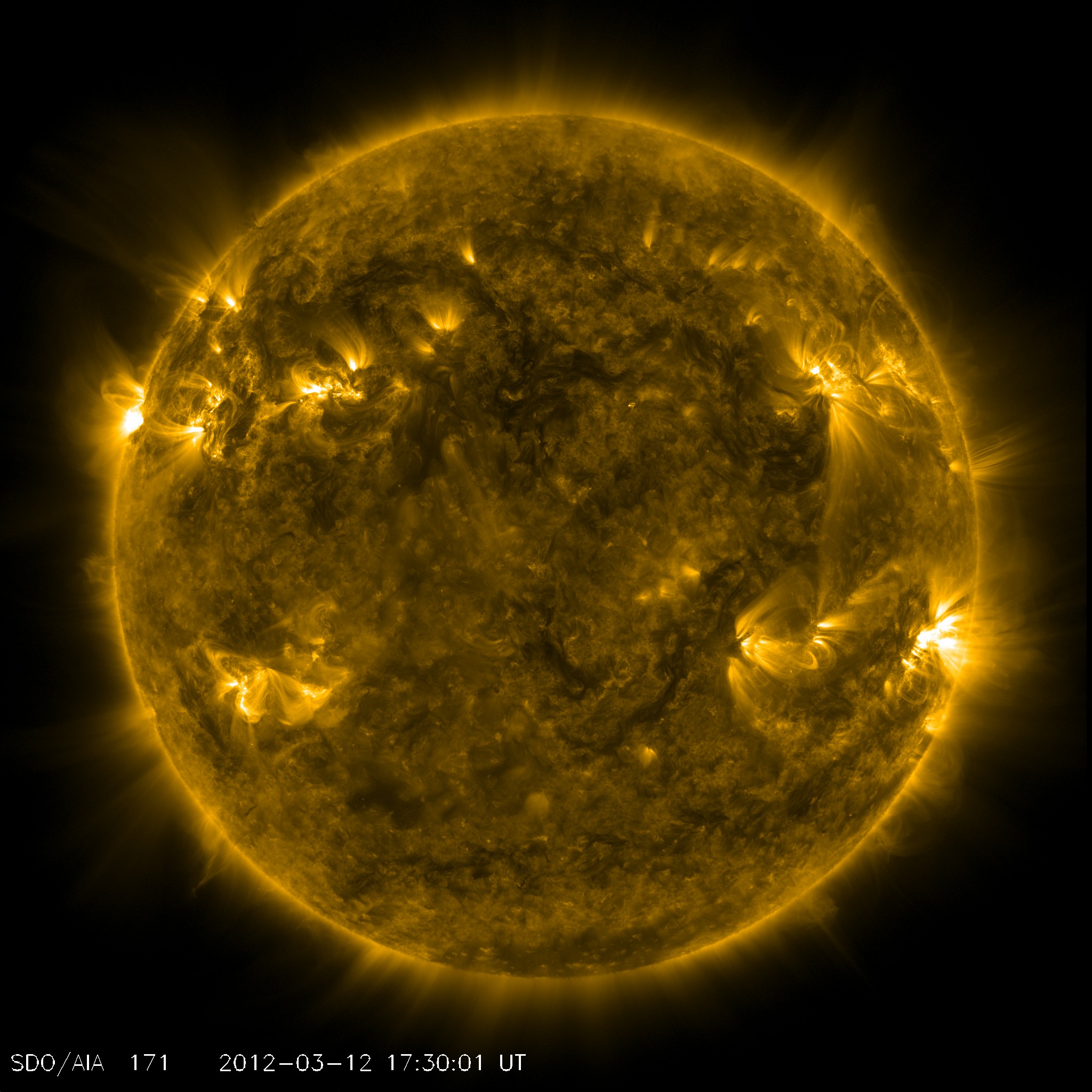
The wave of solar storms that has pounded Earth over the past several weeks is only likely to get worse over the next year, according to a NASA scientist.

Sunspot 1429, the active region of the sun responsible for the flares, has been getting larger over the past several weeks, making it less stable and more likely for additional flares to erupt, which can cause damage to GPS satellites and electronic systems on our planet. NASA reported that the sunspot is now more than seven times the width of earth.

“The larger [the active region] is, the more likely it’s going to produce another big flare,” Phillip Chamberlin, deputy project scientist for the Solar Dynamics Observatory says. “It’s growing, and it’s becoming more dynamic, building energy.”

Over the weekend, two large flares erupted from the region. NASA says the wind and energy particles associated with the flare, began to affect Earth Monday. The region is dangerous for Read more…

Climate change will shake the Earth

February 27, 2012 Comments off

guardian

As the Earth's crust buckles, volcanic activity will increase.

As the Earth’s crust buckles, volcanic activity will increase. Photograph: Corbis

The idea that a changing climate can persuade the ground to shake, volcanoes to rumble and tsunamis to crash on to unsuspecting coastlines seems, at first, to be bordering on the insane. How can what happens in the thin envelope of gas that shrouds and protects our world possibly influence the potentially Earth-shattering processes that operate deep beneath the surface? The fact that it does reflects a failure of our imagination and a limited understanding of the manner in which the different physical components of our planet – the atmosphere, the oceans, and the solid Earth, or geosphere – intertwine and interact.

If we think about climate change at all, most of us do so in a very simplistic way: so, the weather might get a bit warmer; floods and droughts may become more of a problem and sea levels will slowly creep upwards. Evidence reveals, however, that our planet is an almost unimaginably complicated beast, which reacts to a dramatically changing climate in all manner of different ways; a few – like the aforementioned – straightforward and predictable; some Read more…