Archive
Is the European Union on the brink of Collapse?

Foto: THOMAS BORBERG (arkivfoto)
A real risk of disintegration if the EU does not soon display solid internal and external cooperation.
Europe’s external divisions on Libya are as great as its internal divisions on the new Europact.
Over the past few days, EU countries have faced historically difficult decisions without being able to reach agreement.
The indecision has seriously questioned the determination that European countries are able to muster, both in NATO and in the European Union.
The countries seem to have reached agreement on handing over the responsibility for the Libya operation to NATO. The breakthrough has, however, come so late that credibility has already been lost.
For once, Denmark has stood out in a positive light by both sending fighter aircraft to Read more…
Why the World Must Watch Europe
Beyond the EU Debt Crisis
The continent’s financial crisis gave rise to bailouts, infighting and demands for sweeping financial reform. Could there still be a bright future over the horizon for the European Union?

Amid the shift in global superpowers, two names come up as heavyweight world championship opponents: China and the United States.
The constant media exposure and speculation could be likened to a pay-per-view boxing matchup.
In one corner: the world’s largest energy consumer—with a 1.3-billion-strong population—endlessly stockpiling natural resources—and holding nearly $900 billion in United States’ debt.
In the other: longtime democratic world champion—largest economy—and leader in manufacturing.
China is the clear favorite, but the U.S. is still in the running. On its way down from unmatched superpower, it is still a formidable opponent, with its manufacturing sector out-producing China by 40 percent.
Yet America is weighed down by a $14 trillion federal debt and rampant Read more…
Britain’s coming crunch with Europe
 It did not take David Cameron long to realize that there were three parties in his coalition. A few months into government, the Prime Minister worked out that only half of the policies he was enacting came from the shared agenda drawn up when the Tories and LibDems got together. The other half comes from the EU. Or, more specifically, the Civil Service machine, which is busy implementing various EU Directives, often passed many years ago. Cameron is trying to put the brakes on this process.
As I say in my News of the World column, this has led to much frustration in Whitehall. And dismay: the Civil Service remembers how easily Labour waved through EU regulation and the piles of fat that Whitehall likes to pile on top of the EU regulation. Labour would claim that the EU rules were actually its idea, so as not to lose face. Only in government is it clear how far power has slipped; Cameron wants to claw it back.
Oliver Letwin has been tasked with stopping Whitehall from being a breeding ground for new regulations. Cameron jokingly refers to Letwin as a ‘contraceptive’, because it’s his job to stop these regulations being conceived – usually after a little European foreplay. It’s a huge task. The problem is that Read more…
GM crops to be allowed into Britain under controversial EU plans
UK to back imports of animal feed with traces of GM crops in move to benefit US exporters

Genetically modified crops will be allowed to enter the UK food chain without the need for regulatory clearance for the first time under controversial plans expected to be approved this week.
The Observer understands that the UK intends to back EU plans permitting the importing of animal feed containing traces of unauthorised GM crops in a move that has alarmed environmental groups.
Importing animal feed containing GM feed must at present be authorised by European regulators. But a vote on Tuesday in favour of the scheme put forward by the EU’s standing committee on the food chain and animal health would overturn the EU’s “zero tolerance” policy towards the import of unauthorised GM crops.
The move would mark a significant victory for the GM lobby, which has pushed for a relaxation of the blanket ban for years.Environmental groups claim the GM industry wants to use the presence of unauthorised organisms in animal feed as part of a wider strategy to promote its technology.
“The GM industry is pushing this proposal so it can wedge its foot firmly in the door and open up the British and European markets to food no one wants to eat,” said Helen Wallace, director of GeneWatch UK, which campaigns against GM food. “Its long-term aim is to contaminate Read more…
Europe faces a new crisis
Yevgeny Kryshkin
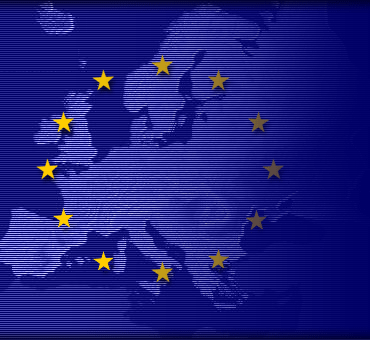 The European Union is facing a new phase of the economic crisis. This depressing forecast was made by a report on the World Economic Situation and Prospects-2011 presented by the United Nations Conference on Trade and Development. Our commentary is by Yevgeny Kryshkin.
Despite the fact that the EU has taken tough austerity measures and is planning to cut the budget deficit, it is risking another economic recession. This opinion was expressed by the authors of the report. They emphasize that a repeated recession in the EU countries and stagnation in the U.S. and Japan may trigger another wave of a global economic crisis.
This pessimistic assessment is based on the state of affairs in the economies of Greece, Ireland, Portugal and Spain, the four countries that were most affected. Greece and Ireland managed to avert a collapse of their financial systems. However, this required incredible joint efforts by all EU member states. Ireland alone received 85 billion euro and with serious risks. Stabilization loans from the International Monetary Fund and the EU are being used to cover budget deficits and support banks. Nevertheless, neither Ireland nor Greece has solved the problems that they faced last year. Here is an opinion from an expert at the Institute of Europe, Vladislav Belov.
“The situation is developing according to the prior scenario. Greece, Spain, Portugal and Ireland have taken austerity measures to reduce the budget deficit through cutting government spending, the salaries of public servants and social expenses, and increasing taxes. At the same time, France and Germany are making attempts to consolidate their efforts. However, the problem has not been solved yet. As before, there is a danger of default, as far as the Euro-zone goes,” Vladislav Belov said.


![[Most Recent Quotes from www.kitco.com]](https://i0.wp.com/www.kitconet.com/charts/metals/gold/t24_au_en_usoz_2.gif)
![[Most Recent Quotes from www.kitco.com]](https://i0.wp.com/www.kitconet.com/charts/metals/silver/t24_ag_en_usoz_2.gif)

 crisisboom
 CRISISBOOM
You must be logged in to post a comment.