Archive
Japan Mulls to Move Capital over Disaster Worries

A handout picture taken and released by Tokyo Electric Power Co (TEPCO) 13 April 2011 shows a fire in the facilities takling seawater samples at Fukushima nuclear power plant in Okuma, Fukushima Prefecture. Photo by EPA/BGNES
As powerful earthquakes continue to jolt Japan and radiation levels near Tokyo are rising, the Asian country’s authorities are considering moving the capital to another city.
The most probable location for a new capital are Osaka and Nagoya, according to ITAR-TASS. Both cities are located near international airports.
The main conditions the new capital has to provide are a population over 50 000 and a sufficient capacity to accommodate the parliament, the government, the Emperor’s residency and the foreign diplomatic missions.
According to experts, should a 7.2 magnitude earthquake shake Tokyo, the casualties will be around 11 000, some 210 000 will be injured and the material damage will be worth about USD 1 B
Japan may raise severity of nuclear crisis to top level: report
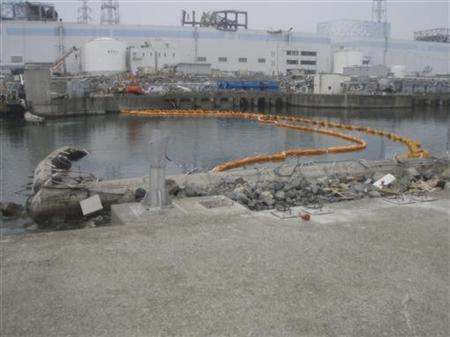 (Reuters) – Japan is weighing raising the severity level of its nuclear crisis at the Fukushima Daiichi nuclear power plant to a level 7 from level 5, putting it at par with the accident at the Chernobyl reactor in 1986, Kyodo news agency reported on Tuesday.
Kyodo said the government’s Nuclear Safety Commission has estimated the amount of radioactive material released from the reactors in Fukushima, northern Japan, reached a maximum of 10,000 terabequerels per hour at one point for several hours, which would classify the incident as a major accident according to the INES scale.
The scale, short for International Nuclear and Radiological Event Scale, is published by the International Atomic Energy Agency and ranks nuclear and radiological accidents and incidents by their severity from 1 to a maximum of 7.
Japan had previously assessed the accident at reactors operated by Tokyo Electric Power Co, which engineers are still trying to bring under control, at level 5, the same level as the Three Mile Island accident in 1979.
On March 11 a 9.0 magnitude earthquake and a massive tsunami triggered the nuclear disaster where reactors at the Fukushima Daiichi complex were crippled due to a loss of power which disabled cooling functions.
A spokesman for the Nuclear and Industrial Safety Agency, Japan’s nuclear safety watchdog, said on Tuesday that the level of the Fukushima incident was still a 5 and that he was unaware of any move by the government to raise the level.
Strain from Japan earthquake may lead to more seismic trouble, scientists say
Japan won’t stop shaking. One month after the March 11 earthquake and tsunami, the nation rode out yet another powerful aftershock Monday, the second in four days. This one rattled buildings in Tokyo and briefly cut power to the damaged nuclear plant in Fukushima.
With soldiers still looking for the bodies of thousands of people who vanished in the killer wave a month ago, Japan is coping with the painful reality that it sits in a seismic bull’s-eye.
A new calculation by American and Japanese scientists has concluded that the March 11 event may have heightened the stress on faults bracketing the ruptured segment of the Japan Trench.
“There’s quite a bit of real estate on which stress has increased, by our calculations,” said U.S. Geological Survey geophysicist Ross Stein. “The possibility of getting large, Read more…
South Korea shuts schools amid Japan radiation fears

Ahn Young-joon / AP
TOKYO — Dozens of schools in South Korea closed Thursday amid concerns about radioactive fallout from Japan’s nuclear disaster.
Classes were canceled or shortened at more than 150 schools as rain fell across the country.
Authorities said radiation levels in the rain posed no health threat.
However, school boards across the country — Japan’s closest neighbor — advised Read more…
MAJOR EARTHQUAKE HITS JAPAN, BLACKOUTS IN SENDAI AND FUKUSHIMA
Could there be a connection with the Solar Storm from yesterday? Definitely.
 A major earthquake between 7.1 and 7.4 magnitude hit northeastern Japan at 11:32 Tokyo time. It was focused 60 kilometers below the seabed off Miyagi Prefecture, which also got slammed last time.
The quake has caused scattered gas leaks and fires. A few dozen injuries have been reported.
U.S. markets turned down on the news and Nikkei futures have plunged.
Tsunami warnings were issued, but then lifted an hour after the quake.
Power is out around Sendai and in parts of Fukushima and Yamagata. Even as two of the three local plants are blacked out, however, cooling activities will continue at Fukushima nuclear plant. No new damage is reported at the Fukushima nuclear plant or others. Workers at the Fukushima plant were briefly evacuated.
NHK reports Rokkasho plutonium reprocessing plant has lost off site power and is on emergency backup.
Bullet trains have started running again less than an hour after the quake. All highways are shut in Miyagi, local police tell Kyodo.
12:16 ET: Japanese officials say there is still a high risk of mud slides and collapsing buildings.
Here’s a video of the tremor in Sendai: What could that strange blue light be??? Read more…
Confidential U.S. document reveals “new threats” at Fukushima: Risk of explosions inside containment structures… “Likely no water” in No. 1 reactor core — “Could persist indefinitely”
U.S. Sees Array of New Threats at Japan’s Nuclear Plant, New York Times by James Glanz and William J. Broad, April 5, 2011:
[Emphasis Added]
United States government engineers sent to help with the crisis in Japan are warning that the troubled nuclear plant there is facing a wide array of fresh threats that could persist indefinitely, and that in some cases are expected to increase as a result of the very measures being taken to keep the plant stable, according to a confidential assessment [dated March 26] prepared by the Nuclear Regulatory Commission. …
The Times’ article spotlighted several items of extreme importance:
- “Semimolten” fuel rods and salt are “impeding the flow of fresh water meant to cool the nuclear cores” in ALL THREE REACTORS
- The water flow in reactor No. 1 “is severely restricted and likely blocked“
- Similar problems exist in No. 2 and No. 3, although the blockage is probably less severe
- “There is likely no water level” inside the core of reactor No. 1
- There is a possibility of “explosions inside the containment structures”
Read the article here.
Japan stops leaks from nuclear plant
TOKYO (Reuters) – Engineers have stopped highly radioactive water leaking into the sea from a crippled Japanese nuclear power plant, the facility’s operator said on Wednesday, a breakthrough in the battle to contain the worst nuclear crisis since Chernobyl.
However, Tokyo Electric Power (TEPCO) still needs to pump contaminated water into the sea because of a lack of storage space at the facility.
“The leaks were slowed yesterday after we injected a mixture of liquid glass and a hardening agent and it has now stopped,” a TEPCO spokesman told Reuters.
Desperate engineers had been struggling to stop the leaks and had used sawdust, newspapers and concrete as well as liquid glass to try to stem the flow of the highly-contaminated water.
Japan is facing its worst crisis since World War Two after a 9.0 magnitude earthquake and tsunami hit its northeast coast, leaving Read more…
1,000 corpses from Japanese quake left uncollected because of fear of radiation
The mother of one of the workers who are battling to stop a meltdown at the Fukushima nuclear plant said today that they all expect to die from radiation sickness ‘within weeks’.
The so-called Fukushima 50 are all repeatedly being exposed to dangerously high radioactive levels as they attempt to restore vital cooling systems following the earthquake and tsunami on March 11.
And speaking tearfully through an interpreter by phone, the mother of a 32-year-old worker told Fox News: ‘My son and his colleagues have discussed it at length and they have committed themselves to die if necessary to save the nation.
 Too dangerous: This aerial photograph of the Fukushima plant shows the damaged reactors three and four at the which will now be entombed in concrete after the battle to contain radiation was lost
‘He told me they have accepted they will all probably die from radiation sickness in the short term or cancer in the long-term.’
‘They have concluded between themselves that it is inevitable some of them may die within weeks or Read more…
IAEA finds high radiation levels outside Japan evacuation zone

Tokyo (CNN) — Radiation levels in a Japanese town outside a government-ordered evacuation zone have exceeded one of the criteria for evacuation, the International Atomic Energy Agency said Wednesday.
The agency said it advised Japan “to carefully assess the situation.”
The elevated levels were found in Iitate, a town of 7,000 residents about 40 kilometers (25 miles) northwest of the earthquake- and tsunami-damaged Fukushima Daiichi nuclear power plant, the agency said. The evacuation zone covers a 20-kilometer (13-mile) radius around the plant.
The agency did not say what levels it found in Iitate, but the environmental group Greenpeace said Sunday it had found radiation levels in the town that were more than 50 times above normal.
Though that is far below the level that would cause radiation sickness, it does pose a risk of cancer to residents in the long term, Greenpeace said.


![[Most Recent Quotes from www.kitco.com]](https://i0.wp.com/www.kitconet.com/charts/metals/gold/t24_au_en_usoz_2.gif)
![[Most Recent Quotes from www.kitco.com]](https://i0.wp.com/www.kitconet.com/charts/metals/silver/t24_ag_en_usoz_2.gif)

 crisisboom
 CRISISBOOM
You must be logged in to post a comment.