Moscow Airport Bombing kills 35: Domodedovo security “soft”
 A suspected ‘black widow’ is said to be behind the suicide blast in Russia’s busiest Domodedovo International Airport in which at least 35 were killed and 178 injured, reports said today.
One of the eyewitnesses questioned by the investigators said he had seen how the hand baggage of a woman dressed in black exploded, according to Interfax.
“The eyewitness declared that the young woman was dressed in black and the explosives were in the bag or suitcase on the floor next to her,” a source was quoted as saying by the agency. It said the security agencies were aware of the possible terror attacks, and were looking for ‘Black Widows’ of the slain militants from the Caucasus, who had carried out all suicide attacks in past, including twin blasts in Moscow metro stations in March 2010.
Investigators say that the bomb blast in the arrival hall overnight, which killed at least 35 people and injured more than 100, was detonated by a suicide bomber.
Airports around the world are likely to boost security checks in the wake of Monday’s deadly bombing in Moscow, experts say.
Eyewitnesses describe horrific scenes. Read more…
Postal Service Eyes Closing Thousands of Post Offices
HOLMES MILL, Ky.—The U.S. Postal Service plays two roles in America: an agency that keeps rural areas linked to the rest of the nation, and one that loses a lot of money.
 Now, with the red ink showing no sign of stopping, the postal service is hoping to ramp up a cost-cutting program that is already eliciting yelps of pain around the country. Beginning in March, the agency will start the process of closing as many as 2,000 post offices, on top of the 491 it said it would close starting at the end of last year. In addition, it is reviewing another 16,000—half of the nation’s existing post offices—that are operating at a deficit, and lobbying Congress to allow it to change the law so it can close the most unprofitable among them. The law currently allows the postal service to close post offices only for maintenance problems, lease expiration’s or other reasons that don’t include profitability.
The news is crushing in many remote communities where the post office is often the heart of the town and the closest link to the rest of the country. Shuttering them, critics say, also puts an enormous burden on people, particularly on the elderly, who find it difficult to travel out of town.
The postal service argues that its network of some 32,000 brick-and-mortar post offices, many built in the horse-and-buggy days, is outmoded in an era when people are more mobile, often pay bills online and text or email rather than put pen to paper. It also wants post offices to be profitable to help it overcome record $8.5 billion in losses in fiscal year 2010.
A disproportionate number of the thousands of post offices under review are in rural or smaller suburban areas, though the postal service declined to provide any estimate on how many beyond those slated to begin closure in March might ultimately close or which ones are being targeted. “We want to make the smartest decisions possible with the smallest impact on communities,” Dean Granholm, vice president for delivery and post office operations, said in an interview. He said the agency is identifying locations that are operating at a deficit and looking “for the opportunity to start the process of closing.” Read more…
Quantitative Easing Causing Food Prices to Skyrocket
 As I’ve previously noted, interest rates have risen both times after the Fed implemented quantitative easing.
Graham Summers points out that food prices have also skyrocketed both times:
In case you’ve missed it, food riots are spreading throughout the developing world Already Tunisia, Algeria, Oman, and even Laos are experiencing riots and protests due to soaring food prices.
As Abdolreza Abbassian, chief economist at the UN’s Food and Agriculture Organization (FAO), put it, “We are entering a danger territory.”
Indeed, these situations left people literally starving… AND dead from the riots.
And why is this happening?
A perfect storm of increased demand, bad harvests from key exporters (Argentina, Russia, Australia and Canada, but most of all, the Fed’s money pumping. If you don’t believe me, have a look at the below chart: Read more…
Gold is to China as paper currency is to US
Bill Bonner
 We’d still like to see a deep decline in the gold price. Too many people are getting onto gold. Most of them have no idea of what they are doing. Like readers of MONEY magazine, they’re buying the yellow metal as a speculation. Most likely they’re going to lose money. Almost everyone who speculates on gold loses money. Don’t ask us why. It’s just one of those Iron Laws of investing.
Gold goes up for 10 years straight. Speculators notice. They jump on board. And then the train runs off the tracks.
That’s just the way it works.
Besides, remember that this Great Correction is not over yet…not by a long shot. It has barely begun to correct the excesses of the Bubble Era. A quarter of all homeowners are said to be underwater on their mortgages – that still needs to be sorted out. And the whole financial industry – with the collusion of the Fed – is sitting on trillions of dollars’ worth of mortgage backed securities, pretending that they are good credits.
There are still major bankruptcies ahead…and deflation of assets prices. And in all the sturm and drang of it, the price of gold could go down too.
But if you’re acquiring gold, you have some powerful competition. As nations become rich and powerful, they accumulate gold. Those that are getting weak and poor give it up. Here’s The Financial Times with the latest news: Read more…
What kinds of societies create wealth? What kinds destroy it?
There are some activities that are positive sum activities. That is, they are productive. They increase the total of real wealth in a society.
Bill Bonner
 There are other activities that are zero sum activities…or even negative sum activities. War, for example. Excess legal wrangling. Paperwork. Too much time spent in schools. Too much support for the unemployed, the malingerers and the loafers. These things decrease the total of real wealth in a society.
Sometimes people are bright, honest and hardworking. Sometimes they are lazy, shiftless and cunning. They always prefer to get wealth and status by the easiest means possible. In some societies, the best way is by working hard. In others, it is by being clever…becoming a lawyer…a banker…or a government hack.
A new society…or a fresh economy (such as one that has just been flattened by war or hyperinflation)…or a new model for an economy…is generally a wealth-creating society.
A free society is also generally a wealth creating society. People do what they want. If they want wealth, they are free to create it.
But as societies (or economies) age, they become Read more…
U.S. Treasury Secretary Admits U.S. Default is Imminent
By James West
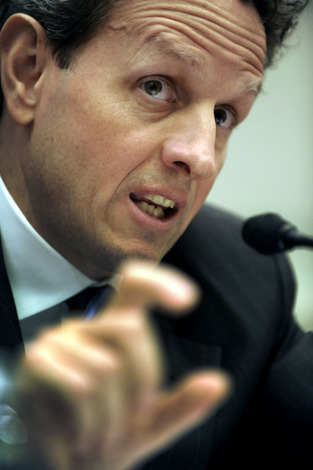 Timothy Geithner, U.S. Treasury Secretary, admitted in a letter to congress dated January 6th, that the United States Treasury would be forced to default on its credit obligations without clearance from congress to raise the amount of money tha the treasury is allowed to borrow.
After citing a list of “extraordinary measures” congress has had to resort to int he past to avoid entering a state of defualt, Geithner stated, “Once these steps have been taken, no remaining legal and prudent measures would be available to create additional headroom under the debt limit, and the United States would begin to default on its obligations. The extraordinary measures include, “suspending sales of State and Local Government Series (SLGS) Treasury securities; suspending reinvestment of the Government Securities Investment Fund (G-Fund); suspending reinvestment of the Exchange Stabilization Fund (ESF); and determining that a “debt issuance suspension period” exists, permitting redemption of existing, and suspension of new, investments of the Civil Service Retirement and Disability Fund (CSRDF).
That the United States has already defaulted on its obligations is beyond dispute, at this point, as its the rate at which its debt service obligations is growing exceeds the rate at which the United States GDP could possibly grow, meaning that, without drastic cuts to governmenbt spending, the debt can only continue to grow.
Before our very eyes, the so-called leadership of the world’s largest economy is intentionally bankrupting the country and devaluing its currency in what can only be a precursor to rampant inflation. Since the integrity necessary to manage this problem does not exist within the United States political system, the rest of the world has no choice but to stand by and watch the value of their United States Treasury Bills diminish incrementally on a daily basis. Selling them will only exacerbate the problem, but the question must be asked, how long until the remedy is preferred over the miserable condition?
Geithner goes on to say, in a remarkable baring of the national soul,
However, if Congress were to fail to act, the specific consequences would be as follows:
The Treasury would be forced to default on legal obligations of the United States, causing catastrophic damage to the economy, potentially much more harmful than the effects of the financial crisis of 2008 and 2009. Read more…
Fed chief expects high unemployment, economic growth in 2011
Vicki Needham
 Unemployment will remain high, the nation’s economy could expand by 4 percent and interest rates may need go up, Federal Reserve Bank of Philadelphia President Charles Plosser said Monday.
“If economic growth in the United States continues to gain traction and the prospects begin to look ever better, it might be time for us to begin thinking about how do we begin to gradually take our foot off the accelerator,” Plosser told reporters after a speech at the Central Bank of Chile in Santiago, according to news reports.
Plosser said he may favor a rate increase if economic growth necessitates a change.
“It might. I’m not going to rule that out,” he said.
The central bank has said that it plans to keep short-term interest rates low for an “extended period.”
During Monday’s speech, Plosser also predicted that the U.S. could grow between 3 percent and 4 percent this year.
The Fed’s plan to purchase $600 billion in government debt will probably continue through June while the nation’s 15 million unemployed look for work, although Plosser didn’t rule out pulling the stimulus funds back earlier.
“It could end earlier if economic conditions call for it, but right now I’m not sure that that’s the most likely outcome,” he told reporters. “It obviously creates challenges for some countries because of appreciating currencies. But I think that will pass. Those are short-run issues.”
Plosser has expressed concern about whether the Fed’s quantitative easing, also known as QE2, will spur economic growth while lowering the jobless rate that has remained above 9 percent for 20 months.
“Monetary policy is not going to be able to speed up the adjustments in labor markets or prevent asset bubbles, and attempts to do so may create more instability, not less,” he said.
“Expecting too much of monetary policy will undermine its ability to achieve the one thing that it is well-designed to do — ensuring long-term price stability.”
QE2 has brought harsh criticism from some lawmakers on Capitol Hill who argue that the plan could devalue the dollar and cause inflation.
China’s coming fall
 Like the Soviet Union before it, much of China’s supposed boom is illusory — and just as likely to come crashing down
In 1975, while I was in Siberia on a two-month trip through the U.S.S.R., the illusion of the Soviet Union’s rise became self-evident. In the major cities, the downtowns seemed modern, comparable to what you might see in a North American city. But a 20-minute walk from the centre of downtown revealed another world — people filling water buckets at communal pumps at street corners. The U.S.S.R. could put a man in space and dazzle the world with scores of other accomplishments yet it could not satisfy the basic needs of its citizens. That economic system, though it would largely fool the West until its final collapse 15 years later, was bankrupt, and obviously so to anyone who saw the contradictions in Soviet society.
The Chinese economy today parallels that of the latter-day Soviet Union — immense accomplishments co-existing with immense failures. In some ways, China’s stability today is more precarious than was the Soviet Union’s before its fall. China’s poor are poorer than the Soviet Union’s poor, and they are much more numerous — about one billion in a country of 1.3 billion. Moreover, in the Soviet Union there was no sizeable middle class — just about everyone was poor and shared in the same hardships, avoiding resentments that might otherwise have arisen.
In China, the resentments are palpable. Many of the 300 million people who have risen out of poverty flaunt their new wealth, often egregiously so. This is especially so with the new class of rich, all but non-existent just a few years ago, which now includes some 500,000 millionaires and 200 billionaires. Worse, the gap between rich and poor has been increasing. Ominously, the bottom billion views as illegitimate the wealth of the top 300 million. Read more…
Australian ‘inland sea’ flood threatens towns
 MELBOURNE — Australia’s flood crisis deepened Saturday with a giant “inland sea” threatening more communities in the southeast, as officials continued the grim search for bodies in worst-hit Queensland.
Sandbagging was underway in some villages in Victoria, where weeks of floods have affected as much as one-third of the state, with swollen rivers overflowing in 75 towns and flooding some 1,770 properties.
“We know that this is the most significant flooding in the north west of Victoria since records began… about 130 years ago,” a spokeswoman for the State Emergency Service told AFP.
“We are still on alert for towns in the north of the state.”
Floodwaters which national broadcaster ABC described as a moving “inland sea” covering an area 90 kilometres (56 miles) long and 40 kilometres wide, were threatening towns around Swan Hill, some 300 kilometres northwest of Melbourne.
“In the actual Swan Hill township itself, we are very confident that the levee system around the town is built to a very high grade and will protect the township,” Mayor Greg Cruickshank told ABC radio.
But rural and outlying areas “will have significant amount of inundation through them,” he said.
While thousands of people around the state have been urged to evacuate, emergency services warned that those people who choose to remain on their properties in the rural areas could be stranded by the floods.
“A number of these communities will be isolated for days as this huge amount of floodwater comes through,” SES spokesman Kevin Monk said. Read more…


![[Most Recent Quotes from www.kitco.com]](https://i0.wp.com/www.kitconet.com/charts/metals/gold/t24_au_en_usoz_2.gif)
![[Most Recent Quotes from www.kitco.com]](https://i0.wp.com/www.kitconet.com/charts/metals/silver/t24_ag_en_usoz_2.gif)

 crisisboom
 CRISISBOOM
You must be logged in to post a comment.