Big Brother
 When you hear the phrase “Big Brother is watching you,” you probably think of two countries in particular: China and the former Soviet Union. Technology has changed the game. Although the Big Brother approach was effective, due to today’s technology alone privacy is almost nonexistent.
Do you know where your children are? Or your wife who says she has gone shopping or the spouse who claims to be “working late”? How about the whereabouts of your pet? Even in Turkey pet owners are required to make sure their pets have their own microchip. My pets each have a chip in case they go astray. Global Positioning System technology, more commonly known as GPS, is making it easier than ever to find stolen cars or track down missing people or Fido when he gets lost. Who would have ever imagined 50 years ago that you could be found, maybe in some cases somewhere you would not want to be Read more…
Soon coupons (or Big Brother) will find you at the store
 Coupons, long the staple of the Sunday paper, are going high tech and with the popularity of smartphones, more young people and men are now using digital coupons. But soon technology will progress further and manufacturers will be able to target shoppers right in the store.
The technology is coming which will pinpoint your exact location in the store. The GPS current phones use doesn’t work indoors, but there are companies hard at work, developing software that will create a detailed map of the store and assign location points throughout the store.
It’s called geotagging.
Companies will be able to geotag consumers with a smartphone. The goal: to send a coupon for an item you wouldn’t normally buy, while you’re near it or standing in front of it in the aisle.
And if you’ve downloaded shopping list apps, or coupon apps, it’s likely the manufacturers or stores will know what kind of items you normally buy, and figure out if they want to offer you a discount to try another brand or an item you might not necessarily buy regularly. Most companies don’t like to give out coupons for items you are going to buy anyway.
The folks I talked to at a grocery store in Metairie say they’d love the savings, but are concerned about having their location pinpointed at all times.
WikiLeaks to speed release of leaked docs

In the event of his untimely death or long-term incarceration, WikiLeaks founder Julian Assange would make public all the leaked documents his group has.
LONDON – WikiLeaks founder Julian Assange vowed Tuesday to step up his site’s release of secret documents while he fights extradition to Sweden, as his lawyers argued that sending him to Stockholm could land him in Guantanamo Bay or even on U.S. death row.
That claim, regarded by many legal experts as extremely unlikely, is part of a preliminary defense argument released by Assange’s attorneys ahead of a court hearing next month.
The Australian computer expert is wanted in Sweden to answer sex-crimes allegations. American officials also are trying to build a criminal case against WikiLeaks, which has published a trove of leaked diplomatic cables and secret U.S. military files on the wars in Iraq and Afghanistan.
Assange’s lawyers are seeking to link the two issues, claiming the Swedish prosecution is politically motivated — an allegation that Sweden strongly denies.
Assange’s defense claims “there is a real risk that, if extradited to Sweden, the U.S. will seek his extradition and/or illegal rendition to the USA, where there will be a real risk of him being detained at Guantanamo Bay or elsewhere.”
The document, prepared by Assange’s lead lawyer, Geoffrey Robertson, adds that “there is a real risk that he could be made subject to the death penalty” if sent to the United States.
Under European law, suspects cannot be extradited to jurisdictions where they may face the death penalty.
It also is not clear what, if any, charges U.S. authorities could bring against Assange, and unclear how he could be classed as an “unlawful enemy combatant,” which could expose him to detention at Guantanamo Bay.
“Mr. Assange would not be sent to Guantanamo,” said John Bellinger, a former legal adviser to the U.S. State Department. “He would be prosecuted in U.S. federal court. He would not be treated as an enemy combatant. Read more…
Could the U.S. central bank go broke?
Reuters
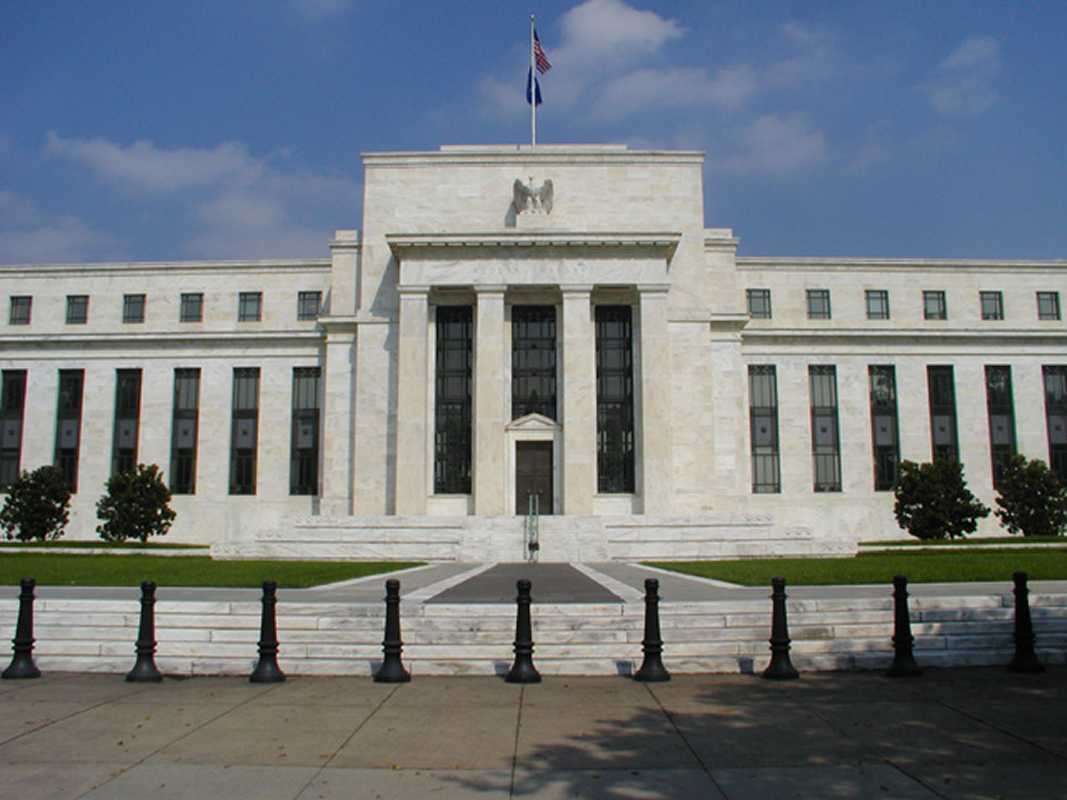 The U.S. Federal Reserve’s journey to the outer limits of monetary policy is raising concerns about how hard it will be to withdraw trillions of dollars in stimulus from the banking system when the time is right.
While that day seems distant now, some economists and market analysts have even begun pondering the unthinkable: could the vaunted Fed, the world’s most powerful central bank, become insolvent?
Almost by definition, the answer is no.
As the monetary authority, the central bank is the master of the printing press. It can literally conjure up money at will, and arguably did exactly that when it bought about $2 trillion of mortgage-backed securities and U.S. Treasuries to push down borrowing costs and boost the economy.
The Fed’s unorthodox steps helped it generate record profits in 2010, allowing it to send $78.4 billion to the U.S. Treasury Department. But its swollen balance sheet leaves the central bank unusually exposed to possible credit losses that could create a major headache at a time of increasing political encroachment on the Fed’s independence. Read more…
Device Records Your Driving Habits
It will be just a matter of time until this technology will be mandatory with ALL driver insurance companies. Big brother is watching…
Progressive Auto Insurance SnapShot Device Analyzes Safety of Driving Patterns

Summary. Progressive offers auto insurance discounts based on an analysis of your driving habits over a thirty-day period.
To do this, they use a small transmitter device (SnapShot) that plugs into your cars computer interface.
The car’s computer provides the SnapShot transmitter with date, time, speed, and other information about your car’s operation. Read more…
Mobile Body Scanners :Backscatter Vans
 X-Ray “Backscatter Vans” Can See in your Car and Home, Feds are Radiating Americans “And not only are you no longer secure in your home but they can see your hidden guns in the wall or in the floor along with your precious metals. American Science & Engineering, a company based in Billerica, Massachusetts, has sold U.S. and foreign government agencies more than 500 backscatter x-ray scanners mounted in vans that can be driven past neighboring vehicles to see their contents, Joe Reiss, a vice president of marketing at the company told me in an interview. While the biggest buyer of AS&E’s machines over the last seven years has been the Department of Defense operations in Afghanistan and Iraq, Reiss says law enforcement agencies have also deployed the vans to search for vehicle-based bombs in the U.S.
“This product is now the largest selling cargo and vehicle inspection system ever,” says Reiss.
The Z Backscatter Vans, or ZBVs, as the company calls them, bounce a narrow stream of x-rays off and through nearby objects, and read which ones come back. Absorbed rays indicate dense material such as steel. Scattered rays indicate less-dense objects that can include explosives, drugs, or human bodies. That capability makes them powerful tools for security, law enforcement, and border control. Read more…
Biometric ATM gives cash via ‘finger vein’ scan
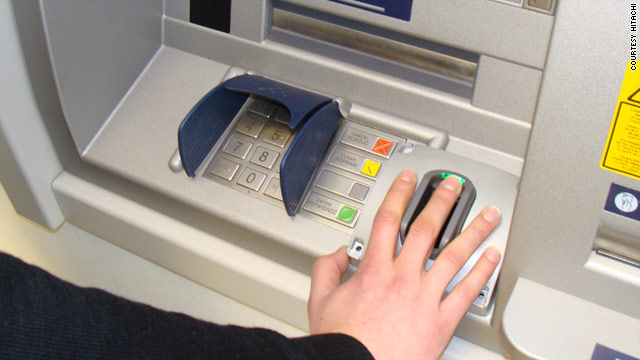 Poland’s cooperative BPS bank says it’s the first in Europe to install a biometric ATM — allowing customers to withdraw cash simply with the touch of a fingertip.
The digit-scanning ATM, introduced in the Polish capital of Warsaw, runs on the latest in “finger vein” technology — an authentication system developed by Japanese tech giant Hitachi.
The company says that an infrared light is passed through the finger to detect a unique pattern of micro-veins beneath the surface – which is then matched with a pre-registered profile to verify an individual’s identity.
“This is a substantially more reliable technique than using fingerprints,” Peter Jones, Hitachi’s head of security and solutions in Europe, told CNN.
“Our tests indicate there is a one in a million false acceptance rate — that’s as good as iris scanning, which is generally regarded as the most secure method.”
Unlike fingerprints, which leave a trace and can be potentially reproduced, finger veins are impossible to replicate, according to Jones, because they are beneath the surface of the skin.
“And before you ask, no — it doesn’t work with fingers that have been chopped off,” he added.
While the technology represents a step forward in reducing cases of identity fraud, Jones said that this is just one of many factors that have encouraged the Polish bank to adopt it. Read more…
Obama Eyeing Internet ID for Americans
 STANFORD, Calif. – President Obama is planning to hand the U.S. Commerce Department authority over a forthcoming cybersecurity effort to create an Internet ID for Americans, a White House official said here today.
It’s “the absolute perfect spot in the U.S. government” to centralize efforts toward creating an “identity ecosystem” for the Internet, White House Cybersecurity Coordinator Howard Schmidt said.
That news, first reported by CNET, effectively pushes the department to the forefront of the issue, beating out other potential candidates including the National Security Agency and the Department of Homeland Security. The move also is likely to please privacy and civil liberties groups that have raised concerns in the past over the dual roles of police and intelligence agencies.
The announcement came at an event today at the Stanford Institute for Economic Policy Research, where U.S. Commerce Secretary Gary Locke and Schmidt spoke.
The Obama administration is currently drafting what it’s calling the National Strategy for Trusted Identities in Cyberspace, which Locke said will be released by the president in the next few months. (An early version was publicly released last summer.)
“We are not talking about a national ID card,” Locke said at the Stanford event. “We are not talking about a government-controlled system. What we are talking about is enhancing online security and privacy and reducing and perhaps even eliminating the need to memorize a dozen passwords, through creation and use of more trusted digital identities.” Read more…
NASA Sold Computer Hard Drives Containing Sensitive Government Info
Julian Assange may have needed a mole inside the Army to get sensitive government documents for WikiLeaks, but thanks to the lax IT procedures at NASA, it looks like he may have only needed an eBay account.
Due to weak security measures and an agency culture that struggles with properly handling property transfer, NASA sold hard drives to the general public that contained information that could help hackers penetrate the space agency’s computers, according to a new report from the NASA’s Office of Inspector General (OIG).
The computers were left over from the shuttle program, which NASA sold off publicly after they had been properly sanitized of any sensitive information. However, it seems that a combination of poorly designed procedures and individual failures led NASA personnel to skip that sanitation step. Overall, 10 entires PCs that might have contained IP information and other sensitive data are known to have ended up sold to private citizens.
“During our audit, we discovered significant weaknesses in the sanitization and disposal processes for IT equipment at four NASA Centers – Kennedy and Johnson Space Centers and Ames and Langley Research Centers,” the report reads.
This is not the first time that NASA has come under fire for poor information technology and equipment management. According to the Government Accountability Office (GAO), NASA misplaced $94 million in equipment between 1997 and 2007, and failed to meet their goals of stopping such losses in six of those ten years.
A 2007 GAO report portrayed a NASA culture where property mismanagement and loss rarely results in punishment. In one instance, a NASA employee escaped punishment despite providing an explanation for losing a laptop consisting of the excuse “this computer, although assigned to me, was being used on board the International Space Station. I was informed that it was tossed overboard to be burned up in the atmosphere when it failed,” the 2007 GAO report said.
Massacre suspect “mentally disturbed,” former teacher says

Tucson, Arizona (CNN) — The suspect in the weekend massacre in Arizona was kicked out of an algebra class at a community college in June after repeated interruptions and clearly “needed psychological help,” his instructor said Sunday.
Jared Lee Loughner was “physically removed” from the Pima Community College course less than a month after it began, its instructor, Ben McGahee told CNN. McGahee said Loughner sometimes shook, blurted things out in class, and appeared to be under the influence of drugs at times.
“I was scared of what he could do,” McGahee said. “I wasn’t scared of him physically, but I was scared of him bringing a weapon to class.”
Loughner is now accused of opening fire at a Tucson supermarket where U.S. Rep. Gabrielle Giffords was hosting a meet-and-greet session with her constituents on Saturday. Six people were killed and 14 others wounded in the shooting. Read more…


![[Most Recent Quotes from www.kitco.com]](https://i0.wp.com/www.kitconet.com/charts/metals/gold/t24_au_en_usoz_2.gif)
![[Most Recent Quotes from www.kitco.com]](https://i0.wp.com/www.kitconet.com/charts/metals/silver/t24_ag_en_usoz_2.gif)

 crisisboom
 CRISISBOOM
You must be logged in to post a comment.