Powerful quake strikes Costa Rica, tsunami warnings issued
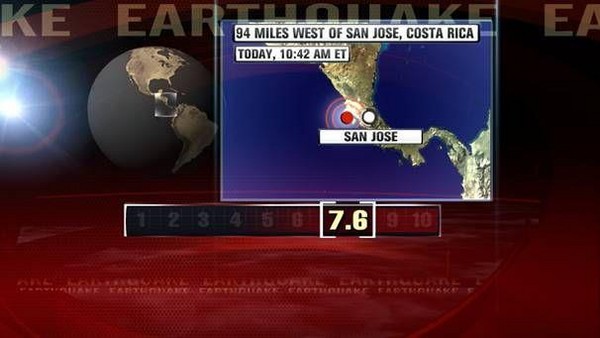 Original Story: A powerful 7.6 magnitude earthquake struck on the west coast of Costa Rica on Wednesday, according to the United States Geological Survey. The epicenter was 38 miles south-southeast of Liberia, Costa Rica at a depth of 25 miles.
According to a statement from the Pacific Tsunami Warning Center, a tsunami warning was in effect for Costa Rica, Panama, Nicaragua, El Salvador, Honduras, Mexico, Colombia, Ecuador, Guatemala and Peru.
The tsunami watch that was issued for the entire Caribbean region was later canceled because it was inadvertently sent by mistake. No tsunami watch is in effect for the Caribbean Sea region.
A later statement said that an evaluation of the Pacific wide tsunami threat was underway and there is a possibility that Hawaii could be elevated to a watch or warning status.
Earthquakes of this size have the potential to create a widespread destructive tsunami that can affect coastlines near the epicenter within minutes and more distant coastlines within hours, but it is not known if one was generated.
According to ABC news, in the coastal town of Nosara in northwest Costa Rica, trees shook violently and light posts swayed. Teachers chased primary school students outside. There were no reports of major damage at this time.
Hacker group claims access to 12M Apple device IDs
 Computerworld – Hacker group AntiSec has published what it claims is about 1 million unique device identifier numbers (UDIDs) for Apple devices that it said it accessed earlier this year from a computer belonging to an FBI agent.
The group, which is a splinter operation of the Anonymous hacking collective, claims that it has culled more than 12 million UDIDs and personal data linking the devices to users from the FBI computer. AntiSec said it chose to publish a portion of those records to prove it has them.
In an unusually lengthy note on Pastebin, a member of AntiSec said the group had culled some personal data such as full names and cell numbers from the published data. Instead, the group said it published enough information such as device type, device ID and Apple Push Notification Service tokens to let users determine whether their devices are on the list. Apple device owners who want to Read more…
The Master ‘PLAN’: China’s New Guided Missile Destroyer
China’s navy appears on the verge of creating a new class of warship. It could eventually alter the balance of naval power in the region.

We are loyal followers of baseball philosopher Yogi Berra, who reportedly proclaimed that “it’s tough to make predictions, especially about the future.” Like the great Yogi, we seldom venture prophecies. But we did hazard one in The Diplomat late in 2010, namely that the People’s Liberation Army Navy (PLAN) would defy those Western experts who opined that Beijing had slowed or halted its naval buildup.
For evidence, such experts claimed that the PLAN had stopped building guided-missile destroyers, or DDGs. If so, Beijing had made a conscious choice to limit its navy’s offensive punch. Not so, said we. Having experimented with various DDG designs, the PLAN was simply settling on a model that incorporated the best of each test platform. And indeed, DDG serial production has recommenced in earnest, judging from pictures of the new Type 052D Luyang II-class DDG that have surfaced on the Internet.
Until recently it was fashionable for Western PLA-watchers to contend that Chinese shipyards had Read more…
UK nightclub uses biometrics to control entry

The Underground, a nightclub in Dundee, Scotland, recently installed biometric fingerprint scanners for first time visitors to prove they are of age to enter. For subsequent visits, customers of the nightclub are identified by scanning their fingerprint.
The club is run by G1 Group PLC, who introduced the Scannet ID Scan system after a successful trial period in its Glasgow club. Scannet ID Scan is used to verify that identification presented is real.
Fingerprints gathered, together with photo-based profiles, are stored in computers in the club. Having this technology makes it easier for the management to identify troublemakers, and scan foreign passports and driving licenses before allow entry to the club.
A spokeswoman from G1 Group said : “The system recognizes most international passports and driving licenses, meaning we can Read more…
Silver at four-month high amid QE3 hopes

Silver prices touched their highest level in more than four months on Monday as the prospect of a fresh bout of quantitative easing from the US Federal Reserve rekindled interest in the precious metal.
Investors have largely shunned silver this year after being burnt by a year of wild price swings that saw it touch a 30-year high in April 2011 before plunging nearly 35 per cent in a fortnight.
But silver, whose primary use is industrial despite a recent surge in investor demand, has jumped 15.8 per cent in price in the past three weeks and on Monday peaked at $32.20 a troy ounce.
The gains have outpaced those of gold,
which has risen just 5.2 per cent over the same period.
The “mint ratio” between the two precious metals, a favorite trade of hedge funds and other investors, has moved 9 per cent in silver’s favour since mid-August – the first time silver has outperformed Read more…
EPA changes rules to allow more toxic cleaning chemicals in mainstream food
 (NaturalNews) Just in case you’ve forgotten, EPA stands for Environmental Protection Agency. That was sarcasm. You haven’t forgotten. But it appears the EPA has.
Reading alphabet soup can be confusing. The FDA, USDA and EPA all seem to cross over each other when it comes to what happens with food.
Recently, the EPA made a ruling on the use of a chemical that’s used for a variety of products, including sanitizing cleaners for facilities of food industry providers and restaurants. The chemical will show up in processed foods.
An August 22, 2012 Courthouse News edition contained a short article entitled “More Ammonia Now Allowed in Processed Food.” It was a reference to the EPA’s latest revision for limits using Didecyl Dimethyl Ammonium in the carbonate or bicarbonate form (DDACB). Focus on ammonia.
The former limit of 240 ppm (parts per million) was raised to 400 ppm. A petition to raise the allowed limit was issued to the EPA by a principle provider of Read more…
Khamenei: Time for new world order
“Iran’s motto is nuclear energy for all, nuclear weapons for none,” Ayatollah Ali Khamenei declared Thursday, in a speech welcoming Egypt’s President Mohammed Morsi to Tehran. Morsi’s visit was the first by an Egyptian leader to Iran in over three decades.
Iran’s state TV in a live broadcast showed Morsi being received with full red-carpet honors by Tehran’s vice president in charge of executive affairs Hamid Baghaei in the capital’s Mehrabad airport on Thursday. The world, Khamenei said “Is in transition towards a new international order and the Non-Aligned Movement (NAM) can and should play a new role.”

The summit (Photos: AFP)
He further underlined the need for solidarity among all NAM member-states, saying it was an “obvious necessity” in the current era for establishing this new order.
Khamenei stressed that Iran “will never pursue nuclear weapons but… will not give up right to nuclear energy,” which he called the “given right of every country.”
Iran, he said, “regards the use of chemical weapons as an unforgivable sin, but it will not Read more…
World Hunger Dilemma Spreads Without Solution
 A new report from the World Bank states what has been obvious for months: food prices have spiked so high that the costs represent a threat to the ability of many people to feed themselves. The organization also offered solutions it would like to implement, but none of them comes close to a solution to the mammoth problem. And solutions cannot come from elsewhere either. Food shortages are too great, and the nations that might offer aid have become hog-tied by moves toward austerity.
In the latest edition of its Food Price Watch report, World Bank Group President Jim Yong Kim commented:
Food prices rose again sharply threatening the health and well-being of millions of people. Africa and the Middle East are particularly vulnerable, but so are people in other countries where the prices of grains have gone up abruptly.
Maize prices were up 25% from June to July, as was the price of wheat. Soybean prices rose 17%. The price of internationally traded commodities moved 1% above the previous high in February 2011. The geographic areas hurt most Read more…
Eye movement biometrics
phys.org
 A biometric security system based on how a user moves their eyes is being developed by technologists in Finland. Writing in the International Journal of Biometrics, the team explains how a person’s saccades, their tiny, but rapid, involuntary eye movements, can be measured using a video camera. The pattern of saccades is as unique as an iris or fingerprint scan but easier to record and so could provide an alternative secure biometric identification technology. Martti Juhola of the University of Tampere and colleagues point out that fingerprint and face recognition are perhaps the most usual biometric means to verify identity for secure access to buildings and computer resources and even at international borders. Other techniques such as iris scanning are also occasionally used in some circumstances. The most obvious disadvantage of such biometrics is that they might be forged through the use of an Read more…

![[Most Recent Quotes from www.kitco.com]](https://i0.wp.com/www.kitconet.com/charts/metals/gold/t24_au_en_usoz_2.gif)
![[Most Recent Quotes from www.kitco.com]](https://i0.wp.com/www.kitconet.com/charts/metals/silver/t24_ag_en_usoz_2.gif)

 crisisboom
 CRISISBOOM
You must be logged in to post a comment.