Archive
New report confirms Arctic melt accelerating

FILE - In this July 19, 2007 file photo an iceberg is seen off Ammassalik Island in Eastern Greenland. A new assessment of climate change in the Arctic shows the ice in the region is melting faster than previously thought and sharply raises projections of global sea level rise this century. (AP Photo/John McConnico, File)
STOCKHOLM (AP) — Arctic ice is melting faster than expected and could raise the average global sea level by as much as five feet this century, an authoritative new report suggests.
The study by the international Arctic Monitoring and Assessment Program, or AMAP, is one of the most comprehensive updates on climate change in the Arctic, and builds on a similar assessment in 2005.
The full report will be delivered to foreign ministers of the eight Arctic nations next week, but an executive summary including the key findings was obtained by The Associated Press on Tuesday.
It says that Arctic temperatures in the past six years were the highest since measurements began in 1880, and that feedback mechanisms believed to accelerate warming in the climate system have now started kicking in.
One mechanism involves the ocean absorbing more heat when it’s not covered by ice, which reflects the sun’s energy. That effect has been anticipated by scientists “but clear evidence for it has only been observed in the Arctic in the past five years,” AMAP said.
The report also shatters some of the forecasts made in 2007 by the U.N.’s expert panel on climate change.
The cover of sea ice on the Arctic Ocean, for example, is shrinking faster than Read more…
Ozone layer damaged by unusually harsh winter

An image of total ozone column profile around the North Pole on March 30, 2011, developed by the Finnish Meteorological Institute using satellite and ground-based data, is seen in this handout, April 5, 2011. Satellite measurement of total ozone from OMI (Ozone Monitoring Instrument) shows a region of low ozone (blue region) above the Arctic regions. As of late March the ozone-poor region is shifted away from the pole and covers Greenland and Scandinavia. — WMO via Reuters
The stratospheric ozone layer, which shields the Earth from the Sun’s harmful ultraviolet rays, has been damaged to its greatest-ever extent over the Arctic this winter.
The protective layer of gas, which can be destroyed by reactions with industrial chemicals, has suffered a loss of about 40 per cent from the start of winter until late March, exceeding the previous seasonal loss of about 30 per cent, according to the World Meteorological Organisation (WMO).
The phenomenon is annual in the Antarctic, where after its discovery in the 1980s it came to be known as the “ozone hole“. Although CFC levels are now dropping, they remain in the atmosphere for so long that they will still be causing ozone depletion for decades in certain conditions, particularly the intense cold of the stratosphere.
Arctic ozone conditions vary more and the temperatures are always warmer than over Antarctica, where the ozone hole forms high in the stratosphere near the South Pole each winter and spring. Because of changing weather and temperatures, some Arctic winters experience almost no ozone loss – but others with exceptionally cold stratospheric conditions can occasionally lead to substantial ozone depletion.
This is what has happened over the Arctic this winter; for while at ground level the Arctic region was unusually warm, temperatures 15-20km above the Earth’s surface plummeted. WMO officials say the latest losses, which are unprecedented, were detected in Read more…
Arctic meltwater could lower temperatures at home, study warns

The pool, which has grown by more than a fifth over the last decade, could interrupt the flow of the Gulf Stream which brings warm water from the tropics, raising average European temperatures by between five and ten degrees Celsius.
Scientists are monitoring the large area of cold water amid fears that changing wind patterns could move it south towards the North Atlantic.
A study by 17 institutes from ten European countries warned that the effects of the melted ice could be abrupt in altering the balance of the Thermohaline Circulation, which keeps warmer waters flowing across the Atlantic.
One theory is that the circulation could slow down dramatically within two decades sending average temperatures plummeting.
The possibility echoes the plot of the 2004 disaster movie The Day After Tomorrow, which depicted the catastrophic effects on world climates when the delicate balance maintained by ocean circulation is suddenly lost.
Scientists have also expressed concern on the environment should the pool of largely fresh water enter the Atlantic altering its salinity levels.
Laura de Steur, an oceanographer at the Royal Netherlands Institute for Sea Research, who helped lead the study told The Times: “Large regional changes could be in store if the ocean circulation changes.”
But researchers have been unable to accurately predict if or when the pool with move southwards.
NASA admits all previous warming trends caused by sun
I wonder what Al Gore’s rebuttal is going to sound like…
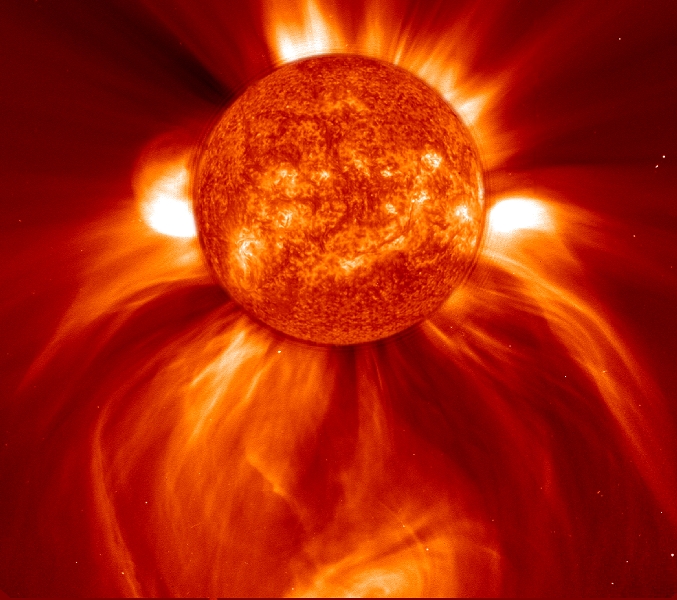 Under mounting pressure from scientists that reject the politically popularized man-made global warming and climate models—the Anthropogenic Global Warming (AGW) theory—the American space agency NASA has admitted that all past warming trends were driven by solar activity.
A victory for the man-made ‘global warming deniers’
As more scientists have joined the outcry over the politicization of Earth’s climate cycles—the current number exceeds 20,000—promoters of the AGW model have denounced the “global warming deniers” countering that little evidence supports the view that the sun is driving the observed warming trend.
Now, however, new study released from NASA’s Goddard Space Flight Center in Greenbelt, Maryland measuring the global temperature variance during the past 100 years has found the sun’s heat and variable cycles have indeed made a significant, measurable impact and greatly influenced Earth’s climate.
In fact, the influence extends as far back as the Read more…
Large-Scale Assessment Of The Arctic Ocean: Significant Increase In Freshwater Content Since 1990s
The freshwater content of the upper Arctic Ocean has increased by about 20 percent since the 1990s. This corresponds to a rise of approx. 8,400 cubic kilometres and has the same magnitude as the volume of freshwater annually exported on average from this marine region in liquid or frozen form. This result is published by researchers of the Alfred Wegener Institute in the journal Deep-Sea Research. The freshwater content in the layer of the Arctic Ocean near the surface controls whether heat from the ocean is emitted into the atmosphere or to ice. In addition, it has an impact on global ocean circulation.
Differences in the mean salinity of the Arctic Ocean above the 34 isohaline between 2006 to 2008 and 1992 to 1999.

Negative values are shown in yellow, green, and blue and stand for an increase of freshwater.
Image: Benjamin Rabe, Alfred Wegener Institute Read more…
First North Pole Ozone Hole Forming?

Spawned by strangely cold temperatures, “beautiful” clouds helped strip the Arctic atmosphere of most of its protective ozone this winter, new research shows.
The resulting zone of low-ozone air could drift as far south as New York, according to experts who warn of increased skin-cancer risk.
The stratosphere’s global blanket of ozone—about 12 miles (20 kilometers) above Earth—blocks most of the sun‘s high-frequency ultraviolet (UV) rays from hitting Earth’s surface, largely preventing sunburn and skin cancer.
But a continuing high-altitude freeze over the Arctic may have already reduced ozone to half its normal concentrations—and “an end is not in sight,” said research leader Markus Rex, a physicist for the Alfred Wegener Institute for Polar and Marine Research in Bremerhaven, Germany.
Preliminary data from 30 ozone-monitoring stations throughout the Arctic show the Read more…
Global warming means more snowstorms: scientists
Climate change is not only making the planet warmer, it is also making snowstorms stronger and more frequent, US scientists said on Tuesday.
 Workers remove snow from a runway at O’Hare International Airport on February 3, in Chicago, Illinois. Climate change is not only making the planet warmer, it is also making snowstorms stronger and more frequent, US scientists said on Tuesday.
“Heavy snowstorms are not inconsistent with a warming planet,” said scientist Jeff Masters, as part of a conference call with reporters and colleagues convened by the Union of Concern Scientists.
“In fact, as the Earth gets warmer and more moisture gets absorbed into the atmosphere, we are steadily loading the dice in favor of more extreme storms in all seasons, capable of causing greater impacts on society.”
Masters said that the northeastern United States has been coated in heavy snowfall from Read more…


![[Most Recent Quotes from www.kitco.com]](https://i0.wp.com/www.kitconet.com/charts/metals/gold/t24_au_en_usoz_2.gif)
![[Most Recent Quotes from www.kitco.com]](https://i0.wp.com/www.kitconet.com/charts/metals/silver/t24_ag_en_usoz_2.gif)

 crisisboom
 CRISISBOOM
You must be logged in to post a comment.