Archive
Close Approach of PHA Asteroid 2012 QG42
 On September 14th, at 05:12 GMT (09:12 Moscow time) asteroid 2012 QG42 will fly at the distance of 0.019 AU – which is 2.84 million kilometers, or about 7.4 average distances from planet Earth to the Moon.
In the future, this asteroid will fly even closer to Earth. On September 15, 2039 it will fly at the distance of 0.014 AU (5.6 distance to the Moon), and on February 15, 2013 at 23:25 MSK -at the distance of 26.9 thousand kilometers far from our planet. This distance is shorter than the height of the geostationary satellites.
Large Asteroid To Zoom Past Earth In Cosmic Close Call

The third near-earth asteroid of 2011 will pass between the moon and earth later this year, NASA has confirmed.
The 575-foot-wide (175 metres) asteroid, which is more than one and a half times the length of a soccer pitch, will pass within 0.85 lunar distances of the Earth on November 8, 2011.
Discovered on December 28, 2005 by Robert McMillan of the Spacewatch Program near Tucson, Arizona, 2005 YU55 is believed to be a very dark, nearly spherical object.
According to NASA’s Near Earth Object Program: “Although classified as a potentially hazardous object, 2005 YU55 poses no threat of an Earth collision over at least the next 100 years. However, this will be the closest approach to date by an object this large that we know about in advance and an event of this type will not happen again until 2028 when asteroid (153814) 2001 WN5 will pass to within Read more…
Collision With Huge Asteroid Caused 17 Kilometer Diameter Crater Found in Congo
Scientists have newly confirmed the Luizi impact structure, Democratic Republic of Congo– and provide insights into central uplift formation and post-impact erosion
Ludovic Ferriere of the Austria’s Natural History Museum and colleagues report on the large, ~17-km-diameter Luizi structure, located in the remote and politically tumultuous Democratic Republic of Congo.
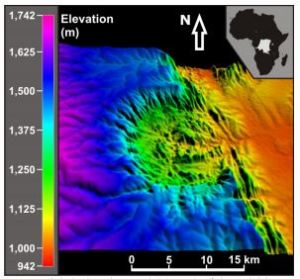 Credit: 42nd Lunar and Planetary Science Conferenc
Military Hush-Up: Incoming Objects Now Classified .. Closing the Eyes of a Nation

The upshot: Space rocks that explode in the atmosphere are now classified.
“It’s baffling to us why this would suddenly change,” said one scientist familiar with the work. “It’s unfortunate because there was this great synergy…a very good cooperative arrangement. Systems were put into Read more…
Britain in list of countries ‘most at risk’ if an asteroid strikes
Britain has been identified among a host of countries scientists believe would be worst affected in the event of an asteroid strike.

Experts at Southampton University have drawn up a league table of countries most likely to suffer severe loss of life or catastrophic damage should a large asteroid hit Earth.
The list is largely made up of developed nations including China, Japan, the United States and Italy, on the basis that the size of their populations would mean millions of deaths.
The US, China, Indonesia, India and Japan are most in danger on this basis. Canada, the US, China, Japan and Sweden are rated most at risk in terms of potential damage to their infrastructure.
The report comes after a rock the size of a house came within 7,500 miles of Earth earlier this Read more…
Astronomers: Comet Elenin may produce greatest meteor showers in history
 The unusual Comet Elenin is expected to pass within 21 million miles of Earth on October 16, 2011 and speeding by at more than 85,000 mph—so fast it could travel from Earth to the Moon in less than five hours.
Discovered by amateur Russian astronomer Leonid Elenin in Lyubertsy, Russia on December 10, 2010—who accessed the International Scientific Optical Network’s robotic observatory near Mayhill, New Mexico—the astronomical community has erupted with the excited possibility the celestial traveller could generate the most spectacular meteor showers ever recorded.
Although the comet’s path is expected to change as it draws closer to the sun, astronomical calculations appear to show Elenin’s perihelion occurring well inside Earth’s orbit by September 5th.
Astronomers believe the comet will be visible with a good pair of field binoculars about the middle of August. After then it should become visible in the Northern hemisphere’s predawn Read more…
NASA Shuts Down Prolific Sky-Mapping Space Telescope
 A prolific sky-mapping telescope that has spent more than a year scanning the heavens for asteroids, comets and other cosmic objects received its last command today (Feb. 17).
NASA shut down its WISE spacecraft – short for Wide-field Infrared Survey Explorer – at 3:00 p.m. EST (2000 UTC) today. The mission’s principal investigator, Ned Wright of the University of California in Los Angeles, sent the final command to the now-hibernating spacecraft, according to an update from the WISE mission’s official Twitter account.
“The WISE spacecraft will remain in hibernation without ground contacts awaiting possible future use,” NASA officials said via Twitter.
WISE launched on Dec. 14, 2009 to begin a 10-month mission to collect Read more…


![[Most Recent Quotes from www.kitco.com]](https://i0.wp.com/www.kitconet.com/charts/metals/gold/t24_au_en_usoz_2.gif)
![[Most Recent Quotes from www.kitco.com]](https://i0.wp.com/www.kitconet.com/charts/metals/silver/t24_ag_en_usoz_2.gif)

 crisisboom
 CRISISBOOM
You must be logged in to post a comment.