Archive
Asteroid to come close to Earth on Febuary 15
An asteroid will come close to the earth on February 15, according to Birla Science Centre here.
“This is the first near-earth asteroid to pass so close to the earth”, said B M Birla Science Centre Director Dr B G Sidharth said in a release here.
The asteroid ‘2012 DA 14’ measures about 50 metres and would swoop to about 27,000 km near earth or roughly about one tenth the distance to moon, he said.
Kansan discovers asteroid that may come near Earth
 For the second time in less than four months, amateur astronomer Gary Hug, of Scranton, has discovered an asteroid that could one day pass close to Earth. The asteroid was found on the evening of Jan. 6 as Hug was searching for another object listed on the NEOCP (Near Earth Object Confirmation Page).
The asteroid discovered by Hug was first noticed on the west edge of the field of vision provided by the camera he had attached to his telescope.
“It was traveling too slow for most satellites but moving about 10 times faster than main belt asteroids,” he explained, noting that main belt asteroids were those found between Mars and Jupiter.
After determining that the asteroid he found wasn’t one that had been seen before, he ran a brief analysis of it and then reported his find to the Minor Planet Center.
“Within 15 minutes, this asteroid was listed on the NEOCP at the Minor Planet Center,” Hug said. “A few hours later, another Read more…
Star Betelgeuse to Crash within 5,000 Years

As per a new image provided by the Herschel Space Observatory, it has been revealed that Betelgeuse, one of the star’s in Orion constellation is going to crash in 5,000 years. The information about the same has been provided by the NASA, which has also unveiled that the star is the going to crash with a cosmic wall.
Experts said that the orange-red star is quite a bright star and its collision will definitely prove costly. It has been said so as the star is already started shedding a large amount of its exterior most layer. The shedding was visible in the Hershel’s picture as well.
The picture has also showed the effect of star’s fierce winds. It has been found that the winds have been causing whipping around the nearby space. It has also been seen that the dusty debris lies around the star.
Experts have predicted that it will take 5,000 years for the outer arc of the star to crash. If to talk about the whole star, then it will take approximately 12,500 years. Astronomers said that the star has swelled up and has been shedding a lot of fraction of its outermost layer. This has made sure that its collision will be a supernova explosion. Read more…
Rogue Planet Like Nibiru Found By Hubble Space Telescope
This diagram shows the orbit of the exoplanet Fomalhaut b as calculated from recent Hubble Space Telescope observations. The planet follows a highly elliptical orbit that carries it across a wide belt of debris encircling the bright star Fomalhaut. 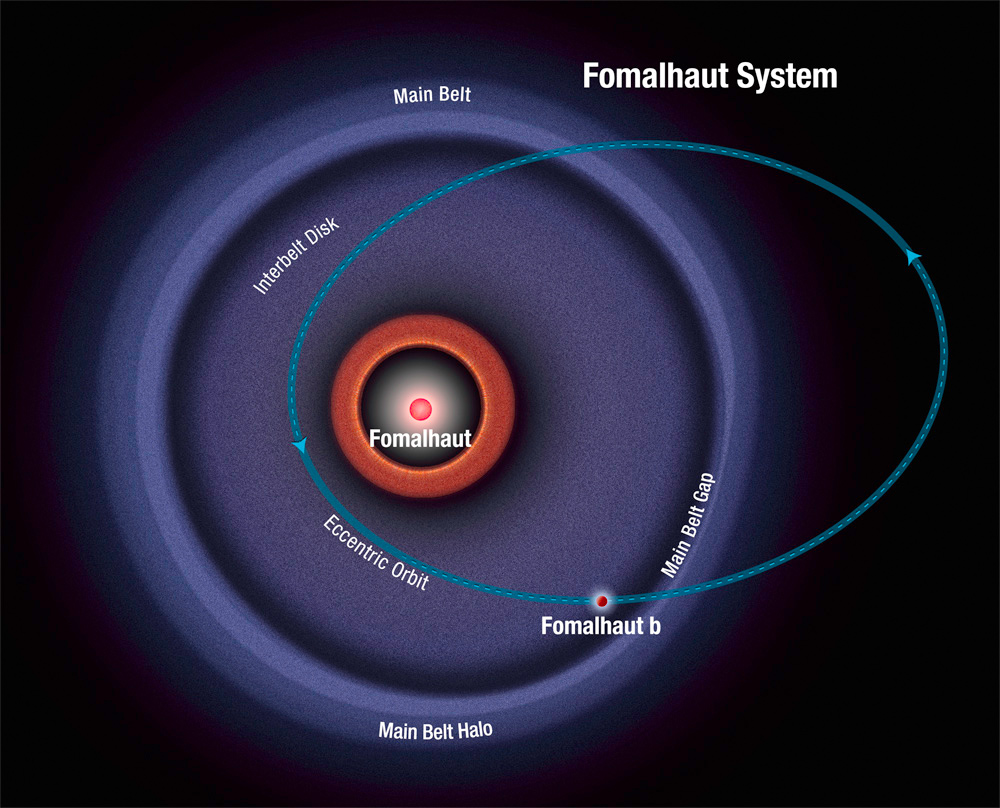 The planet swings as close to its star as 4.6 billion miles, and the outermost point of its orbit is 27 billion miles away from the star. The orbital period is approximately 2,000 years.
Illustration Credit: NASA, ESA, and A. Feild (STScI)
Newly released NASA Hubble Space Telescope images of a vast debris disk encircling the nearby star Fomalhaut and a mysterious planet circling it may provide forensic evidence of a titanic planetary disruption in the system.
Astronomers are surprised to find the debris belt is wider than previously known, spanning a Read more…
SOFIA Spots Recent Starburst in the Milky Way Galaxy’s Center

Researchers using the Stratospheric Observatory for Infrared Astronomy (SOFIA) have captured new images of a ring of gas and dust seven light-years in diameter surrounding the supermassive black hole at the center of the Milky Way, and of a neighboring cluster of extremely luminous young stars embedded in dust cocoons.
The images of our galaxy’s circumnuclear ring (CNR) and its neighboring quintuplet cluster (QC) are the subjects of two posters presented this week during the American Astronomical Society’s meeting in Long Beach, Calif. Ryan Lau of Cornell University and his collaborators studied the CNR. Matt Hankins of the University of Central Arkansas in Conway is lead author of the other paper, regarding the QC.
‘Brighter than a full moon’: The biggest star of 2013… could be Ison – the comet of the century
A comet discovered by two Russian astronomers will be visible from Earth next year. Get ready for a once-in-a lifetime light show, says David Whitehouse

At the moment it is a faint object, visible only in sophisticated telescopes as a point of light moving slowly against the background stars. It doesn’t seem much – a frozen chunk of rock and ice – one of many moving in the depths of space. But this one is being tracked with eager anticipation by astronomers from around the world, and in a year everyone could know its name.
Comet Ison could draw millions out into the dark to witness what could be the brightest comet seen in many generations – brighter even than the full Moon.
It was found as a blur on an electronic image of the night sky taken through a telescope at the Kislovodsk Observatory in Russia as part of a project to survey the sky looking for comets and asteroids – chunks of rock and ice that litter space. Astronomers Vitali Nevski and Artyom Novichonok were expecting to use the Read more…
Mysterious Fireballs Light up Night Sky across UK (VIDEO)

Hundreds of people across the UK witnessed bright objects shooting across the night sky on 21 September.
Sightings of huge fireballs, thought to be a meteor shower, were reported in northern England, central Scotland and Northern Ireland.
Witnesses described seeing a bright fireball shooting across the sky with a large bright tail.
Many people took to Twitter to post photos, videos and comments on the sightings.
The UK Met Office tweeted, “Hi all, for anyone seeing something in the night sky, we believe it was a meteorite”, while some speculated that it could be space junk burning up in the atmosphere.
The Kielder Observatory in Northumberland also reported sighting huge fireballs streaking from east to west at 9:41pm. It reported nearly 100 bright fragments shooting across the sky.
“Many many fragments maybe in Read more…
Strange Energy From Galactic Center Bombarding Earth
Strange particles believed to be emanating from the elusive ‘dark matter’ at the center of the galaxy have been confirmed to be bombarding Earth. Two physicists from the prestigious Department of Physics & Astronomy at University of California discovered more gamma-rays bombarding Earth than believed by astronomers. The stream of electromagnetic radiation (spewed by the process of intensive radioactive decay and other other high-energy emmisions) may be triggering the bizarre mutation of matter and an incredible energy cloud that an astrophysicist says threatens Earth.

According to a groundbreaking investigation conducted by two UC Irvine astrophysicists and submitted to the peer-reviewed American Physical Society journal Physical Review, colliding particles of dark matter may be creating a maelstrom of turbulent energy deep in the heart of the Milky Way Galaxy. Among the particles streaming from the Read more…
Scientists discover planetary system orbiting Kepler-47

This diagram compares our own solar system to Kepler-47, a double-star system containing two planets, one orbiting in the so-called “habitable zone.” This is the sweet spot in a planetary system where liquid water might exist on the surface of a planet. Credit: NASA/JPL-Caltech/T. Pyle
Astronomers see bright impact on gas giant Jupiter
 The impact captured on Video by George Hall in Dallas, Texas. Image: George Hall.
Amateur astronomers in the United States of America have reported a bright fireball in the Jupiter clouds tops as a result of an apparent impact. The first to see and report the event was amateur astronomer Dan Peterson from Racine, Wisconsin, who just happened to be observing the gas giant through his 300-mm LX200 ‘scope when the fireball burst into view; “This morning (9/10/2012) at 11:35:30 UT, I observed a bright white two second long explosion just inside Jupiter’s eastern limb, located at about Longitude 1 = 335, and Latitude = + 12 degrees north, inside the southern edge of the NEB. This flash appeared to be about 100 miles in diameter. I used my Meade 12 LX200 GPS telescope and a binoviewer working at 400X for the observation, seeing was very good at the time. We’ll have to Read more…


![[Most Recent Quotes from www.kitco.com]](https://i0.wp.com/www.kitconet.com/charts/metals/gold/t24_au_en_usoz_2.gif)
![[Most Recent Quotes from www.kitco.com]](https://i0.wp.com/www.kitconet.com/charts/metals/silver/t24_ag_en_usoz_2.gif)

 crisisboom
 CRISISBOOM
You must be logged in to post a comment.