Archive
Study says humans now use the internet as our main ‘memory’ – instead of our heads

Helping hand? Harvard researchers found that we now use the internet to remember 'for us' - and decide not to store facts if we think we can Google them later
The Internet is becoming our main source of memory instead of our own brains, a study has concluded.
In the age of Google, our minds are adapting so that we are experts at knowing where to find information even though we don’t recall what it is.
The researchers found that when we want to know something we use the Internet as an ‘external memory’ just as computers use an external hard drive.
Nowadays we are so reliant on our smart phones and laptops that we go into ‘withdrawal when we can’t find out something immediately’.
And such is our dependence that having our Internet connection severed is growing ‘more and more like losing a friend’.
Researchers from Harvard University, the University of Wisconsin-Madison and Columbia University in the U.S. carried out four tests to check their theory.
They involved giving test participants a trivia quiz and then seeing whether they recognised Read more…
Study of the Day: Soon, You May Download New Skills to Your Brain
New research suggests it may be possible to learn complex tasks with little to no conscious effort, just like in The Matrix. Whoa, indeed.

PROBLEM: Unlike Neo in The Matrix or the titular superspy in the comedy series Chuck, we can’t master kung fu just by beaming information to our brain. We have to put in time and effort to learn new skills.
RESULTS: The experiments successfully demonstrated that Read more…
IBM develops first ‘brain chips’ capable of mimicking the process of human thought
 The challenge in training a computer to behave like a human brain has tested the limits of science for decades.
But researchers from IBM today said they have made a key step towards combining the two worlds.
The U.S. technology firm has built two prototype chips that it says process data more like how humans digest information than the chips that currently power PCs and supercomputers.
The chips represent a significant milestone in a six-year-long project that has involved 100 researchers and some $41million (£25million) in funding from the U.S. government’s Defense Advanced Research Projects Agency (Darpa). IBM has also committed an Read more…
RFID Chips And Soul Catcher 2025
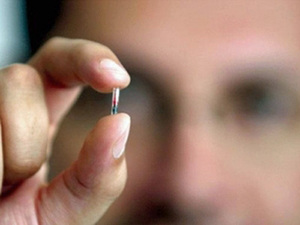
From RFID chips to Soul Catcher 2025 - technology to capture your soul and implant it in somebody else...
News that the British government is planning to tag prisoners with radio frequency identification (RFID) chips was met last year with instant opposition from probation officers and civil rights lawyers.
And rightly so. Government plans to implant the RFID chips without prisoners’ consent would in any circumstance be deemed an illegal act. It would also, of course, create a major moral dilemma.
“If the Home Office doesn’t understand why implanting a chip in someone is worse than an ankle bracelet,” said Shami Chakrabarti of the civil rights group, Liberty, “they don’t need a human-rights lawyer—they need a common-sense bypass.”
And Harry Fletcher, Assistant General Secretary of the National Association of Probation Officers, had this to say about the no-brainer scheme:
“Knowing where offenders like paedophiles are does not mean you know what they are doing. Treating people like pieces of meat does not seem to represent an improvement Read more…
StunRay disables your brain with inverse blindness

Until we figure out how to make a phaser that can be set to stun, we’ve been stuck with non less-lethal options like tasers (which can kill) and laser dazzlers (which can cause eye damage). StunRay is basically just a big flashlight, except with the ability to disable you by causing “inverse blindness.”
If you’re wondering what inverse blindness looks like, it’s easy to do to yourself: just stare at a bright light for a minute or two and then look around. It’s not dark, really, but you can’t see anything very well, and it’s because the exposure to bright light has overloaded the neurons that connect your retinas to your brain, and mostly all you can see is a featureless white expanse. The technical term for this is “loss of contrast sensitivity,” and it’s an effective way of disabling someone.
A company called Genesis Illumination is working what’s basically a giant fancy flashlight called StunRay that can inflict this loss of contrast sensitivity or inverse blindness or neural overload or whatever you want to call it on people at long range in a split second. Each burst of super bright light incapacitates subjects for five seconds or so without causing any pain, and subjects fully recover in about five minutes. The “fully recover” bit is key, since StunRay won’t roast your eyeballs like a laser dazzler can.
StunRay uses a 75 watt bulb, which doesn’t seem like much, but with some fancy optics, the device is able to focus its light beam to be ten times brighter than an aircraft landing light, even up to 150 feet away. And in case you were wondering, and I’m sure you were, this is bright enough to read a newspaper from a mile away.
Genesis Illumination just received a patent for StunRay, so in the near future, we’ll be able to rely on one single device for both our disabling and long distance newspaper-reading needs.
Sixth Study in Recent Months Linking Mercury in Flu Shots to Brain Damage, Autism
 The toxic effects of the mercury, also known in vaccines as Thimerosal, have once again been confirmed, this time by researchers from the University of Brazil. Marking the sixth major study in recent months to condemn the use of mercury in medicine, the new study reveals that mercury causes serious brain damage, and is linked to autism and other developmental diseases in children and Alzheimer’s disease in adults.
Dr. Jose Dorea and his colleagues conducted an extensive, peer-reviewed analysis of various studies and available information in major databases that address the effects of low-dose Thimerosal, or ethylmercury, on neural tissue and behavior. They found conclusively that Thimerosal accumulates in brain tissue, negatively affects brain development, and harms brain cells.
“Mercury is known to cause serious harm, especially to fetuses and children because of their Read more…
Chip in the Brain Controls Computer: Braingate Neural Interface System Reaches 1,000-Day Performance Milestone
 An investigational implanted system being developed to translate brain signals toward control of assistive devices has allowed a woman with paralysis to accurately control a computer cursor at 2.7 years after implantation, providing a key demonstration that neural activity can be read out and converted into action for an unprecedented length of time.

![[Most Recent Quotes from www.kitco.com]](https://i0.wp.com/www.kitconet.com/charts/metals/gold/t24_au_en_usoz_2.gif)
![[Most Recent Quotes from www.kitco.com]](https://i0.wp.com/www.kitconet.com/charts/metals/silver/t24_ag_en_usoz_2.gif)

 crisisboom
 CRISISBOOM
You must be logged in to post a comment.