Archive
Warm Ocean Waters to Blame for Antarctic Ice Melt
 |
| Antarctica’s Brunt Ice Shelf. CREDIT: British Antarctic Survey |
When it comes to melting ice shelves in Antarctica, the danger comes from below, new research suggests.
By discovering the anatomy of ice loss across this chilly expanse, research may be able to forecast how the continent will melt in the future — and also how much global seas may rise.
Team member David Vaughan, a scientist at the European Union initiative ice2sea, said this study “shows the key to predicting how the ice sheet will change in the future is in understanding the oceans.”
Water or wind?
Scientists have long known that the wide platforms of ice extending from the southernmost continent have been shrinking away. But what’s behind the melting hasn’t been clear — whether warm ocean currents or surface winds have a bigger impact on the ice.
Now, a new satellite survey of Antarctica places the blame largely on the water. “In most places in Antarctica, we can’t explain the ice-shelf thinning through melting of snow at Read more…
Arctic methane leaks threaten climate
 Methane released as ice retreats could force greater climate warming (Image: KPA/Zuma/Rex Features)
As Arctic sea ice breaks apart, massive amounts of methane could be released into the atmosphere from the cold waters beneath.
High concentrations of the greenhouse gas have been recorded in the air above cracks in the ice. This could be evidence of yet another positive feedback on the warming climate – leading to even faster Arctic warming.
The Arctic is home to vast stores of methane – there are billions of tonnes of methane in permafrost alone. It is a potent greenhouse gas, so a major methane release would greatly accelerate climate change. The gas is found in icy crystals called hydrates beneath the shallow seas that flood some areas of the continental crust, as well as in permafrost. It is also being released from Arctic wetlands.
But this doesn’t explain why Eric Kort of the Jet Propulsion Laboratory in Pasadena, California, and his colleagues found patches of methane in remote regions of the Arctic Ocean, far from any of these known methane sources.
The team found the patches during five flights over the Arctic Ocean between 2009 and 2010, as part of a project to systematically map greenhouse gas levels in the atmosphere.
Kort estimates Read more…
Saturday Tornado Recap: 100+ Tornadoes, 6 Dead
 AccuWeather.com reports tornadic thunderstorms ravaged parts of the Plains Saturday and Saturday night, killing six people and leaving behind incredible destruction.
According to the Storm Prediction Center, over 100 tornadoes were reported from Oklahoma through Kansas, Nebraska and southern Iowa on Saturday.
The deadliest of the tornadoes ravaged the town of Woodward, Oklahoma, where six people were killed and 30 injured.
The tornado ripped through the northwest side of the city, destroying or damaging dozens of homes.
Another tornado tore through the southern portion of Wichita, Kan., causing significant damage but no major injuries.
Wichita, Mid-Continent Airport recorded a wind gust of 84 mph just after the control tower evacuated.
Damage was recorded at the Boeing and Spirit Aerosystems plants. Six buildings at Spirit Aerosystems were heavily damaged while four others had major damage.
According to the Kansas City Star, damage in the Wichita area is estimated at as much as $283 million.
A tornado ripped through the town of Thurman, Iowa, Read more…
Mt. Fuji is melting its snow
Though it was the season when Mt. Fuji has the most snow, snow is already disappearing.
From December to January, most of the snow melted only within a month. Mt. Fuji is heated.
↓ 12/10/2011

↓ 1/13/2012

Citizens near Mt. Fuji talks they haven’t seen such a thing.
Spring has Sprung, it’s getting warmer
 Across the country, more than 7,700 daily temperature records were broken last month, on the heels of the fourth warmest winter on record.
While it might be time to lie on a blanket in the park, climate scientists are worried. They say all these sunny days are actually an extreme weather event, one with local and global implications.
In Iowa, March was so hot — a record-breaking 84 degrees — that some crops there, like oats, are now running way ahead of schedule.
Joe Prusacki, a statistician with the Department of Agriculture, says this time of year Iowa usually has just 7 percent of its oats planted.
“Right now, they’re at 58 percent planted,” Prusacki says. “That’s because if you plant the crop now, it’s going to germinate and grow.”
It’s hard to say whether that could be good for farmers, since crops could still get hit with frost as late as May.
Even with the early warm weather, that chance of a hit of frost could spell trouble for farmers. But if you’ve got allergies, you may already be in trouble.
“Barring some sort of dramatic snow or change, we probably won’t see much relief until midsummer when things do calm down,” says Jim Sublett, an allergist in Louisville, Ky. He says patients have been coming to him with runny noses, itchy eyes and even asthma flare-ups since mid-February, about a month earlier than normal.
Weather Extremes & Global Warming — The Connection

Seasonal Jun-Jul-Aug 2010 sea surface temperature (SST) anomalies relative to 1951–70. Record high SSTs were recorded in the locations and at the times indicated with record flooding nearby.
Curious about the connection between global warming and extreme weather? You ought to be. And who better to learn about this from than National Center for Atmospheric Research senior scientist Kevin E. Trenberth?
Here’s a new article by Trenberth published in the journal Climatic Change under a Creative Commons-Attribution license (PDF here, HTML here) — thanks to Climate Progress for the find and share: Read more…
Effective World Government Will Be Needed to Stave Off Climate Catastrophe

Receding Himalayan glaciers
Almost six years ago, I was the editor of a single-topic issue on energy for Scientific American that included an article by Princeton University’s Robert Socolow that set out a well-reasoned plan for how to keep atmospheric carbon dioxide concentrations below a planet-livable threshold of 560 ppm. The issue came replete with technical solutions that ranged from a hydrogen economy to space-based solar.
If I had it to do over, I’d approach the issue planning differently, my fellow editors permitting. I would scale back on the nuclear fusion and clean coal, instead devoting at least half of the Read more…
New figures: More of US at risk to sea level rise
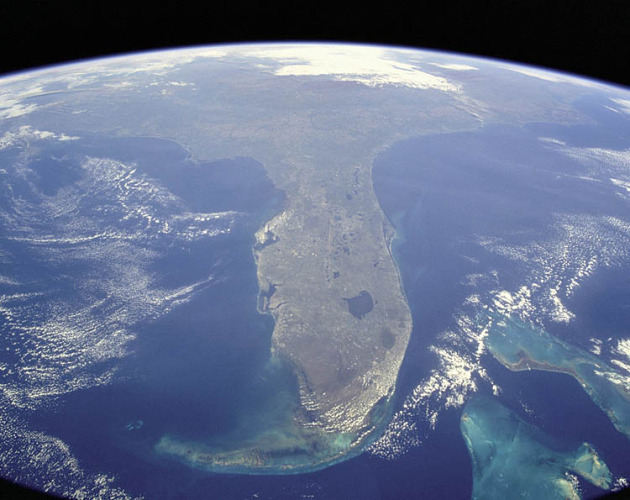 WASHINGTON (AP) — Nearly 4 million people across the United States, from Los Angeles to much of the East Coast, live in homes more prone to flooding from rising seas fueled by global warming, according to a new method of looking at flood risk published in two scientific papers.
The cities that have the most people living within three feet (one meter) of high tide – the projected sea level rise by the year 2100 made by many scientists and computer models – are in Florida, Louisiana, and New York. New York City, often not thought of as a city prone to flooding, has 141,000 people at risk, which is second only to New Orleans’ 284,000. The two big Southeast Florida counties, Miami-Dade and Broward, have 312,000 people at risk combined.
All told, 3.7 million people live in homes within three feet of high tide. More than 500 US cities have at least 10 percent of the population at increased risk, the studies said.
“Southeast Florida is definitely the highest density of population that’s really on Read more…
Greenland ice sheet may melt completely with 1.6 degrees global warming
 Photo: christine zenino/Flickr
The Greenland ice sheet is likely to be more vulnerable to global warming than previously thought. The temperature threshold for melting the ice sheet completely is in the range of 0.8 to 3.2 degrees Celsius of global warming, with a best estimate of 1.6 degrees above pre-industrial levels, shows a new study by scientists from the Potsdam Institute for Climate Impact Research (PIK) and the Universidad Complutense de Madrid. Today, already 0.8 degrees of global warming has been observed. Substantial melting of land ice could contribute to long-term sea-level rise of several meters and therefore it potentially affects the lives of many millions of people. The time it takes before Read more…
After 4 Years, Checking Up on The Svalbard Global Seed Vault
For its birthday, Svalbard will receive seeds from war-torn Syria and celebrate years of success preserving our inheritance from Neolithic times.

The world’s agricultural hard drive, the Svalbard Global Seed Vault, turns four years old today. The vault was a media sensation when it first opened in 2008, but it hasn’t been in the news much since. I figured it was time to check in and see how these first four years have gone. An awesome technology by any measure, the vault is a steely compound tunneled five hundred feet into an icy mountain in the Norwegian Arctic, just 600 miles from the North Pole. It is designed to last a thousand years, and to withstand a wide range of global disasters, including climate change, nuclear war, and even an asteroid strike. Over the past four years the vault has amassed some 740,000 seed samples and eventually it may house every crop seed ever used by a human being.


![[Most Recent Quotes from www.kitco.com]](https://i0.wp.com/www.kitconet.com/charts/metals/gold/t24_au_en_usoz_2.gif)
![[Most Recent Quotes from www.kitco.com]](https://i0.wp.com/www.kitconet.com/charts/metals/silver/t24_ag_en_usoz_2.gif)

 crisisboom
 CRISISBOOM
You must be logged in to post a comment.