Archive
Can You Anticipate Gold To Hit $1,500 & Silver $50 Quite Soon, Probably As Early As Summertime?
 Yes, I believe that you can anticipate gold to hit $1,500 and silver to hit $50 extremely quickly, perhaps as early as this summertime. Now would be an excellent time for you for making investments in gold and silver. Buy precious metals now.
FOR IMMEDIATE RELEASE
Governments have in turn cherished it, hated it and now are beginning to adore it again. It’s what it is purported to signify that leads to all the fuss. Just take a look at the factors put forward by some regarding why it’s rising in price and Read more…
Wal-Mart US CEO To America: “Prepare For Serious Inflation”
 To those who think that buying food in the corner deli is becoming a luxury, we have five words: you ain’t seen nuthin’ yet. U.S. consumers face “serious” inflation in the months ahead for clothing, food and other products, the head of Wal-Mart’s U.S. operations warned Wednesday talking to USA Today. And if Wal-Mart which is at the very bottom of commoditized consumer retail, and at the very peak of avoiding reexporting of US inflation by way of China is concerned, it may be time to panic, or at least cancel those plane tickets to Zimbabwe, which is soon coming to us.
The world’s largest retailer is working with suppliers to minimize the effect of cost increases and believes its low-cost business model will position it better than its competitors.
Still, inflation is “going to be serious,” Wal-Mart U.S. CEO Bill Simon said during a meeting with USA TODAY’s editorial board. “We’re seeing cost increases starting to come through at a pretty rapid rate.”
Along with steep increases in raw material costs, John Long, a retail strategist at Kurt Salmon, says labor costs in China and fuel costs for transportation are weighing heavily on retailers. He predicts prices will start increasing at all retailers in June. Read more…
Worldwide Silver Shortage?

FutureMoneyTrends.com has recently received several reports, published and non published reports about possible silver shortages. Is their a very limited supply of silver, yes, is there a worldwide shortage happening right now, well not exactly. Under the agreement that we wouldn’t reveal their name, a major bullion dealer who we are friends with, told us that their traders are not having any issues buying physical silver, and that their warehouse had a significant amount of physical silver. Now, will there one day be a shortage of silver, in our opinion at these prices, yes, the price for silver will have to move up considerably in order to come in line with the above ground available supply and ever increasing demand. Sorry to disappoint you, Read more…
The Coming Rout QE3
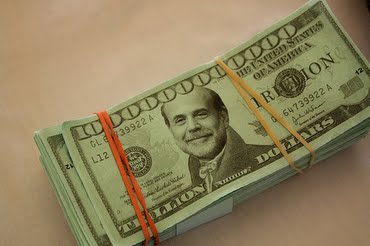 There’s a scenario that could play out between May and September in which commodities (including my beloved silver) and the stock and bond markets could all sell off between 20% and 40%. The trigger will be the cessation of QE II and a multi-month pause before QE III.
This is a reversal in my thinking from the outright inflationary ‘buy with both hands’ bent that I have held for the past two years. Even though it’s quite a speculative analysis at this early stage, it is a possibility that we must consider.
Important note: This is a short-term scenario that stems from my trading days, so if you are a long-term holder of a core position in gold and silver, as am I, nothing has changed in my extended outlook for these metals. The fiscal and monetary path we are on has a very high likelihood of failure over the coming decade, and I see nothing that shakes that view.
But over the next 3-6 months, I have a few specific concerns.
It’s time to build on the idea I planted in the Insider article entitled Blame the Victim (February 28, 2011) where I speculated on the idea that the Fed might be forced to end its Read more…
The Oil-Food Price Shock
 When future historians attempt to trace the origins of the current turmoil in the Middle East, they will find that one of the earliest of the many explosions of rage occurred in Algeria and was triggered by the rising price of food. On January 5, young protesters in Algiers, Oran and other major cities blocked roads, attacked police stations and burned stores in demonstrations against soaring food prices. Other concerns—high unemployment, pervasive corruption, lack of housing—also aroused their ire, but food costs provided the original impulse. As the epicenter of youthful protest moved elsewhere, first to Tunisia and then to Egypt and other countries, the food price issue was subordinated to more explicitly political demands, but it never disappeared. Indeed, the rising cost of food has been a major theme of anti government demonstrations in Jordan, Sudan and Yemen. With the price of most staples still climbing—spurred in part by a parallel surge in oil costs—more such protests are bound to occur.
Oil will go up ‘ballistically’ if unrest shifts to Saudi Arabia, says Marc Faber
INTERNATIONAL. Marc Faber the Swiss fund manager and Gloom Boom & Doom editor sees oil prices extending their bull run despite the 15% run-up this year alone.
 In an optimistic scenario demand for oil will rise as the global recovery takes hold, and in a pessimistic scenario prices still go up if the Middle East unrest spreads and crude production is curtailed. In both cases, he says, you should be long energy and energy related shares.
Speaking to CNBC today, Faber said: ” I think long term you should be exposed to energy in either scenario….if you are extra bearish and believe that War World III is going to start soon, as I believe, or in an optimistic scenario”.
Addressing the fundamentals of the oil market, Faber said: “What we had over the last couple of years is essentially a reduction in demand from the developed world, the US, Western Europe and Japan, and continued growth in emerging economies.
“So, if you take a very optimistic view of the world, namely a global economic recovery, demand in the Western World will pick up and demand in the Emerging World will continue to rise strongly, so from a very optimistic point of view you should be long oil,” he recommended.
On the flip side, “in a very pessimistic scenario you have to assume that unrest will shift to Saudi Arabia and other countries in the gulf and at that stage the production is curtailed and in that case obviously oil will go up ballistically.”
Brent crude futures could hit US$200 a barrel if political unrest spreads into Saudi Arabia, Societe Generale said on Monday.
Under what the bank called Geopolitical Scenario 3, “unrest spreads to Read more…
China Takes Giant Step Towards Making the Yuan the World’s Reserve Currency
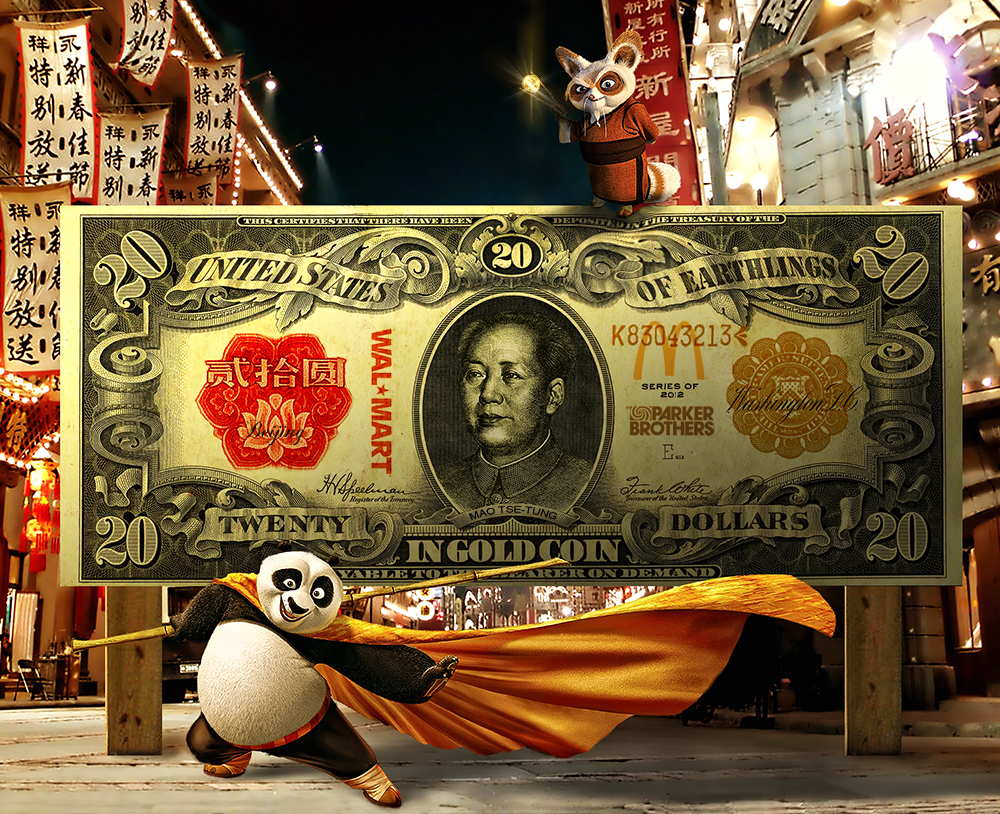 For years, I’ve been writing about the long-term decline of the Dollar, and the rise of the Chinese Yuan … and it’s potential to become the world’s next reserve currency.
As I pointed out in 2007, many countries have started moving out of the Dollar as the basis for international trade settlements, including:
-
Venezuela and 12 other Latin American countries as well as Cuba
-
Many other countries
In 2008, I wrote: Read more…
Need Versus Greed

NEW YORK – India’s great moral leader Mohandas Gandhi famously said that there is enough on Earth for everybody’s need, but not enough for everybody’s greed. Today, Gandhi’s insight is being put to the test as never before.
The world is hitting global limits in its use of resources. We are feeling the shocks each day in catastrophic floods, droughts, and storms – and in the resulting surge in prices in the marketplace. Our fate now depends on whether we cooperate or fall victim to self-defeating greed.
The limits to the global economy are new, resulting from the unprecedented size of the world’s population and the unprecedented spread of economic growth to nearly the entire world. There are now seven billion people on the planet, compared to just three billion a half-century ago. Today, average per capita income is $10,000, with the rich world averaging around $40,000 and the developing world around $4,000. That means that the world economy is now producing around $70 trillion in total annual output, compared to around $10 trillion in 1960.
China’s economy is growing at around 10% annually. India’s is growing at Read more…
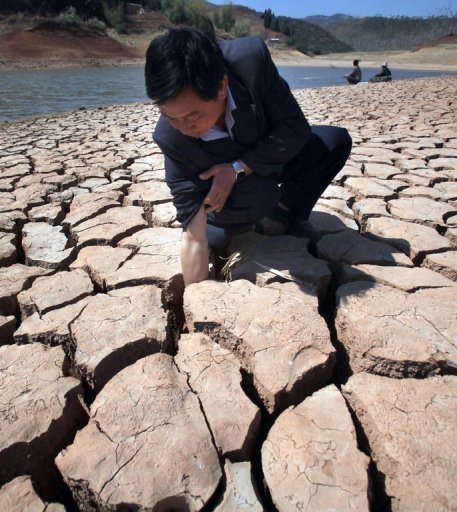
China’s droughts nears worst in 200 years, adding pressure to world food prices
The recent unrest in the Middle East, which has been attributed, in part, to high food prices, gives us a warning of the type of global unrest that might result in future years if the climate continues to warm as expected. A hotter climate means more severe droughts will occur. We can expect an increasing number of unprecedented heat waves and droughts like the 2010 Russian drought in coming decades. This will significantly increase the odds of a world food emergency far worse than the 2007 – 2008 global food crisis. When we also consider the world’s expanding population and the possibility that peak oil will make fertilizers and agriculture much more expensive, we have the potential for a perfect storm of events aligning in the near future, with droughts made significantly worse by climate change contributing to events that will cause disruption of the global economy, intense political turmoil, and war. Read more…


![[Most Recent Quotes from www.kitco.com]](https://i0.wp.com/www.kitconet.com/charts/metals/gold/t24_au_en_usoz_2.gif)
![[Most Recent Quotes from www.kitco.com]](https://i0.wp.com/www.kitconet.com/charts/metals/silver/t24_ag_en_usoz_2.gif)

 crisisboom
 CRISISBOOM
You must be logged in to post a comment.