Archive

Posts Tagged ‘earth’

Strange Energy From Galactic Center Bombarding Earth

September 14, 2012 Comments off

beforeitsnews.com

Strange particles believed to be emanating from the elusive ‘dark matter’ at the center of the galaxy have been confirmed to be bombarding Earth. Two physicists from the prestigious Department of Physics & Astronomy at University of California discovered more gamma-rays bombarding Earth than believed by astronomers. The stream of electromagnetic radiation (spewed by the process of intensive radioactive decay and other other high-energy emmisions) may be triggering the bizarre mutation of matter and an incredible energy cloud that an astrophysicist says threatens Earth.

According to a groundbreaking investigation conducted by two UC Irvine astrophysicists and submitted to the peer-reviewed American Physical Society journal Physical Review, colliding particles of dark matter may be creating a maelstrom of turbulent energy deep in the heart of the Milky Way Galaxy. Among the particles streaming from the Read more…

Close Approach of PHA Asteroid 2012 QG42

September 9, 2012 Comments off

remanzacco.blogspot.com

On September 14th, at 05:12 GMT (09:12 Moscow time) asteroid 2012 QG42 will fly at the distance of 0.019 AU – which is 2.84 million kilometers, or about 7.4 average distances from planet Earth to the Moon.

In the future, this asteroid will fly even closer to Earth.  On September 15, 2039 it will fly at the distance of 0.014 AU (5.6 distance to the Moon), and on February 15, 2013 at 23:25 MSK -at the distance of 26.9 thousand kilometers far from our planet.  This distance is shorter than the height of the geostationary satellites.

M.P.E.C. 2012-Q72, issued on 2012 Aug. 28, reports the discovery of the PHA asteroid 2012 QG42 (discovery magnitude 16.8) by Catalina Sky Survey on images taken on August 26.3 with a 0.68-m Schmidt + CCD.
2012 QG42 has an estimated size of 200 m – 500 m (H=20.4) and it will have a close approach with Earth at Read more…
Categories: astronomy Tags: , ,

Who’s ready for a solar super storm? Not us, emergency officials warn

April 18, 2012 Comments off

floridatoday.com

Satellite captures giant eruption from sun
Satellite captures giant eruption from sun: NASA’s solar orbiter captured an enormous eruption from the sun today, Space.com reports.
Jim Waymer | FLORIDA TODAY
This visually spectacular explosion occurred Monday on the sun’s Northeastern limb, seen at left, and was not directed at Earth. Emergency management officials want to prepare should one ever threaten Earth. / NASA

INDIALANTIC — Atomic particles explode off the sun’s surface, with the force of millions of hydrogen bombs, clobber Earth’s magnetic field in less than a day and black out the electric grid for days or longer.

Such a solar “super storm” happened in 1859. Called the Carrington Event, solar wind smacked the Earth within 18 hours, though the trip usually takes four days. Auroras lit the night sky as far south as Cuba, and in Boston and London, people read the newspaper under the nighttime glow.

A similar event now could cause $2 trillion in damage to Read more…

Categories: Solar Storm, Sun Tags: , ,

Galactic Cosmic Ray Volleys: A Coming Global Disaster (Video)s

April 18, 2012 Comments off

starburstfound.org

This is a very interesting interview with Dr. Paul LaViolette regarding the superwave theory.  The interview is pretty lengthy, however, it provides much insight on how our position in the Milkyway Galaxy will affect us. 

Galactic core outbursts are the most energetic phenomenon taking place in the universe. During the early 60′s astronomers began to realize that the massive object that forms the core of a spiral or giant elliptical galaxy periodically becomes active spewing out a fierce barrage of cosmic rays with a total energy output equal to hundreds of thousands of supernova explosions(1, 2). The cosmic ray electron component of such an outburst is always accompanied by synchroton emission which consists of electromagnetic radiation ranging from Read more…

‘The Great Acceleration’ And The State Of The Planet: Ominous Outlook

March 27, 2012 Comments off

nanopatentsandinnovations

Scientists describe humanity’s global impact as ‘The Great Acceleration’ and offer ominous outlook: An uncertain future on a much hotter world

Time is running out to minimize the risk of setting in motion irreversible and long-term climate change and other dramatic changes to Earth’s life support system, according to scientists speaking at the Planet Under Pressure conference, which began in London today.

The unequivocal warning is delivered on the first day of the four-day conference opening with the latest readings of Earth’s vital signs.

In subsequent days at the meeting, nearly 3,000 experts spanning the spectrum of interconnected scientific interests, will examine solutions, hurdles and ways to break down the barriers to progress. The conference is the largest gathering of experts in development and global environmental changes in advance of June’s UN “Rio+20” summit in Brazil.

“The last 50 years have without doubt seen one of the most Read more…

2012 Earth’s Equator-Actual New Location after Major Earth Changes

March 26, 2012 Comments off
Categories: Earth, Earth changes Tags: ,

Newly discovered asteroid will not ANNIHILATE THE EARTH

March 16, 2012 Comments off

theregister

A panic-inducing asteroid, catchily named 2012 DA14, will not obliterate all life on Earth when it swings very close by in early 2013 – BUT it might do the next time it pops round.

The European Space Agency said today that although the space rock will miss our planet this time, it won’t be by much, which goes to show how important it is for folks to be watching the sky.

The path of near-Earth asteroid 2012 DA14

The asteroid is due to whiz by at a distance of just 24,000km, closer than many commercial satellites, and it’ll be back again soon.

“A preliminary orbit calculation shows that 2012 DA14 has a very Earth-like orbit with a period of 366.24 days, just one more day than our terrestrial year, and it ‘jumps’ inside and outside of the path of Earth two times per year,” said Jaime Nomen, one of the discoverers of the rock. The astroid was spotted by the La Sagra Sky Survey observatory in Spain in February this year.

Despite how often 2012 DA14 comes through the neighbourhood, the rock hadn’t been seen before because of its relatively small size – 50m – and unusual orbit.

“Considering its path in the morning sky, its rather

Read more…

Categories: astronomy Tags: , ,

Solar Flares to Continue Pounding Earth Until 2014

March 12, 2012 1 comment

usnews.com

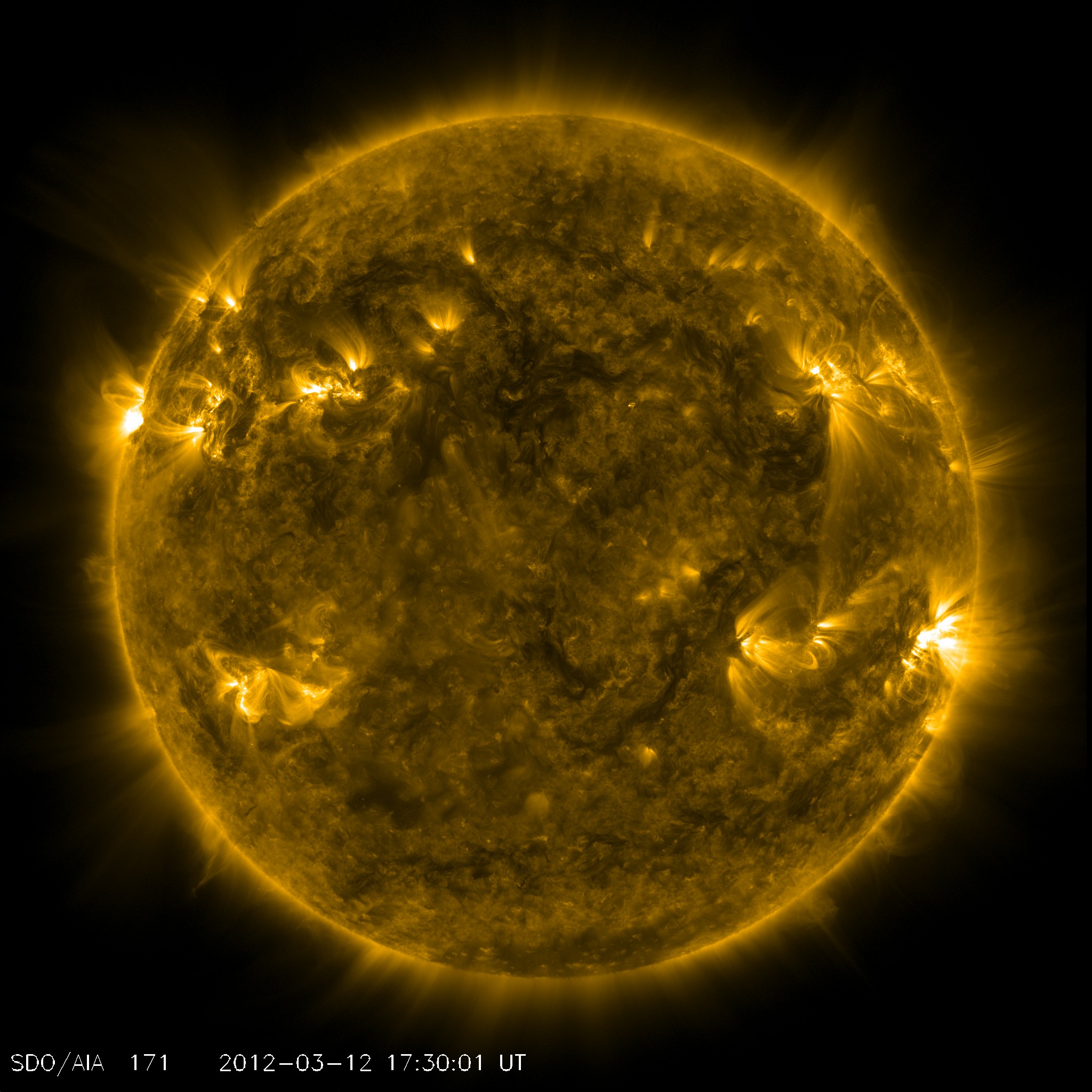
The wave of solar storms that has pounded Earth over the past several weeks is only likely to get worse over the next year, according to a NASA scientist.

Sunspot 1429, the active region of the sun responsible for the flares, has been getting larger over the past several weeks, making it less stable and more likely for additional flares to erupt, which can cause damage to GPS satellites and electronic systems on our planet. NASA reported that the sunspot is now more than seven times the width of earth.

“The larger [the active region] is, the more likely it’s going to produce another big flare,” Phillip Chamberlin, deputy project scientist for the Solar Dynamics Observatory says. “It’s growing, and it’s becoming more dynamic, building energy.”

Over the weekend, two large flares erupted from the region. NASA says the wind and energy particles associated with the flare, began to affect Earth Monday. The region is dangerous for Read more…

Solar storm headed toward Earth may disrupt power

March 7, 2012 Comments off

yahoo

WASHINGTON (AP) — The largest solar flare in five years is racing toward Earth, threatening to unleash a torrent of charged particles that could disrupt power grids, GPS and airplane flights.

The sun erupted Tuesday evening, and the effects should start smacking Earth around 7 a.m. EST Thursday, according to forecasters at the federal government’s Space Weather Prediction Center. They say the flare is growing as it speeds outward from the sun.

“It’s hitting us right in the nose,” said Joe Kunches, a scientist for the National Oceanic and Atmospheric Administration. He called it the sun’s version of “Super Read more…

Climate change will shake the Earth

February 27, 2012 Comments off

guardian

As the Earth's crust buckles, volcanic activity will increase.

As the Earth’s crust buckles, volcanic activity will increase. Photograph: Corbis

The idea that a changing climate can persuade the ground to shake, volcanoes to rumble and tsunamis to crash on to unsuspecting coastlines seems, at first, to be bordering on the insane. How can what happens in the thin envelope of gas that shrouds and protects our world possibly influence the potentially Earth-shattering processes that operate deep beneath the surface? The fact that it does reflects a failure of our imagination and a limited understanding of the manner in which the different physical components of our planet – the atmosphere, the oceans, and the solid Earth, or geosphere – intertwine and interact.

If we think about climate change at all, most of us do so in a very simplistic way: so, the weather might get a bit warmer; floods and droughts may become more of a problem and sea levels will slowly creep upwards. Evidence reveals, however, that our planet is an almost unimaginably complicated beast, which reacts to a dramatically changing climate in all manner of different ways; a few – like the aforementioned – straightforward and predictable; some Read more…