Archive
Earthquake hits west of Scotland
 The British Geological Survey (BGS) said the 3.5-magnitude quake struck in Glenuig, 25 miles (40km) west of Fort William in the Highlands at about 0600 GMT.
People in Inverness, Skye and Oban, reported feeling tremors, which were experienced across the west Highlands.
The BGS said a such an earthquake might be felt up to 120km (74 miles) away but was unlikely to cause much damage.
It comes two weeks after residents in the North Yorkshire town of Ripon experienced a similar sized quake on 4 January.
Seismologist Davie Galloway said the UK tended to experience such quakes, on average, about once a year.
He said: “This quake was recorded on our instruments in Wales and in Shetland but it was actually felt by people 120km away in Inverness.
“We had a few calls from people who said they felt a vibration in their beds and also from people who said their cats were going mad.”
Mr Galloway said the quake originated from 16km below the ground.
He added: “Britain is criss-crossed by many geological faults but fortunately we are some distance away from the plate edges where most activity is experienced.”
5.0 earthquake shows growing unrest in Caribbean plate

January 21, 2011 – CARIBBEAN – The 5.0 earthquake that struck Saint Kitt and Leward Islands at a depth of 163.7 km today is one more indication of the growing unrest and tension seen in the Caribbean plate as planetary tremors have intensified in frequency across the globe. The massive volcanic eruptions in the Caribbean over the last two years, the earthquakes swarms around Puerto Rico in 2010, and the massive earthquake that struck Haiti in January of 2010 are all indications that this region is destined to see more violent seismic and volcanic turbulence in the near future.
Michio Kaku Warns the World Citizens of Potential Mega Earthquake

Physicist and author of “Physics of the Future” Michio Kaku warned world citizens this morning on Good Morning America about the pending threat of enormous earthquakes.
“In our life time, we could very well see one of these cities destroyed,” Kaku said. “Los Angeles, San Francisco, Mexico City, Tehran, Tokyo.”
Kaku pointed to changes in the physical structures of human civilization, and how the new composure poses many risks. “We are creating mega cities where there used to be fishing villages,” he said.
About the many disasters this year, he said: “Well, look at the Chilean earthquake. You realize it was so big it actually rocked the planet earth. The axis of the earth shifted 3 inches as a result of that 8.8 earthquake. The day is no longer 24 hours, it’s been shortened by one micro-second, That’s how big that earthquake was.”
Yellowstone Supervolcano Bulges 10 inches as Magma Pocket Swells
Brian Handwerk

Pakistan earthquake felt in India and the Middle East


Tremors from a powerful earthquake that rattled many parts of Pakistan early Wednesday were felt as far as New Delhi, 700 miles away.
The 7.2 magnitude quake hit in a sparsely-populated area near the nation’s borders with Iran and Afghanistan, 640 miles west-southwest of Islamabad, according to the U.S. Geological Survey.
No fatalities have been reported.
Officials in Karen, a town in a sparsely populated area close to the epicenter, told the Associated Press that the town suffered no widespread damage.
People came out of their houses in the southern city of Karachi, home to 18 million people, but no major damage was reported there either.
Tremors shook structures in many other parts of the country and were felt as far as Dubai in the Middle East.
The earthquake’s intensity was just below that of another earthquake measuring 7.6 that struck parts of northern Pakistan in 2005 and killed more than 70,000 people.
Government officials warned of the danger of aftershocks in coming days. In some instances such aftershocks have come within a week of previous earthquakes.
“It’s not uncommon for this region to have earthquakes. It is where two tectonic plates come together” CNN quoted Kurt Frankel of the Georgia Institute of Technology.
In Pakistan’s capital Islamabad a Western diplomat quoted by CBS News warned that further damage from the earthquake, notably any of its aftershocks, could seriously undermine Pakistan’s future, right at a time when the United States is urging the country to extend more cooperation in its campaign to fight militants.
“A humanitarian crisis in Pakistan caused by the earthquake will only undermine U.S. interests,” the diplomat said. “As it is, we must all worry about instability in a country armed with nuclear weapons and with political and economic problems,” he added.
Extent of Corruption in Countries Around the World Tied to Earthquake Fatalities

God is talking and you’re not listening…
A new assessment of global earthquake fatalities over the past three decades indicates that 83 percent of all deaths caused by the collapse of buildings during earthquakes occurred in countries considered to be unusually corrupt.
Authored by Professor Nicholas Ambraseys of the Imperial College of London and Professor Roger Bilham of the University Colorado at Boulder, the study also found that in some relatively wealthy countries where knowledge and sound business practices would be expected to prevail, the collapse of many buildings is nevertheless attributable to corrupt building practices.
A commentary piece on the subject is being published in the Jan. 13 issue of Nature.
Corrupt building practices — which are generally covert and hard to quantify — can include the use of substandard materials, poor assembly methods, the inappropriate placement of buildings and non-adherence to building codes, said the authors.
Ambraseys and Bilham used data gathered by Transparency International, a global organization based in Berlin that operates through more than 70 national chapters around the world. Transparency International annually generates a Read more…
Haiti: A year after the quake, waiting to rebuild
 PORT-AU-PRINCE, Haiti – The man’s body lay face down, his white dress shirt shining like wax in the sun, as he was unearthed in the ruins of a Port-au-Prince restaurant a year after the earthquake.
The bodies still being found in the rubble are a sign of how far Haiti must go to recover from a disaster that left the capital in ruins and is estimated to have killed more than 230,000 people.
In the days after the Jan. 12, 2010 disaster, volunteers and hundreds of aid groups flocked in with food, water and first aid that saved countless lives. But the effort to rebuild has been dwarfed by the extent of the need and a lack of leadership — both in Haiti and internationally.
President Rene Preval did not speak publicly for days after the quake, and many observers have criticized him for not spearheading a coherent reconstruction effort, or making the hard policy decisions needed to rebuild.
Still, advocacy groups also blame the Haitian government’s weakness on an international community that is not keeping its pledge of support.
“The international community has not done enough to support good governance and effective leadership in Haiti,” the aid group Oxfam said in a recent report. “Aid agencies continue to bypass local and national authorities in the delivery of assistance, while donors are not coordinating their actions or adequately consulting the Haitian people.”
Street markets were soon up and running after the quake and Port-au-Prince’s traffic is worse than ever. On Tuesday, Preval, his wife and other officials lay flowers at symbolic black crosses marking a mass grave outside the capital where hundreds of thousands of earthquake victims are buried.
But from the barren hillside, the destruction is clearly visible. The slogan “build back better,” touted by former President Bill Clinton and others, remains an unfulfilled promise.
Less than 5 percent of the debris has been cleared, leaving enough to fill dump trucks parked bumper to bumper halfway around the world. In the broken building where the dead man was discovered last week, workers hired to clear rubble by hand found two other people’s Read more…
Earthquakes Increase in US/ World
Since 2006, earthquakes have been increasing at an alarming rate. Unfortunately it appears as if we are getting warning signals from the ground. It is apparent that in the very near future, a great event of unimaginable proportions will occur. In 2010 there was a unprecedented 7,924 earthquakes in the U.S. which was an increase of 86% prior to 2009’s total of 4,264. If you were to compare 2006 to 2010 it would be an increase of a whopping 185%! Numbers don’t lie.

Newsworthy events within the last 7 days:
A 3.8 magnitude earthquake centered near Kokomo, Indiana. Dec 30 2010
Cedar City, Utah a magnitude 4.5 earthquake at 5:06 a.m. Jan 3, 2011
Plymouth, N.H 2.6-magnitude earthquake was recorded at 11:46 p.m Jan 3, 2011
A magnitude 3-point-0 earthquake was recorded at 12:31 p.m. Tuesday afternoon about 15 miles east-northeast of Oklahoma City Jan 4, 2011
3.9 magnitude struck Eureka California at around 2:40 Sunday afternoon Jan 2, 2011
3.8 magnitude earthquake shook an area near the Southern California town of Julian on Thursday morning at 9:37 a.m. Dec 30, 2010
A 3.6-magnitude earthquake recorded early Thursday in Maupin, Oregon Dec 30, 2010
| Magnitude | 2003 | 2004 | 2005 | 2006 | 2007 | 2008 | 2009 | 2010 | 2011 |
|---|---|---|---|---|---|---|---|---|---|
| 8.0 to 9.9 | 0 | 0 | 0 | 0 | 0 | 0 | 0 | 0 | 0 |
| 7.0 to 7.9 | 2 | 0 | 1 | 0 | 1 | 0 | 0 | 1 | 0 |
| 6.0 to 6.9 | 7 | 2 | 4 | 7 | 9 | 9 | 4 | 8 | 0 |
| 5.0 to 5.9 | 54 | 25 | 47 | 51 | 72 | 85 | 59 | 71 | 0 |
| 4.0 to 4.9 | 541 | 284 | 345 | 346 | 366 | 432 | 288 | 632 | 0 |
| 3.0 to 3.9 | 1303 | 1362 | 1475 | 1213 | 1137 | 1486 | 1492 | 3394 | 0 |
| 2.0 to 2.9 | 704 | 1336 | 1738 | 1145 | 1173 | 1573 | 2380 | 3770 | 3 |
| 1.0 to 1.9 | 2 | 1 | 2 | 7 | 11 | 13 | 26 | 34 | 0 |
| 0.1 to 0.9 | 0 | 0 | 0 | 1 | 0 | 0 | 1 | 0 | 0 |
| No Magnitude | 333 | 540 | 73 | 13 | 22 | 20 | 14 | 14 | 0 |
| Total | 2946 | 3550 | 3685 | 2783 | 2791 | 3618 | * 4264 | * 7924 | * 3 |
http://earthquake.usgs.gov/earthquakes/eqarchives/year/eqstats.php
http://www.csmonitor.com/USA/2010/1230/Indiana-earthquake-extremely-rare-and-unprecedented
http://www.boston.com/news/local/breaking_news/2011/01/small_earthquak_4.html
http://www.thespectrum.com/article/20110104/NEWS01/101040315
295,000 Deaths :950 Natural Disasters in 2010
By: Munich RE
Jan. 3, 2011 – Several major catastrophes in 2010 resulted in substantial losses and an exceptionally high number of fatalities. The overall picture last year was dominated by an accumulation of severe earthquakes to an extent seldom experienced in recent decades. The high number of weather-related natural catastrophes and record temperatures both globally and in different regions of the world provide further indications of advancing climate change.
Altogether, a total of 950 natural catastrophes were recorded last year, nine-tenths of which were weather-related events like storms and floods. This total makes 2010 the year with the second-highest number of natural catastrophes since 1980, markedly exceeding the annual average for the last ten years (785 events per year). The overall losses amounted to around US$ 130bn, of which approximately US$ 37bn was insured. This puts 2010 among the six most loss-intensive years for the insurance industry since 1980. The level of overall losses was slightly above the high average of the past ten years.
“2010 showed the major risks we have to cope with. There were a number of severe earthquakes. The hurricane season was also eventful – it was just fortunate that the tracks of most of the storms remained over the open sea. But things could have turned out very differently”, said Torsten Jeworrek, Munich Re’s Reinsurance CEO. “The severe earthquakes and the hurricane season with so many storms demonstrate once again that there must be no slackening of our efforts to analyze these risks in detail and provide the necessary insurance covers at adequate prices. These prices calculated by the insurance industry make it possible to assess the economic consequences of these otherwise difficult-to-evaluate risks.”
Major catastrophes dominate the list of losses
In all, there were five catastrophes last year assignable to the top category of “great natural catastrophes” based on the definition criteria of the United Nations: the earthquakes in Read more…
Are you prepared for a emergency?
The Council for Excellence in Government and American Red Cross conducted a poll that found that Hurricanes Katrina and Rita did not motivate a plurality of Americans to prepare for an emergency. Only 12 percent say they’ve done a great deal to prepare for a natural disaster, terrorist attack, or other major emergency.
The poll shows that most Americans yawned and went back to sleep (Table 1).
Conclusion
We are our own first responders, and it is up to each of us to create a family communication plan, put together emergency supplies, and practice evacuation plans. We are an optimistic, generous nation, which opened its hearts and wallets to those whose lives were turned upside down. We are willing to help others. Now we’ve got to help ourselves.
Patricia McGinnis is president and CEO of the Council for Excellence in Government (www.excelgov.org).
Table 1. Is It Time to Wake Up?
It won't happen to me. More than half say that one reason they
have not done more to prepare is because
they do not think another disaster is
likely to happen to them. We seem to
believe that the tragedies of Katrina and
Rita were terrible events with horrific
consequences--but the devastation was
someplace else--not in my community,
home, or business.
I don't mind inconvenience Since the 9/11 attacks, we have given our
as long as I don't have to leaders wide latitude to protect our
do anything. Nation. For the most part, we have been
more than willing to sacrifice some
privacy for safety and preparedness.
After July's London subway bombings, a
Fox News poll found that 85 percent would
not mind a bag search before entering
public transportation, which would not
require any extra effort on our part.
I don't know what to do. Two months after Katrina, the Americans
who said they hadn't prepared because
they didn't know what to do actually
increased by 9 percent. We saw and heard
the desperate pleas of family members
separated by Katrina, yet most of us
still have no plan on how to communicate
with family members during or after a
disaster. Just 36 percent report that
they have prepared a communications plan
to contact loved ones in an emergency if
they get separated. Only one-quarter have
established a specific meeting place in
the event that they or their family are
evacuated or cannot return home. Only one
in three have stored extra food or
bottled water for emergencies.
Some Americans have gotten More than half of Southerners say that
the wake up call. the hurricanes gave them motivation to
prepare for a disaster. But others are
still hitting the snooze button: just 35
percent of people in the West, 31 percent
of people in the East, and only 21
percent of Mid-westerners have been
motivated to prepare.
We demand that our leaders give us better and more effective emergency
plans for our communities, yet only 18 percent of Americans are
familiar with their city or town's emergency plan. Even fewer are
aware of their state's plan. We know significantly more about plans
for our workplaces (45 percent) and local schools (28 percent), but
we're nowhere near ready.
The Home Survival Kit
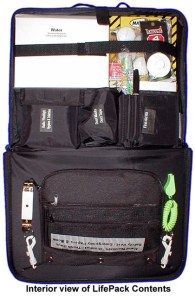
Store everything here in sealed plastic bags or containers, and keep in a place that is fairly accessible. This probably won’t cost as much as it might seem, and you probably have most of it already. Still, if price is an issue, buy this stuff a little at a time (maybe when it’s on sale?) and eventually you will have a truly epic survival kit.
1. Water: 1 gallon per person per day. For a family of 4 that makes 12 gallons. The best way is to buy gallon jugs of drinking water, because they are pre-sanitized and sealed to prevent any nastiness from getting in. If you decide to fill your own jugs, read this for instructions on how. Also, keep a bottle of non-scented bleach – 12 drops in a gallon of water makes it drinkable, and tea bags can make it taste better.
Word to the wise: As a last resort, there is a handy backup reserve of water – in your hot water heater. Open the drain valve at the bottom to get some water of last resort. Don’t forget to sterilize it with bleach!
2. Food: Go ahead and plan out 3 days worth of meals, using non-perishable food that does not need to be heated. Canned tuna, veggies, and fruits are great, as well as canned beans and potatoes, and dried fruit and nuts. They may not taste great cold, but they will work. Peanut butter is a high-calorie food with a long shelf life. Freeze dried camping meals and MRE’s are nice too, but they can get a little pricey. Stay away from foods that will make you thirsty, like high-sodium crackers or soups, and go for whole grains as much as possible. Don’t forget to add in some comfort food. You may be stuck inside for days, and a little candy or other snacks can go a long way.
Word to the wise: Don’t forget to pack a manual can opener!
3. First Aid Kit: You can buy one for about $25, (here is a good one from the Red Cross) or you can make your own. Check out this list of suggested first aid items. Don’t forget to include any prescription medication!
4. Clothes: A full change of clothes, including warm outer layers and sturdy comfortable shoes, for each person under your roof.
5. Flashlight: A crank powered led light with a built in emergency radio is my personal favorite, but a cheapo dollar-store version will work. Don’t forget the extra batteries!
6. Plastic Sheeting: Fiber-reinforced, laminated polyethylene film, 0.006 inches thick. You can buy 1,200 square feet of Dura Skrim DS2 for about $100. Or get a tarp — for covering broken windows or roofs.
7. Zip Ties and Duct Tape: These DIY favorites are great for attaching the aforementioned plastic sheeting, or even making compression bandages or splints.
8. Protective Wear: Waterproof and cut resistant Kevlar gloves and N95 face masks. Get one face mask for each person, at least.
9. Tools: A crowbar to pry debris that might stand between you and a loved one. An adjustable wrench. Screwdrivers. A staple gun. Rope. Fire extinguisher: small canister, ABC type.
10. Matches: Strike-anywhere, waterproof, and windproof. Keep them in a plastic bag. In another bag, hoard some dryer lint for kindling.
11. Sanitation: Toilet paper, soap, liquid detergent, feminine supplies, personal hygiene items (travel-sized, please), plastic garbage bags, ties (for personal sanitation uses), plastic bucket with tight lid, disinfectant, household chlorine bleach.
12. Radio


![[Most Recent Quotes from www.kitco.com]](https://i0.wp.com/www.kitconet.com/charts/metals/gold/t24_au_en_usoz_2.gif)
![[Most Recent Quotes from www.kitco.com]](https://i0.wp.com/www.kitconet.com/charts/metals/silver/t24_ag_en_usoz_2.gif)

 crisisboom
 CRISISBOOM
You must be logged in to post a comment.