Archive
CIA Spy Captured Giving Nuclear Bomb To Terrorists
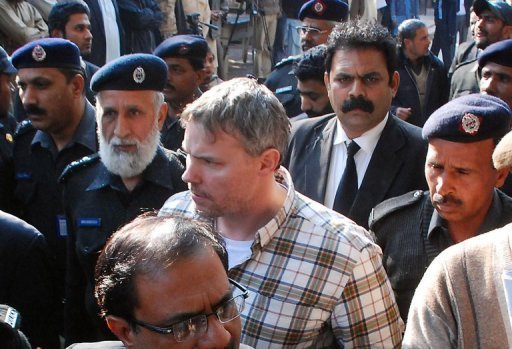
While all eyes in the West are currently trained on the ongoing revolution taking place in Egypt, Russia’s Foreign Intelligence Service (SVR) is warning that the situation on the sub-continent has turned “grave” as it appears open warfare is about to break out between Pakistan and the United States.
Fueling this crisis, that the SVR warns in their report has the potential to ignite a total Global War, was the apprehension by Pakistan of a 36-year-old American named Raymond Allen Davis (photo), whom the US claims is one of their diplomats, but Pakistani Intelligence Services (ISI) claim is a spy for the Central Intelligence Agency (CIA).
Davis was captured by Pakistani police after he shot and killed two men in the eastern city of Lahore on January 27th that the US claims were trying to rob him.
Pakistan, however, says that the two men Davis killed were ISI agents sent to follow him after it was discovered he had been making contact with al Qaeda after his cell phone was tracked to the Waziristan tribal area bordering Afghanistan where the Pakistani Taliban and a dozen other militant groups have forged a Read more…
IMF Calls for Dollar Alternative
 The IMF is trying to move the world away from the U.S. dollar and towards a global currency once again. In a new report entitled “Enhancing International Monetary Stability—A Role for the SDR“, the IMF details the “problems” with having the U.S. dollar as the reserve currency of the globe and the IMF discusses the potential for a larger role for SDRs (Special Drawing Rights). But the IMF certainly does not view SDRs as the “final solution” to global currency problems. Rather, the IMF considers SDRs to be a transitional phase between what we have now and a new world currency. In this newly published report, the IMF makes this point very clearly: “In the even longer run, if there were political willingness to do so, these securities could constitute an embryo of global currency.” Yes, you read that correctly. The SDR is supposed to be “an embryo” from which a global currency will one day develop. So what about the U.S. dollar and other national currencies? Well, they would just end up fading away.
CNN clearly understands what the IMF is trying to accomplish with this new report. The following is how CNN’s recent story about the new IMF report begins….
“The International Monetary Fund issued a report Thursday on a possible replacement for the dollar as the world’s reserve currency.”
That is exactly what the IMF intends to do.
They intend to have SDRs replace the U.S. dollar as the world reserve currency.
So exactly what are SDRs?
Well, “SDR” is short for Special Drawing Rights. It is a synthetic currency unit that is made up of Read more…
HIGH RANKING BILDERBERG MASON SPILLS THE BEANS ON HIS DEATH-BED

worthless as THEY usher in the new One World Currency. The world as we know it now will be completely different in 2012. Disruption of
currencies plotted so pull your money out of the Banks, spend it NOW!
“China are the strong ones” – China are the New World Order
Leaders with America reduced to Third World status! Timothy Geithner of the US Treasury speaks fluent Chinese! (KEVIN RUDD SPEAKS MANDARIN ALSO. ED.) Within 2 years we will not recognize America. The Elites have altered their Time Line. After 2 years we will be so poor, we will not be able to rebel!
3 – Gold and Silver is all you can rely on – convert your assets and
cash to Gold ASAP – Urgent. Don’t hang around because the Illuminati are going to crash the banks further very soon. We are entering into a depression whereby we are ALL going to be utterly poor within two years from now – peasant attitude and peasant way of life.. Don’t depend on Real Estate, Assets!
4 – Crude Oil will be $150 – $200 per barrel in the next Read more…
A New World Order Reserve Currency
 What do the riots in Egypt and a new world reserve currency have in common?
Perhaps more than we think.
Consider the following statements from George Soros in a recent interview:
Some statements of Soros (who happens to be a Fabian Socialist):
The efficient market hypothesis has failed.
Markets are not tending toward equilibrium.
There is imperfect knowledge of regulators and market participants.
He has an economic theory that is “more relevant” than the dominant one and is supporting an institute for new economic thinking….
Inflation (in the United States) is helpful because the burden of debt was getting too heavy.
The problem is you don’t have a Read more…
Huge protest to kick off in Egypt
 |
| The army has said it is aware of the “legitimate demands” of the people, and has promised not to use force [Reuters] |
Protesters in the Egyptian capital have begun gathering for a planned “march of a million”, calling for Hosni Mubarak, the embattled Egyptian president, to step down.
Thousands of demonstrators began gathering from early on Tuesday morning in Cairo’s Tahrir Square, which has been the focal point of protests in the capital and served as the meeting area for the march to begin on the eighth day of an uprising that has so far claimed more than 125 lives.
Another million-strong march is planned in the Mediterranean port city of Alexandria, as national train services were canceled in an apparent bid to stymie protests. Protest organizers have also called for the march to coincide with the beginning of an indefinite strike.
Reporting from Cairo, an Al Jazeera correspondent reported that the number of people gathered in Tahrir Square on Tuesday morning, was Read more…
Economist: United States Worse Off than Greece
Kurt Nimmo
Infowars.com
Dr. Laurence Kotlikoff is an economics professor at Boston University. He says the Treasury and the government are fudging the national debt numbers. Kotlikoff says the United States is bankrupt and we don’t even know it.
During his SOTU address, Obama called for a freeze on discretionary spending. He called for a five-year freeze on non-mandatory domestic spending, a proposal he estimated would save $400 billion over the next decade.
He said entitlements like Medicare, Medicaid and Social Security will need to be reformed without mentioning specifics. In other words, the government is thinking about cutting these programs to the bone. Boomers will be eating dog food after their pensions are stolen and the entitlement Ponzi scheme breaks down. Read more…
Gold Reserves of the World
Bullion analyst Mark Robinson says this is the biggest and most ambitious task that China has ever announced.
“If China wants to take its gold reserves to 10,000 tonnes in 10 years, the country needs to buy or acquire the yellow metal to the quantity of nearly 1000 tonnes per year.”
Which countries own the largest quantity of gold reserves right now?
- World leader the United States has 8133 tonnes of gold reserves, accounting for 76.5% of its foreign exchange reserves;
- Germany has the second highest gold reserves at 3412.6 tonnes;
- France has 2508 tonnes of gold constituting 58.7% of its forex assets;
- Italy has 2451.8 tonnes of gold constituting 61.9% of forex reserves;
- China became the fifth biggest holder of gold reserves this April with 1054 tonnes;
- Switzerland has 1040 tonnes of gold reserves constituting 23.8% of total forex reserves;
- India which recently bought 200 tonnes of gold from IMF has 557 tonnes of gold reserves representing 3% of total forex reserves.
- The IMF, which currently holds 3,217 tonnes of gold, is the third-largest official holder of the precious metal, but is not technically a sovereign central bank. The IMF has made gold sales a key element of its new income model aimed at lowering its dependence on lending revenue to cover expenses.
2010 in Review-Commodities affected by World Events
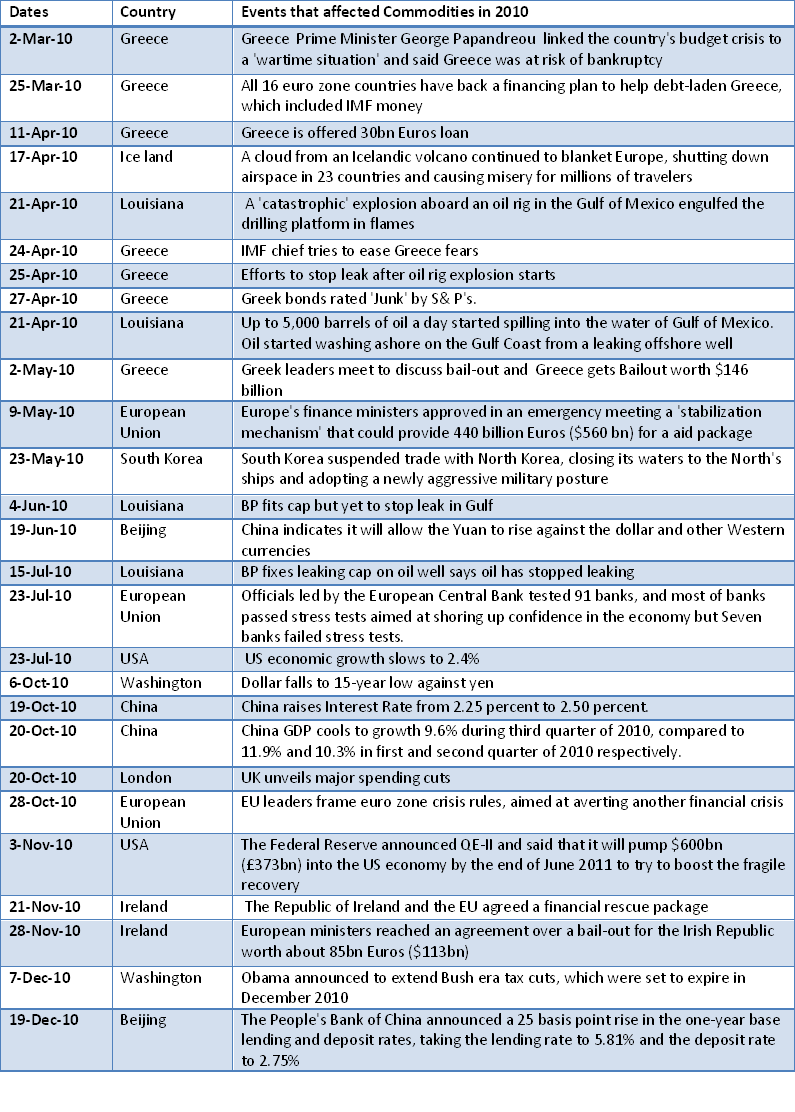 Notable events that affected commodity prices in 2010
BRIC-The Trillion Dollar World Club
Brazil, Russia, India and China matter individually. But does it make sense to treat the BRICs—or any other combination of emerging powers—as a block?
 IN ANY global gathering, the American president is usually seen, at a minimum, as primus inter pares: the one who can make or break the final bargain and select his favoured interlocutors. So in Copenhagen last December, as negotiations for a new climate-change
treaty were entering their final hours, a hastily convened meeting between Barack Obama and China’s prime minister, Wen Jiabao, looked as if it would be the critical moment when a deal might be struck. But when the president turned up, he found not only Mr Wen but the heads of government of Brazil, South Africa and India. This was unexpected. The Americans even thought the Indians had already left the summit. What was conceived as a bilateral talk turned instead into a negotiation with an emerging-market block. As an additional sign that things were changing in the world, the president got a finger-wagging from one of Mr Wen’s hangers-on. But at least Mr Obama was in the room; Europeans were shut out while the emerging powers and America put the final touches to their deal.
This week the same developing countries are meeting again, in Brasília. On April 15th Brazil, India and South Africa—rising powers that are also democracies—put their heads together. The next day South Africa will drop out and Russia and China will join the party, to create a meeting of the so-called BRICs.
For this group, it is a second summit; last June their leaders met in Yekaterinburg, in Russia. That inaugural summit, which produced almost nothing concrete, appeared to be Read more…


![[Most Recent Quotes from www.kitco.com]](https://i0.wp.com/www.kitconet.com/charts/metals/gold/t24_au_en_usoz_2.gif)
![[Most Recent Quotes from www.kitco.com]](https://i0.wp.com/www.kitconet.com/charts/metals/silver/t24_ag_en_usoz_2.gif)

 crisisboom
 CRISISBOOM
You must be logged in to post a comment.