Archive
Will $200 oil kill the economy?
Unrest in key oil-producing nations opens the door to price spikes that could push gas to $7 a gallon and spin the world back into recession. Here’s how we’d get there, and how to protect your portfolio.

Are your pocketbook and portfolio ready for $200-a-barrel oil?
This kind of dramatic price spike may seem less likely now than a few days ago, with oil markets calming down a bit and the price slipping below $100. But given the instability and unrest rolling through the Middle East and North Africa, it’s a definitely a viable scenario.
For the moment, most oil sector analysts have gone off high alert because of a Saudi Arabian pledge to increase production to make up for any shortfalls sparked by unrest. But that ignores a key angle in all this: There’s simply not enough spare capacity to make up for the production losses we’d see if the rolling crises in the region hit just two or three major producers at once.
This could easily happen, given the heightened Read more…
China tamps down Middle East-inspired protests before they can gain momentum

The Chinese government met protesters with a show of force Sunday. In Shanghai, police converged whenever a group of more than a dozen people seemed to be forming. (Peter Parks)
BEIJING – Police and security officials displayed a show of force here and in other Chinese cities Sunday, trying to snuff out any hint of protests modeled on the uprisings in the Middle East and North Africa. In Shanghai, several hundred people trying to gather were dispersed with a water truck.
Premier Wen Jiabao, meanwhile, used a morning Internet chat to promise to purge senior officials who are corrupt and to rein in inflation and rising home prices, directly addressing some of the most common grievances of ordinary Chinese.
Since a January uprising in Tunisia spurred similar anti-government protests across the Arab world, threatening long-entrenched authoritarian regimes, China’s Communist rulers have reacted nervously, with both defensive and aggressive tactics.
Officials have used state-run media outlets to dismiss any comparisons of those regimes with China. At the same time, they have stepped up public comments on the need to address “social conflict” and to tackle problems such as the growing income disparity between the rich and poor. They also have Read more…
Russia Vows to Sell Missiles to Syria
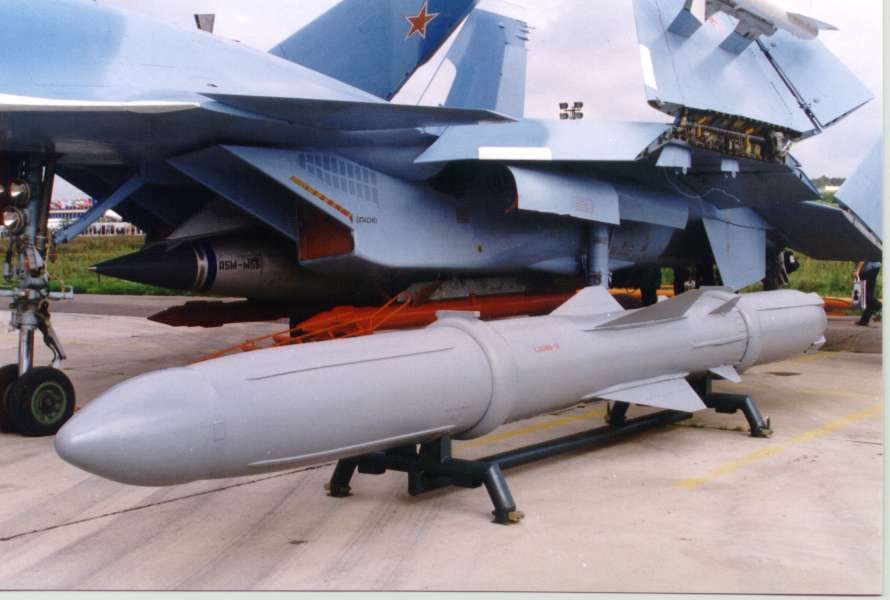 MOSCOW – Russia announced Feb. 26 that it intended to fulfill its contract to supply Syria with cruise missiles despite the turmoil shaking the Arab world and Israel’s furious condemnation of the deal.
“The contract is in the implementation stage,” news agencies quoted Defence Minister Anatoly Serdyukov as saying.
Russia initially agreed to send a large shipment of anti-ship Yakhont cruise missiles to Syria in 2007 under the terms of a controversial deal that was only disclosed by Serdyukov in September 2010.
The revelation infuriated Israel and the United States and there had been speculation that Russia would decide to tear up the contract amid the current turmoil plaguing Read more…
After the ecstasy of revolution, the Bankers quietly begin carving up Egypt and North Africa
By Richard Eastman
21st Century Wire
Feb 25, 2011
The European Bank for Reconstruction and Development (EBRD) is ready to lend one billion EUROS a year to Egypt for reconstruction and “free-market reform”- even as Egypt’s Minister of Finance Samir Radwan has gone begging to the City of London bankers and the British Ministry of Trade and Investment for relief on debt payments that are about to throw Egypt into bankruptcy.
All this, as Egypt has been such a good boy with regards to privatization and austerity, measures which awarded Egypt its celebrated 7 percent growth rate- mostly in investments that will end up in international hands as ventures fail to pay out with ever diminishing Egyptian domestic purchasing power.
FRESH CYCLES OF DEBT
First EBRD will lend at interest and build what they want backed by Egyptian collateral and the value of the projects themselves. Then when it turns out they can’t make the debt payments because of all the interest we have sucked from them, we take over all of the assets we have developed. That’s freedom and EBRD is really going to give it to them. After all EBRD is experienced at this. In 1991 the EBRD was organized to financially lead Russia and Eastern Europe in their transition from paternalistic socialism to sustainable free-market economies open to international Read more…
Ethiopia will soon arise to protest
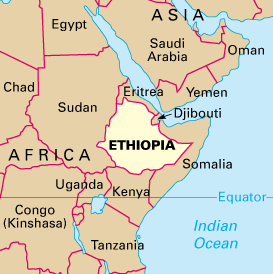
WINDS OF CHANGE CONTINUES BLOWING Major developments in 6 African countries and other Arab nations. And Ethiopians fate!
Today, the drama of utmost importance is underway in different parts of the world, specially, in the North African countries. After its beginning in Tunisia, the flammable and miserable peoples voices is fast circulating from country to country. The basic demands of peoples of these nations is clear; the quest for better living conditions, jobs, respect of human and democratic rights and so on.
What makes special the current movement in Africa and the Arab world is women’s and children’s gather out in the streets to oppose the rotten regime of their country. More of less the peaceful demonstration were carried out with fruitful results in Egypt and Tunisia. On the other way, in LIBYA and Lebanon the governments use machine guns to disperse protesters. A people went out bare handed shot by government mercenaries. Though, the protesters are still going on. as the Tunisian protests were still escalating,
What we are observing in North Africa and Middle East are the results of unfolded dramas left on the society for decades. The Bahrain and Libyan Governments uses their special forces to disperse the protesters. They come up against the protesters by hiring foreign mercenaries to fire against the peaceful demonstrators.
Let’s see the blowing winds of change in these Countries
TUNISIA: When the demonstrations started on 17 December, It wasn’t expected. Just before the December protests began, WikiLeaks released internal U.S. State Department communications in Read more…
Parties up pressure on Moroccan King for reform
By Souhail Karam
 RABAT (Reuters) – Two of Morocco’s biggest political parties and human rights groups have joined calls by a youth movement for constitutional reform that could reduce the role of the king.
Most Moroccan political parties boycotted a February 20 nationwide protest calling for the adoption of a parliamentary monarchy, the dismissal of the coalition government and the dissolution of parliament.
The march, in 53 towns and cities, was organised by the February 20 Movement for Change, and was joined by youths of the banned Islamist Justice and Charity opposition group. The
Interior Ministry said 37,000 people took part in the protest while organisers put the number at 300,000.
Morocco’s King Mohammed said on Monday he would not cede to Read more…
Arrests in Zimbabwe for Seeing Videos
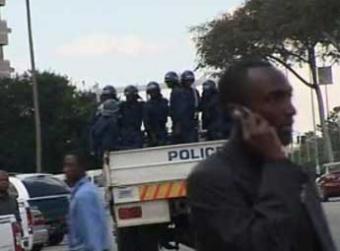 JOHANNESBURG — Dozens of students, trade unionists and political activists who gathered to watch Al Jazeera and BBC news reports on the uprisings that brought down autocrats in Tunisia and Egypt have been arrested on suspicion of plotting to oust President Robert Mugabe of Zimbabwe.
James Sabau, a spokesman for the police force, which is part of the security services controlled by Mr. Mugabe’s party, was quoted in Monday’s state-controlled newspaper as saying that the 46 people in custody were accused of participating in an illegal political meeting where they watched videos “as a way of motivating them to subvert a constitutionally elected government.”
The evidence seized by the police included a Read more…
N.Korean Regime Worried About Arab Uprisings
 The North Korean authorities are apparently on full alert as news trickles in about pro-democracy protests in the Middle East despite an official blackout. According to a source, security agents have banned all gatherings, especially of university students, as news spreads about the public revolts in Egypt, Tunisia and elsewhere in the Arab world.
The source added that partitions have been removed in restaurants across the country, and security agents break up even small gatherings in open-air markets.
“This is the first time I saw even partitions removed from restaurants in North Korea,” a recent defector said. Students in Pyongyang have begun Read more…
Rising world food prices may soon hit Africa hard, but could be a future boon
 Damaged rice is seen in a paddy field destroyed by flood- waters near a village in Manmunai West in Batticaloa district, about 199 miles east of Colombo, Sri Lanka, on Jan. 26. The floods inundated rice paddies, and according to the UN Food and Agriculture Organization, at least 15.5 percent of the main annual rice harvest could be lost.
Andrew Caballero-Reynolds/Reuters
Johannesburg, South Africa
Global food prices reached a historic high last month, a fact that may cause even the most comfortable of Americans to cinch in their belts and cut back on spending.
But what about the world’s poor?
“Global food prices are rising to dangerous levels and threaten tens of millions of poor people around the world,” World Bank Group President Robert Zoellick said Tuesday as he announced the bank’s findings that about 44 million people in developing countries have been pushed into poverty since Read more…
NATO Warns of Food Crisis and More Unrest, Prices Increase 15% in Four Months
The World Food Program’s representative in one of the countries which has seen protests, Yemen, recently stated: ‘There is an obvious link between high food prices and unrest.’

Credit: NATO
The 2008 food crisis was a warning of things to come. More recently, food prices rose by 15% in just the period October 2010 to January 2011, according to the World Bank’s Food Price Watch.
This time, the impacts have been felt more keenly in political and security circles. The President of Read more…


![[Most Recent Quotes from www.kitco.com]](https://i0.wp.com/www.kitconet.com/charts/metals/gold/t24_au_en_usoz_2.gif)
![[Most Recent Quotes from www.kitco.com]](https://i0.wp.com/www.kitconet.com/charts/metals/silver/t24_ag_en_usoz_2.gif)

 crisisboom
 CRISISBOOM
You must be logged in to post a comment.