Archive
Silver soars to 31-year high
 Gold rose over 1 per cent to a near-record and silver surged Thursday as dollar weakness, inflation worries and a European debt crisis powered bullion to its biggest one-day gain in about seven weeks.
Silver futures soared to their highest since 1980, rising more than 4 per cent for their biggest one-day gain since November, as strong investment and speculative buying sent the gold/silver ratio to a low.
Gold received a boost from inflation worries triggered by a crude oil rally and data showing rising U.S. core producer prices in March, and as higher-than-expected jobless claims knocked the dollar.
“The combination of higher oil prices, weaker dollar and the resurrection of discussions of Greek sovereign risk problems has galvanized the gold market. It’s particularly impressive because we ran into selling above the market yesterday,” said James Steel, chief commodity analyst at HSBC.
Spot gold rose 1.4 per cent to $1,474.30 an ounce by 4:02 p.m. ET, within striking distance of its record $1,476.21 set on Monday. U.S. gold futures for June delivery settled up $16.80 at $1,472.40 an ounce.
Investors grew jittery on talk of debt restructuring by Greece, the first euro zone member to receive a bailout a year ago in the crisis Read more…
Setbacks in Portugal and Ireland Renew Worry on Debt Crisis

Allied Irish Bank is one of several prominent financial institutions in Ireland in need of a rescue.
LONDON — A higher-than-expected budget deficit in Portugal and the need for more money to rescue Ireland’s failing banks have renewed fears that Europe’s debt crisis is worsening despite its sizable bailout fund.
Officials in Lisbon said Thursday that the country’s budget deficit last year was 8.6 percent of its gross domestic product, well above the goal of 7.3 percent. Although officials said the revision would not affect the government’s goal of reaching a deficit of 4.6 percent of domestic product in 2011, the news was a reminder that, even after the problems from Greece’s fraudulent deficit statistics, some numbers from the euro zone remain unreliable.
Also Thursday, Ireland’s central bank announced that four of the country’s most prominent financial institutions would need an additional 24 billion euros to cover sour real estate loans, a move that pushes the Read more…
Worldwide Silver Shortage?

FutureMoneyTrends.com has recently received several reports, published and non published reports about possible silver shortages. Is their a very limited supply of silver, yes, is there a worldwide shortage happening right now, well not exactly. Under the agreement that we wouldn’t reveal their name, a major bullion dealer who we are friends with, told us that their traders are not having any issues buying physical silver, and that their warehouse had a significant amount of physical silver. Now, will there one day be a shortage of silver, in our opinion at these prices, yes, the price for silver will have to move up considerably in order to come in line with the above ground available supply and ever increasing demand. Sorry to disappoint you, Read more…
Portugal’s Government May Collapse Before EU Summit
 In a report published by Reuters, the Portuguese parliament is expected to reject government austerity measures on Wednesday, which could lead to the collapse of the minority Socialist administration one day before the EU summit.
The country’s Prime Minister, Jose Socrates, has declared that he will resign if the plan is defeated, due to the fact that its rejection would force debt-ridden Portugal to seek a similar international bailout to Greece and Ireland.
If Socrates stands by his word, then he appears to be heading for the exit door as all opposition parties have proposed resolutions calling for the rejection of the measures, which would look to cut the debt by reducing pensions and state spending.
The main opposition is the Social Democrats, and the party has already begun talking about a snap election. When asked if it is likely that the government will step down, Socialist bench leader in parliament Francisco Assis said that, “If all these positions that now seem irreversible are confirmed, then yes.”
“The prime minister does not want to resign, but he cannot govern against his convictions,” Assis said.
Silver, gold gain on fast-changing global events
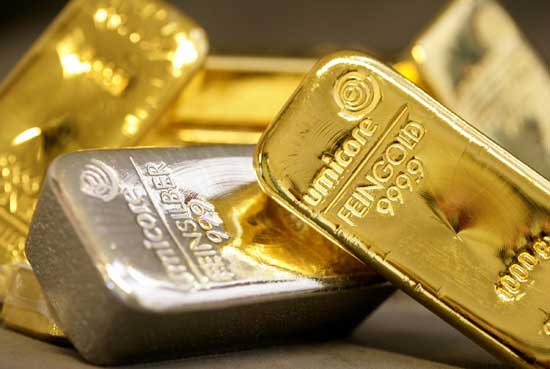 Silver and gold prices are climbing as developing crises from Portugal’s financial problems to uprisings in the Middle East are prompting investors to buy more stable assets.
Silver for May delivery rose 2.6 percent Wednesday to settle at $37.198 an ounce. Gold settled up $10.40 at $1,438 an ounce.
Investors are nervous as they monitor fast-changing global events.
In Portugal, lawmakers are poised to vote against more austerity measures for the debt-stressed country. Meanwhile violence in the Middle East and North Africa is raising concern about oil supplies.
The uncertainty of how those events will play out is supporting both precious metals, which have the reputation of being safer assets to hold during turbulent economic times.
Energy prices were mainly higher. Bean and grain prices fell.
Pressure on Portugal After New Credit Downgrade
 LISBON — Portugal’s borrowing costs pushed higher after Moody’s downgraded the country’s credit rating, stoking the pressure on the country’s beleaguered minority government.
The yield on Portugal’s ten-year bond rose 0.04 percentage point to 7.44 percent. The equivalent yields for Greece and Spain, two other euro countries struggling with high borrowing levels, were down modestly.
Moody’s Investors Services cut the country’s rating by two notches to A3 late Tuesday, saying the debt-stressed country is struggling to generate growth and faces a tough battle to restore the fiscal health needed to calm jittery financial markets.
Prime Minister Jose Socrates said late Tuesday he would quit if Parliament doesn’t consent to his government’s latest batch of contested austerity measures.
Portugal aims to raise up to €1 billion in a sale of Read more…
Why the World Must Watch Europe
Beyond the EU Debt Crisis
The continent’s financial crisis gave rise to bailouts, infighting and demands for sweeping financial reform. Could there still be a bright future over the horizon for the European Union?

Amid the shift in global superpowers, two names come up as heavyweight world championship opponents: China and the United States.
The constant media exposure and speculation could be likened to a pay-per-view boxing matchup.
In one corner: the world’s largest energy consumer—with a 1.3-billion-strong population—endlessly stockpiling natural resources—and holding nearly $900 billion in United States’ debt.
In the other: longtime democratic world champion—largest economy—and leader in manufacturing.
China is the clear favorite, but the U.S. is still in the running. On its way down from unmatched superpower, it is still a formidable opponent, with its manufacturing sector out-producing China by 40 percent.
Yet America is weighed down by a $14 trillion federal debt and rampant Read more…
Wikileaks: GMO conspiracy reaches highest levels of US Government
 Recent Wikileaks cables are typically associated with information leaks related to U.S. war strategy, and foreign policy, which has led some people to conclude that leaked information of this nature is a possible threat to national security.
But in this case, Wikileaks cables leaked information regarding global food policy as it relates to U.S. officials — in the highest levels of government — that involves a conspiracy with Monsanto to force the global sale and use of genetically-modified foods.
In 2007, then-U.S. ambassador to France Craig Stapleton conspired to retaliate against European countries for their anti-biotech policies. U.S. diplomatic cables released by WikiLeaks reveal the Bush administration formulated battle plans to extract revenge against Europe for refusing to use genetically modified seeds.
In the leaked cable, Stapleton writes: “Europe is Read more…


![[Most Recent Quotes from www.kitco.com]](https://i0.wp.com/www.kitconet.com/charts/metals/gold/t24_au_en_usoz_2.gif)
![[Most Recent Quotes from www.kitco.com]](https://i0.wp.com/www.kitconet.com/charts/metals/silver/t24_ag_en_usoz_2.gif)

 crisisboom
 CRISISBOOM
You must be logged in to post a comment.