Archive
China – Security System on Steroids for Mega-City

The mega-city of Chongqing in southwest China plans to build a $2.6 billion security system that will be one of the world’s largest with 500,000 surveillance cameras, state media have said.
Chongqing police chief Wang Zhijun said the system would be the world’s largest new security network since the September 11, 2001 attacks in the United States, the Global Times reported.
The system would dwarf a network of 40,000 security cameras installed in the capital of China’s far-western Xinjiang region last year, following deadly July 2009 clashes between Muslim Uighurs and members of the majority Han group.
Chongqing’s more than 500,000 cameras, which are due to be installed by Read more…
Leaks Reveal Deeper Palestinian-Israeli Security Ties
JERUSALEM—Leaked documents published Tuesday show extensive collaboration between Palestinian security forces and their Israeli counterparts, a relationship Israeli commanders say has been key to security gains in the West Bank.

Among the most explosive revelations in the latest release are minutes of a 2005 meeting in which Palestinian officials appear to be plotting with Israeli officials to assassinate a Palestinian militant in Gaza.
The leaks are likely to aggravate unease in the Palestinian territories, following revelations earlier in the week that showed the Palestinian leadership offering extensive compromises to Israel in peace talks.
Qatar-based al-Jazeera satellite channel on Sunday began releasing what they say are internal Palestinian negotiating-team papers dating from 1999 to 2010.
According to the Palestinian minutes of a 2005 meeting, Israel’s defense minister at the time, Shaul Mofaz, asked then Palestinian Interior Minister Nasser Youssef about a militant named Hassan al-Madhoun.
“Why don’t you kill him?” Mr. Mofaz asked Mr. Youssef, according to the document. Mr. Youssef replied that he instructed the Palestinian security forces commander in Gaza to do just that. “We will see,” he said.
Weeks later an Israeli missile struck the militant’s car in Gaza City and killed Mr. Madhoun.
Neither Mr. Youssef nor Mr. Mofaz could be reached to comment. Gen. Adnan Damiri, a spokesman for the Palestinian security forces, said the documents were “filled with lies,” but declined to comment on the specific incident.
“We have a professional security force, not a Read more…
Moscow Airport Bombing kills 35: Domodedovo security “soft”
 A suspected ‘black widow’ is said to be behind the suicide blast in Russia’s busiest Domodedovo International Airport in which at least 35 were killed and 178 injured, reports said today.
One of the eyewitnesses questioned by the investigators said he had seen how the hand baggage of a woman dressed in black exploded, according to Interfax.
“The eyewitness declared that the young woman was dressed in black and the explosives were in the bag or suitcase on the floor next to her,” a source was quoted as saying by the agency. It said the security agencies were aware of the possible terror attacks, and were looking for ‘Black Widows’ of the slain militants from the Caucasus, who had carried out all suicide attacks in past, including twin blasts in Moscow metro stations in March 2010.
Investigators say that the bomb blast in the arrival hall overnight, which killed at least 35 people and injured more than 100, was detonated by a suicide bomber.
Airports around the world are likely to boost security checks in the wake of Monday’s deadly bombing in Moscow, experts say.
Eyewitnesses describe horrific scenes. Read more…
TSA Now Forcing Opt-Outs To Walk Through Body Scanners
Agency claims machines are “switched off,” traveler says policy is part of psychological ploy to coerce subservience from other passengers

Paul Joseph Watson
Prison Planet.com
Tuesday, January 18, 2011
If the experience of a man traveling through Baltimore Washington International Airport last night is anything to go by, the TSA is now forcing people who opt out of the naked body scanner to walk through the machine as part of a psychological ploy to coerce subservience out of other travelers.
Alexander Petersen was passing through security to board a domestic flight to Florida with his wife and three children. After the backscatter x-ray machines were turned on, TSA staff started corralling passengers to go through the naked body scanners. Petersen’s family escaped selection but when he was told to submit to a scan, Peterson declined and opted for the invasive pat down instead.
“They then called for an “opt-out” pat down and still told me I had to go through the machine,” writes Petersen. “I said no, and reiterated that I opt for the pat-down. They said that I just have to walk through the machine and that they won’t turn it on. I said “how do I know it’s not on, just because you say so?” Then, one of the other workers stood inside of the machine where the footprints were and waived for me to go through. With that, I assumed that it was indeed off, and proceeded through the machine for my enhanced pat-down molestation.”
After receiving his advanced grope down, during which a TSA worker felt his crotch and backside, much to the confusion of Peterson’s young son who asked, “what is that man doing to you?,” Petersen reflected on being forced to walk through the machine with assurances that it was “switched off,” even though he had declined to be body scanned.
Airports Consider Using Private Security Screeners
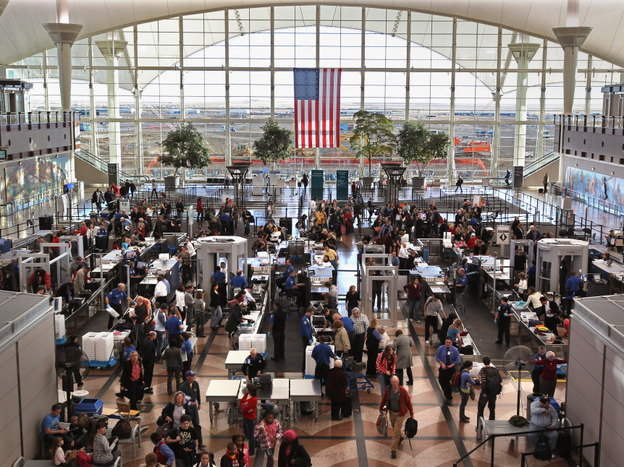 Following the furor over invasive airport security screenings and personal pat-downs, some airports are now considering replacing government security screeners with private companies.
It’s a step the new chairman of the House Transportation Committee has been urging the nation’s airports to take. But it’s not clear travelers would notice much of a difference.
The Kansas City International Airport is one of 17 in the United States where the screeners work for private contractors, not the Transportation Security Administration.
The airport’s director, Mark VanLoh, is expecting to be busy this winter: “I will be giving a lot of tours in the next few months from airports all over the country coming to Kansas City to check us out.”
Using private contractors does make a difference, VanLoh says.
“In my opinion, these contract employees — they’re not federal employees; they’re not guaranteed a job for life,” he says. “If they don’t meet the performance goals or maybe they’re consistently rude, or maybe they miss objects that go through the machine, they are terminated. I can’t remember how easy that would be to do with a federal employee. I don’t think it is.”
Under TSA Supervision
Kansas City was one of the first airports after the Sept. 11 attacks to use screeners hired by private contractors. The Aviation and Transportation Security Act of 2001, which created the TSA, also gave airports the option of using private security screeners. Those that have range in size from San Francisco’s international airport to the regional facility in Tupelo, Miss.
With private screeners, the security line operates the same way it does at airports where TSA handles the screening: Travelers remove their shoes; take out their laptops. They go through the same full-body scanners Read more…
Report: heavy growth in biometrics
The research firm MarketsandMarkets has released a new study of the biometrics marketplace that projects a heavy growth rate over the next four years. Advances in Biometric Technologies and Market Analysis breaks down the various modes of biometrics such as fingerprint, iris and facial and by regions such as North America, Asia and Europe.
Specifically, the report projects a compound annual growth rate of 21.6% between 2010 and 2015 which would result in a marketplace worth over $11 billion.
While the mode projected to have the largest share of the marketplace in 2015 is still fingerprint biometrics with a 19% growth rate, iris, vein and facial biometrics are expected to close their respective gaps with growth rates of 27.5%, 25.4% and 24.2%. Majority of the reasoning the authors are using for the expected booms in the marketplace are due to growing concerns for national security and the need for ID programs to deal with such concerns
Utah’s $1.5 billion cyber-security center under way
CAMP WILLIAMS — Thursday’s groundbreaking for a $1.5 billion National Security Agency data center is being billed as important in the short term for construction jobs and important in the long term for Utah’s reputation as a technology center.
“This will bring 5,000 to 10,000 new jobs during its construction and development phase,” Sen. Orrin Hatch, R-Utah, said on Wednesday. “Once completed, it will support 100 to 200 permanent high-paid employees.”

- Utah’s NSA spy center will house data, not analysts – Jan. 7, 2011
- Utah firm to work on NSA data center – Sept. 27, 2010
- National Security Agency data center at Camp Williams drawing huge interest in Utah – Jan. 13, 2010
Officially named the Utah Data Center, the facility’s role in aggregating and verifying dizzying volumes of data for the intelligence community has already earned it the nickname “Spy Center.” Its really long moniker is the Community Comprehensive National Cyber-security Initiative Data Center — the first in the nation’s intelligence community.
A White House document identifies the Comprehensive National Cyber-security Initiative as addressing “one of the most serious economic and national security challenges we face as a nation, but one that we as a government or as a country are not adequately prepared to counter.” The document details a number of technology-related countermeasures to the security threat.
Hatch said Utah was chosen for the project over 37 other locations. He characterized the cyber-security center as the “largest military construction project in recent memory.”
Hatch said he promoted Utah’s favorable energy costs, Internet infrastructure, thriving software industry and proximity to the Salt Lake City International Airport in the bid process that ended up with Camp Williams earning the data center.
The Army Corps of Engineers is overseeing the project that is under contract to a joint venture between Big-D Construction in Salt Lake City, U.K.-based Balfour Beatty Construction and DPR Construction out of California.
“This project is going to give an opportunity for an awful lot of Utahns” who have seen construction jobs in Utah drop from 100,000 in 2008 to about 66,000 today, said Rob Moore, president and COO of Big-D and chairman of the Associated General Contractors in Utah. “My subcontractors, suppliers and vendors are very appreciative of the work that will be available on this project.”
Grading work is already under way for the complex, which is scheduled to include 100,000 square feet for the data center and 900,000 square feet for technical support and administrative space. The center is designed to be capable of generating all of its own power through backup electrical generators and will have both fuel and water storage. Construction is designed to achieve environmentally significant LEED Silver certification.
“It is so unique and so intensive,” Hatch said. “This will establish our state as one of the leading states for technology.”


![[Most Recent Quotes from www.kitco.com]](https://i0.wp.com/www.kitconet.com/charts/metals/gold/t24_au_en_usoz_2.gif)
![[Most Recent Quotes from www.kitco.com]](https://i0.wp.com/www.kitconet.com/charts/metals/silver/t24_ag_en_usoz_2.gif)

 crisisboom
 CRISISBOOM
You must be logged in to post a comment.