Archive
How the Spike in Solar Flares May Affect Earth in 2012
 According to NASA, A solar flare is defined as a “sudden, rapid, and intense variation in brightness”, which occurs when “magnetic energy that has built up in the solar atmosphere is suddenly released.”
For centuries, solar flares have caused various calamities on Earth, such as disrupted communications, blackouts and unusual lights appearing in the sky.
In 1859, the most powerful solar flare in recorded history hit Earth and was observed by the English amateur astronomer Richard Christopher Carrington. It became known as the “Carrington Event”, or as the “Carrington Super Flare”.
The event occurred during solar cycle 10, the tenth solar cycle since 1755.
The powerful solar storm not only created auroras across the world, but also interrupted telegraphs for weeks. That was back in the mid-nineteenth century.
Can you imagine, with the modern reliance on satellites, how devastating such a Read more…
New Sunspot AR1271 Emerges
A big new sunspot is emerging over the sun’s northeastern limb. AR1271 has at least four dark cores and it is crackling with small flares. The sunspot’s entrance was captured in this 24-hour movie from the Solar Dynamics Observatory:

NOAA forecasters estimate a 60% chance of M-class solar flares during the next 24 hours. Because of its location near the sun’s limb, AR1271 does not yet pose a threat for Earth-directed eruptions. This could change in the days ahead, however, as the sunspot turns to face our planet. Readers with solar telescopes are encouraged to monitor developments.
Solar Storms Building Toward Peak in 2013, NASA Predicts
 |
| This image from the Solar Dynamics Observatory shows the X6.9 solar flare of Aug. 9, 2011 near the western limb (right edge) of the sun. CREDIT: NASA/SDO/Weather.com |
Solar flares like the huge one that erupted on the sun early today (Aug. 9) will only become more common as our sun nears its maximum level of activity in 2013, scientists say.
Tuesday’s flare was the most powerful sun storm since 2006, and was rated an X6.9 on the three-class scale for solar storms (X-Class is strongest, with M-Class in the middle and C-Class being the weakest).
Flares such as this one could become the norm soon, though, as our sun’s 11-year cycle of magnetic Read more…
Intense Solar Flare Erupts From the Sun
 |
| A powerful M9-class solar flare erupted from the sun at 10:09 p.m. EDT on July 29 (0209 GMT July 30). CREDIT: NASA/SDO |
A powerful flare erupted from the sun this past weekend, but while the storm was not aimed directly at Earth, it was nearly the most powerful type of solar storm there is, scientists say.
The brief but strong solar flare occurred late Friday (July 29) at 10:09 p.m. EDT (0209 GMT July 30), and grew in intensity. The flare was followed by an unrelated geomagnetic storm, which was triggered by fluctuations in the solar wind, according to Spaceweather.com, a website that monitors space weather events.
As a result of the solar storm, skywatchers at high latitudes, particularly in the southern Read more…
Bastille Day Solar Storm: Anatomy of a Gargantuan Sun Tempest

The "Bastille Day" solar flare as seen by SOHO's EIT instrument in the 195 Å emission line. CREDIT: NASA
One of the most violent sun storms in recorded history erupted 11 years ago today (July 14).
The event was called the Bastille Day Solar Storm, and it registered as an X-class flare, the highest designation possible. (One storm since then, in October 2003, was even more powerful.)
Ever wonder just how a solar storm brews? So do scientists. Here’s a rundown of what happened on July 14, 2000, one of the sun’s most violent days:
A sunspot was born. This occurred when magnetic field lines became tangled by the  churning and shifting of plasma bubbles on the sun’s surface. These twisted magnetic field lines formed a sunspot — an active region that appeared darker than the surrounding area. [Infographic: Anatomy of Solar Storms & Flares]
As the magnetic field lines became more and more twisted, magnetic potential energy built up, similar to how a roller coaster car at the top of the track builds up gravitational potential energy, which is then converted to the kinetic energy of motion as the car zooms downward.

CREDIT: NASA/TRACE
When the magnetic potential energy of the sun finally hit a certain point, it snapped, releasing that energy in the form of heat, light and the motion of particles. Plasma on the sun was heated up to 20 million or 30 million degrees Kelvin (36 million to 54 million degrees Fahrenheit). Plasma particles were accelerated along giant loops that traced magnetic field lines down through successive layers of the sun’s atmosphere.
These loops connected to form large ribbons of superheated plasma.
At the same time, some plasma particles from the sun’s atmosphere were accelerated away from the surface, out into space. Such a release of material is called a coronal mass ejection. Many of these protons and electrons made their way to Earth, where they disrupted satellites and blocked radio communications.
Though scientists understand many aspects of the storm’s process, there are still some pressing questions. One of the biggest is: What sparked the storm in the first place? [Hell Unleashed: Sun Spits Fire in Close-Up]
“The holy grail, which is not solved yet, is, what is the actual trigger mechanism that causes this buildup of energy to be released?” said Phil Chamberlin, a solar scientist at NASA’s Goddard Space Flight Center in Greenbelt, Md.
However, the Bastille Day solar storm did go a long way toward helping scientists piece together a general theory of how eruptions on the sun occur.
“This theory is all based on observations from the Bastille Day flare,” Chamberlin told SPACE.com.
That knowledge will come in especially handy in the coming years, as the sun ramps up toward a peak in its 11-year cycle of activity. Near the end of 2013, we are likely to see storms that rival, or even surpass, the Bastille Day event.
Solar Activity Intensifying
Dr. Mark Sircus, Contributing Writer
Activist Post
On June 7th, Dr. C. Alex Young from the NASA Goddard Space Flight Center woke to an email from a friend saying, “I have never seen anything like this before.” There are many things happening around us that we have not seen before, but when it happens on the sun certain people take notice. On the 7th the sun produced a prominence eruption and Dr. Young had never seen such a spectacular event, which luckily did not affect the Read more…
Incoming Geomagnetic Storm Alert:C7-Flare/CME (June 21st, 2011).
INCOMING: Magnetic fields above sunspot complex 1236 erupted during the early hours of June 21st, producing a C7-class solar flare and a full-halo CME. The expanding cloud appears to be heading almost directly toward Earth:
This does not appear to be an especially powerful CME. Nevertheless, the incoming cloud could trigger polar geomagnetic storms when it reaches Earth on or about June 23rd. The aurora outlook favors southern hemisphere observers, where solstice skies are winter-dark. Stay tuned for updates.
Solar Activity Heats Up
April 14, 2011: If you’ve ever stood in front of a hot stove, watching a pot of water and waiting impatiently for it to boil, you know what it feels like to be a solar physicist.
 NASA’s Solar Dynamics Observatory recorded this X1.5-class solar flare on March 9, 2011. [movie]
Back in 2008, the solar cycle plunged into the deepest minimum in nearly a century. Sunspots all but vanished, solar flares subsided, and the sun was eerily quiet.
“Ever since, we’ve been waiting for solar activity to pick up,” says Richard Fisher, head of the Heliophysics Division at NASA Headquarters in Washington DC. “It’s been three long years.”
Quiet spells on the sun are nothing new. They come along every 11 years or so—it’s a natural part of the solar cycle. This particular solar minimum, however, was lasting longer than usual, prompting some researchers to wonder if it would ever end.
News flash: The pot is starting to boil. “Finally,” says Fisher, “we are beginning to see some action.”
As 2011 unfolds, sunspots have returned and they are crackling with activity. On February 15th and again on March 9th, Earth orbiting satellites detected a pair of “X-class” solar flares–the most powerful kind of x-ray flare. The last such eruption occurred back in December 2006.
Another eruption on March 7th hurled a billion-ton cloud of plasma away from the sun at five million mph (2200 km/s). The rapidly expanding cloud wasn’t aimed directly at Earth, but it did deliver a glancing blow to our planet’s magnetic field. The off-center impact on March 10th was enough to send Northern Lights spilling over the Canadian border into US states such as Read more…
NASA admits all previous warming trends caused by sun
I wonder what Al Gore’s rebuttal is going to sound like…
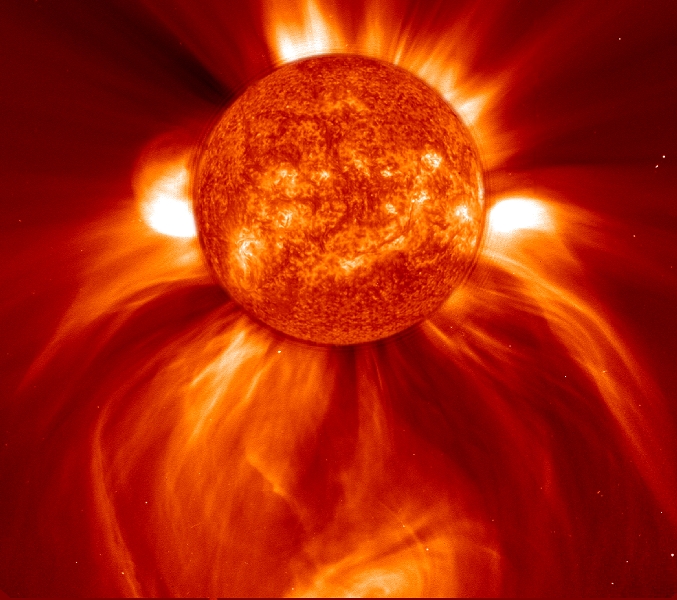 Under mounting pressure from scientists that reject the politically popularized man-made global warming and climate models—the Anthropogenic Global Warming (AGW) theory—the American space agency NASA has admitted that all past warming trends were driven by solar activity.
A victory for the man-made ‘global warming deniers’
As more scientists have joined the outcry over the politicization of Earth’s climate cycles—the current number exceeds 20,000—promoters of the AGW model have denounced the “global warming deniers” countering that little evidence supports the view that the sun is driving the observed warming trend.
Now, however, new study released from NASA’s Goddard Space Flight Center in Greenbelt, Maryland measuring the global temperature variance during the past 100 years has found the sun’s heat and variable cycles have indeed made a significant, measurable impact and greatly influenced Earth’s climate.
In fact, the influence extends as far back as the Read more…
Modern Society Threatened by Solar Storms

NASA/SDO/AIA
The Earth just dodged a solar bullet. But it won’t be the last. Experts say a geomagnetic storm, sparked by a massive solar eruption similar to the one that flared toward the Earth on Tuesday, is bound to strike again, and the next one could wreak more havoc than the world has ever seen.
Modern society is increasingly vulnerable to space weather because of our dependence on satellite systems for synchronizing computers, navigational systems, telecommunications networks and other electronic devices.
A potent solar storm could disrupt these technologies, scorch satellites, crash stock markets and cause months-long power outages, experts said Saturday at the Read more…


![[Most Recent Quotes from www.kitco.com]](https://i0.wp.com/www.kitconet.com/charts/metals/gold/t24_au_en_usoz_2.gif)
![[Most Recent Quotes from www.kitco.com]](https://i0.wp.com/www.kitconet.com/charts/metals/silver/t24_ag_en_usoz_2.gif)

 crisisboom
 CRISISBOOM
You must be logged in to post a comment.