Archive
NASA Shuts Down Prolific Sky-Mapping Space Telescope
 A prolific sky-mapping telescope that has spent more than a year scanning the heavens for asteroids, comets and other cosmic objects received its last command today (Feb. 17).
NASA shut down its WISE spacecraft – short for Wide-field Infrared Survey Explorer – at 3:00 p.m. EST (2000 UTC) today. The mission’s principal investigator, Ned Wright of the University of California in Los Angeles, sent the final command to the now-hibernating spacecraft, according to an update from the WISE mission’s official Twitter account.
“The WISE spacecraft will remain in hibernation without ground contacts awaiting possible future use,” NASA officials said via Twitter.
WISE launched on Dec. 14, 2009 to begin a 10-month mission to collect Read more…
New North Korean Space Launch Site Appears Completed
Steve Herman

Photo: GeoEye and Globalsecurity.org
Image taken from the Ikonos satellite, January 10, 2011
New satellite imagery seen by VOA News shows North Korea has completed a launch tower at its second missile launch facility, in the country’s northwest. Intelligence analysts in the United States and South Korea are keeping a close eye on the facility, near Tongchang-dong.
The site is seen as a critical element in Pyongyang’s quest to build a missile capable of delivering a nuclear weapon across the Pacific.
The satellite pictures were taken during the past month. Most significantly, the photographs reveal Read more…
Spacecraft to be controlled by artificial intelligence
 It is a concept that had fatal consequences for the astronauts in the science fiction movie 2001: A Space Odyssey after their spaceship’s artificially intelligent computer reasoned it had to kill them in order to continue the mission.
Yet despite this warning from Arthur C Clarke and director Stanley Kubrick, The European Space Agency now hopes to use real-life artificial intelligence to control future spacecraft.
British engineers, supported by ESA, are developing control systems that can be used in satellites, robotic exploration vehicles and spacecraft capable of controlling themselves.
The space vehicles will be able to learn, identify problems, adapt during missions, carry out repairs and take their own decisions about how best to carry out a task.
Details of the research have emerged as ESA prepares to launch the second of its Read more…
China’s hostile space capabilities worry US: official
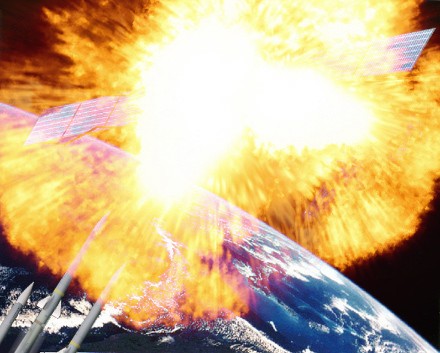 WASHINGTON (AFP) – China is developing “counterspace” weapons that could shoot down satellites or jam signals, a Pentagon official said Friday as the United States unveiled a 10-year strategy for security in space.
“The investment China is putting into counterspace capabilities is a matter of concern to us,” deputy secretary of defense for space policy Gregory Schulte told reporters as the defense and intelligence communities released their 10-year National Security Space Strategy (NSSS).
The NSSS marks a huge shift from past practice, charting a 10-year path in space to make the United States “more resilient” and able to defend its assets in a dramatically more crowded, competitive, challenging and sometimes hostile environment, Schulte said.
“Space is no longer the preserve of the US and the Soviet Union, at the time in which we could operate with impunity,” Schulte said.
“There are more competitors, more countries that are launching satellites… and we increasingly have to Read more…
“Suicide” Comet Storm Hits Sun—Bigger Sun-Kisser Coming?

The sun-kissing comet Ikeya-Seki, as it appeared in the dawn sky in 1965.
Photograph by Victor R. Boswell, Jr., National Geographic
Andrew Fazekas
Published January 17, 2011
A recent storm of small comets that pelted the sun could herald the coming a much bigger icy visitor, astronomers say.
Since its launch in 1995, NASA’s Solar and Heliospheric Observatory, or SOHO, orbiter has captured pictures of 2,000 comets as they’ve flown past the sun.
Most of these comets are so-called sungrazers, relatively tiny comets whose orbits bring them so near the sun that they are often vaporized within hours of discovery. (See a picture of a sungrazer spied in October.)
The sun-watching telescope usually picks up one sungrazer every few days. But between December 13 and 22, SOHO saw more than two dozen sungrazers appear and disintegrate.
Seeing “25 comets in just ten days, that’s unprecedented,” Karl Battams, of the United States Naval Research Laboratory in Washington, D.C., said in a statement. “It was crazy!”
According to Battams and colleagues, the comet swarm could be forerunner fragments from a much larger parent comet that may be headed along a similar path. And such a large icy body coming so near the sun would result in a spectacular sky show.
Sun-Kissing Comet “Granddaddy” on the Way? Read more…
Green Blob in Space
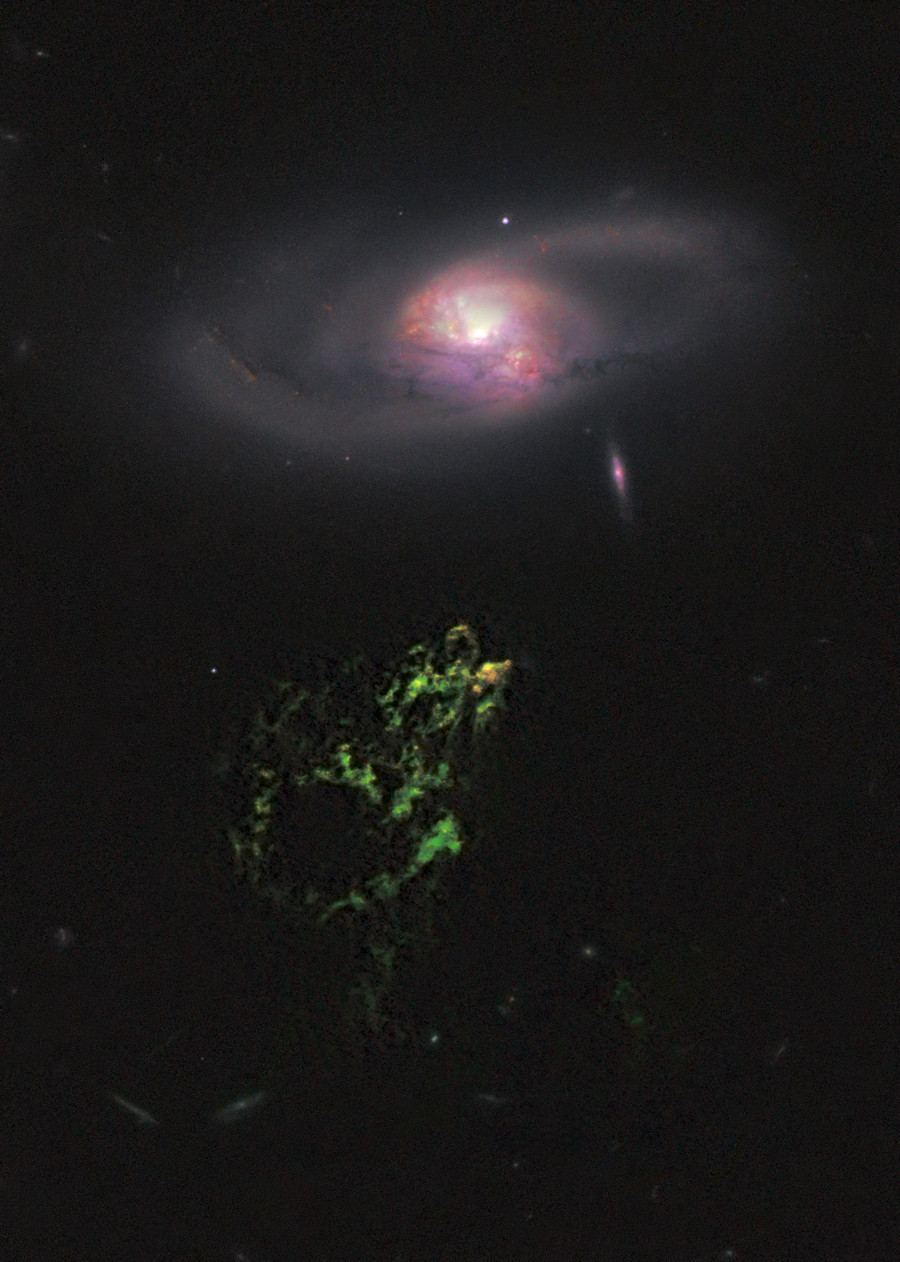 The Hubble Space Telescope got its first peek at a mysterious giant green blob in outer space and found that it’s strangely alive. The bizarre glowing blob is giving birth to new stars, some only a couple million years old, in remote areas of the universe where stars don’t normally form.
The blob of gas was first discovered by a Dutch school teacher in 2007 and is named Hanny’s Voorwerp (HAN’-nee’s-FOR’-vehrp). Voorwerp is Dutch for object.
NASA released the new Hubble photo Monday at the American Astronomical Society meeting in Seattle.
Parts of the green blob are collapsing and the resulting pressure from that is creating the stars. The stellar nurseries are outside of a normal galaxy, which is usually where stars live.
That makes these “very lonely newborn stars” that are “in the middle of nowhere,” said Bill Keel, the University of Alabama astronomer who examined the blob.
The blob is the size of our own Milky Way galaxy and it is 650 million light years away. Each light year is about 6 trillion miles.
The blob is mostly hydrogen gas swirling from a close encounter of two galaxies and it glows because it is illuminated by a quasar in one of the galaxies. A quasar is a bright object full of energy powered by a black hole. Read more…
Huge asteroid will hit Antarctica in 2012?

Update: Jan 13, 2011.
If you caught Starfire Tor on CoastToCoastAM last week you may have heard her mention that ‘they’, the PowersThatBe know that an incoming near earth object is going hit earth sometime in the next 2 years. There is evidence to suggest the object is going to strike one of the poles… most likely the south pole. Special Scientific teams have been down in Antarctica mapping the ice shelf for probable weak points. The object is rumored to be 800 meters wide and when it hits the south pole the entire ice shelf will collapse within months.
A University of British Columbia Professor published an online article that projected an 800m asteroid would hit Antarctica in the fall of 2012. His article was on the http://www.phas.ubc.ca website Read more…
Iran announces new satellite launch plan
 Iran is planning to launch a new satellite into orbit by the end of March, according to the country’s semi-official Fars News Agency.
Wednesday’s announcement for the planned launch of the Fajr — or “Dawn” — satellite follows a recent statement by Iranian President Mahmoud Ahmadinejad on strengthening the country’s space-based presence.
The satellite “will be launched into space from an Iranian launch-pad and will have an Iranian exchange station and control station,” Ahmadinejad said, according to Fars.
Iran’s first research satellite — named “Omid,” or “Hope” — completed 700 orbits over seven weeks before reentering the Earth’s atmosphere last April, Fars noted.
Ahmadinejad asserted that Iran now plans to send astronauts into space by 2019 as opposed an earlier announced timeline of 2024, Fars reported.


![[Most Recent Quotes from www.kitco.com]](https://i0.wp.com/www.kitconet.com/charts/metals/gold/t24_au_en_usoz_2.gif)
![[Most Recent Quotes from www.kitco.com]](https://i0.wp.com/www.kitconet.com/charts/metals/silver/t24_ag_en_usoz_2.gif)

 crisisboom
 CRISISBOOM

You must be logged in to post a comment.