Archive
Police Use of iPhone Iris Scanners Raise Privacy Concerns
 The so-called “biometric” technology, which seems to take a page from TV shows like “MI-5″ or “CSI,” could improve speed and accuracy in some routine police work in the field. Dozens of police departments nationwide are gearing up to use a tech company’s already controversial iris- and facial-scanning device that slides over an iPhone and helps identify a person or track criminal suspects.
But its use has set off alarms with some people who are more concerned about possible civil liberties and privacy issues. Constitutional rights advocates are concerned, in part because the device can accurately scan an individual’s face from up to four feet away, potentially without a person’s being aware of it.
“This is (the technology) stepping out of the cruiser and riding on the officer’s belt, along with his flashlight, his handcuffs, his sidearm or the other myriad tools,” said John Birtwell, spokesman for the Plymouth County Sheriff’s Department in southeastern Massachusetts, one of the first departments to use the devices.
“What we don’t want is for them to become a general surveillance tool, where the Read more…
NSA Is Building An Artificial Intelligence System That Can Read Minds
 The NSA is working on a computer system that can predict what people are thinking.
“Think of 2001: A Space Odyssey and the most memorable character, HAL 9000, having a conversation with David. We are essentially building this system. We are building HAL. The system can answer the question, ‘What does X think about Y?'”
These are the words of an unnamed researcher who discussed an amazing artificial intelligence system she was building at the NSA.
It sounds like something right out of science fiction — a system that can literally read thoughts like a magician.
It’s called “Aquaint” (Advanced QUestion Answering for INTelligence), and PBS’s James Bamford takes a stab at explaining how it works:
“As more and more data is collected — through phone calls, credit card receipts, Read more…
Court Papers Suggest Pakistani Interest in Thermonuclear Weapon
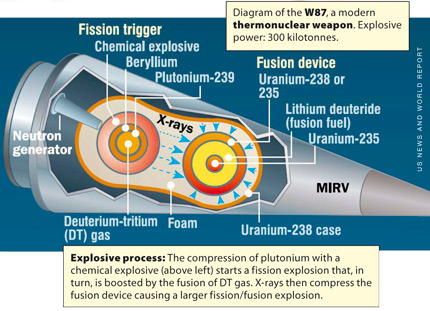 The United States in federal court documents offered its first open suggestion that nuclear-armed Pakistan could be seeking to build a thermonuclear weapon, the Pittsburgh Tribune-Review reported on Sunday (see GSN, July 7).
The Justice Department has charged a Chinese woman living in the United States with illegally exporting high-tech paint coatings that could aid Pakistan’s nuclear weapons development. As the ex-managing director of a Chinese branch of PPG Industries, Xun Wang is accused of shipping the material five years ago in direct disobedience of the Pittsburgh-based company and nonproliferation guidelines issued by the U.S. Commerce Department.
Pakistan holds nuclear arms outside the Nuclear Nonproliferation Treaty and is a known past proliferator of sensitive technology and information through the black market operation once led by scientist Abdul Qadeer Khan. As such, the United States has placed a number of restrictions on the trade of sensitive goods with the South Asian nation.
The U.S. Justice Department questions in court filings whether the paint coating shipments could Read more…
Russia Launches Long-Delayed Deep Space Radio Telescope
 |
| An artist’s depiction of Russia’s huge Spektr-R radio astronomy satellite in Earth orbit. The satellite launched on July 18, 2011. CREDIT: NPO Lavochkin |
PARIS — Russia’s long-delayed Spektr-R radio telescope successfully launched July 18 aboard a Zenit rocket from the Baikonur Cosmodrome in Kazakhstan, the country’s Federal Space Agency said.
There was no immediate word on the operational status of the new radio observatory beyond the fact that it was placed into the planned elliptical orbit that peaks nearly 207,000 miles (330,000 kilometers) above the Earth, and reaches a low of about 621 miles (1,000 km).
Featuring a giant 30-foot (10-meter) wide antenna, the Spektr-R observatory is Read more…
‘Ice Wars’ heating up the Arctic


Editor’s note: CNN correspondent Kaj Larsen recently visited the Arctic to observe the U.S. naval exercise known as ICEX. His experience is part of the CNN documentary “Ice Wars,” which will air at 8 p.m. ET Sunday on CNN Presents.
(CNN) — On a small, floating piece of ice in the Beaufort Sea, several hundred miles north of Alaska, a group of scientists are documenting what some dub an “Arctic meltdown.”
According to climate scientists, the warming of the region is shrinking the polar ice cap at an alarming rate, reducing the permafrost layer and wreaking havoc on polar bears, arctic foxes and other indigenous wildlife in the region.
What is bad for the animals, though, has been good for commerce.
The recession of the sea ice and the reduction in permafrost — combined with advances in technology — have allowed access to oil, mineral and natural gas deposits that were previously trapped in the ice.
The abundance of these valuable resources and the opportunity to exploit them has created a Read more…
China Violating Missile Proliferation Controls, Cables State
 Recently leaked U.S. diplomatic memos assert that China has flouted missile proliferation controls by selling the arms and their components to Pakistan, Iran and Syria, the Washington Times reported on Wednesday (see GSN, June 2).
A classified September 2009 State Department memo written ahead of a meeting of the 34-nation Missile Technology Control Regime repeatedly references a “lack of political will” on Beijing’s part to block Chinese firms from proliferating missile technology.
The Missile Technology Control Regime is a voluntary coalition of nations that aims to constrain the sale of missiles with traveling distances in excess of roughly 185 miles and explosive payloads weighing more than 1,100 pounds. It also works to head off the proliferation of missiles designed to carry weapons of mass destruction.
“Chinese authorities and firms fail to Read more…
Official confirms ‘carrier killer’ is being developed
GAME CHANGER:Reports claim the Dong Feng 21D anti-ship missile has a range of almost 3,000km, nearly twice as long as previously assessed by the US military
 General Chen Bingde speaks during a meeting with US officials at the Bayi Building in Beijing on Monday.
Photo: Reuters
People’s Liberation Army (PLA) Chief of General Staff Chen Bingde (陳炳德) confirmed earlier this week that China was developing the Dong Feng 21D anti-ship ballistic missile (ASBM), the first Chinese official to publicly state that the missile is in development.
His comments came as the English-language China Daily reported that the DF-21D had a range of 2,700km, well beyond assessments by the Office of Naval Intelligence last year, which put it at about 1,500km.
The missile, which is capable of hitting moving targets at sea and is seen as a potential threat to aircraft carrier battle groups, would represent a powerful deterrent to the US Navy in the Pacific.
However, Chen said the DF-21D, which can be fired from mobile Read more…
Cops to Get Facial Recognition Devices; Will They Need Warrants to Use Them?
 Police departments in several states are getting new high-tech devices that can scan irises, recognize faces and collect fingerprints.
The devices, made by BI2 Technologies, are attached to an iPhone for immediate searches of criminal databases, the Wall Street Journal (sub. req.) reports. The development is “raising significant questions about privacy and civil liberties,” the story says.
Currently the technology, called “Moris” for Mobile Offender Recognition and Information System, is used by the military to identify insurgents. But B12 has Read more…
Chinese Satellites May Aid Strikes on U.S. Warships: Report
New advanced satellites could enable China to direct its ballistic missiles in striking U.S. naval vessels sailing in the region in the event of an outbreak of hostilities, Reuters reported on Monday (see GSN, Jan. 10).

(Jul. 13) - A U.S. guided missile destroyer fires an artillery round during an exercise last month in the South China Sea. China could train its ballistic missiles on nearby U.S. warships using a new generation of reconnaissance satellites, a report warns (U.S. Navy photo).
A soon-to-be-released analysis in the British Journal of Strategic Studies concludes that the fast pace of work on cutting-edge spy orbiters would give China the ability to monitor up-to-the-minute U.S. military movements and to steer its ballistic missiles in strikes on U.S. warships.
“The most immediate and strategically disquieting application (of reconnaissance satellites) is a targeting and tracking capability in support of the antiship ballistic missile, which could hit U.S. carrier groups,” according to the report.
“But China’s growing capability in space is not designed to support any single weapon; instead it is being developed as a dynamic system, applicable to other long-range platforms,” the analysis continues. “With space as the backbone, China will be Read more…
Biometric access could control South Africa schools
 Liam Terblanche, CIO at Accsys
Many schools in South Africa may have considered biometric access control as a means of combating truancy and ensuring learner safety and security.
In the UK, an estimated 30% of all schools use biometric access control. Although concerns have been raised over privacy and the collection of fingerprints into national data sets, the Data Protection Act (1998) of that country allows schools to record fingerprint biometrics without the consent of the parents.
In South Africa, however, the almost to be promulgated Protection of Personal Information (POPI) bill prevents the collection of personal information without the written consent of the individual, or that of a legal guardian in the case of minors. (See section 25 – Prohibition on processing of special personal information).
This would imply that, even if a school’s governing body agrees to the implementation of biometric access control at a school, the individual learners would still be able to Read more…


![[Most Recent Quotes from www.kitco.com]](https://i0.wp.com/www.kitconet.com/charts/metals/gold/t24_au_en_usoz_2.gif)
![[Most Recent Quotes from www.kitco.com]](https://i0.wp.com/www.kitconet.com/charts/metals/silver/t24_ag_en_usoz_2.gif)

 crisisboom
 CRISISBOOM
You must be logged in to post a comment.