Archive
RFID Chips And Soul Catcher 2025
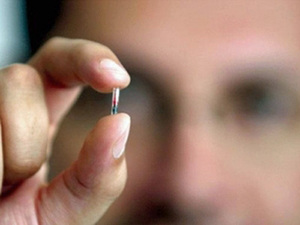
From RFID chips to Soul Catcher 2025 - technology to capture your soul and implant it in somebody else...
News that the British government is planning to tag prisoners with radio frequency identification (RFID) chips was met last year with instant opposition from probation officers and civil rights lawyers.
And rightly so. Government plans to implant the RFID chips without prisoners’ consent would in any circumstance be deemed an illegal act. It would also, of course, create a major moral dilemma.
“If the Home Office doesn’t understand why implanting a chip in someone is worse than an ankle bracelet,” said Shami Chakrabarti of the civil rights group, Liberty, “they don’t need a human-rights lawyer—they need a common-sense bypass.”
And Harry Fletcher, Assistant General Secretary of the National Association of Probation Officers, had this to say about the no-brainer scheme:
“Knowing where offenders like paedophiles are does not mean you know what they are doing. Treating people like pieces of meat does not seem to represent an improvement Read more…
Salt Lake City goes wallet-free with Isis
Trial run for national rollout
 Operator consortium Isis has selected Salt Lake City as its flagship deployment to show the rest of the USA what NFC can do for them.
The plan will see Salt Lake City’s public transport system accepting pay-by-wave from a mobile phone by the middle of next year. Retailers have also been encouraged to adopt Near Field Communications technology at the point of sale, as Salt Lake City strives to become The Place You Can Leave Your Wallet At Home.
Isis was set up less than six months ago: a consortium of US network operators including AT&T, T-Mobile and Verizon. The consortium is dedicated to ensuring that electronic payments based on NFC keep their secure element in the SIM – under the control of the network operator, not the handset manufacturer or bank-card supplier – by promoting the technology and business models associated with it.
In Salt Lake City, that involves working with the Utah Transit Authority to convert all the buses and trains to accept NFC payments, as well as flooding the area with NFC handsets and SIM chips.
“I would like to express our excitement that the Salt Lake City area has been chosen to lead the roll-out of Isis mobile payments,” said Mayor Ralph Becker’s canned statement, though looking a little closer it becomes obvious why Salt Lake was chosen to lead the US into contactless payments.
The Utah Transit Authority already uses proximity payment cards, deployed in 2009, so adding NFC functionality to public transport is a matter of software not hardware, and while the City might be the capital of Utah it has a population somewhat smaller than Northampton, so presents a nicely sized area for experimentation rather than a sprawling metropolis where deployment would be more challenging.
But the transition to electronic payments isn’t going to happen overnight, and it’s good to see Isis doing something practical, and with a reasonably aggressive timetable. It will be interesting to see how the locals take to paying by wave.
StunRay disables your brain with inverse blindness

Until we figure out how to make a phaser that can be set to stun, we’ve been stuck with non less-lethal options like tasers (which can kill) and laser dazzlers (which can cause eye damage). StunRay is basically just a big flashlight, except with the ability to disable you by causing “inverse blindness.”
If you’re wondering what inverse blindness looks like, it’s easy to do to yourself: just stare at a bright light for a minute or two and then look around. It’s not dark, really, but you can’t see anything very well, and it’s because the exposure to bright light has overloaded the neurons that connect your retinas to your brain, and mostly all you can see is a featureless white expanse. The technical term for this is “loss of contrast sensitivity,” and it’s an effective way of disabling someone.
A company called Genesis Illumination is working what’s basically a giant fancy flashlight called StunRay that can inflict this loss of contrast sensitivity or inverse blindness or neural overload or whatever you want to call it on people at long range in a split second. Each burst of super bright light incapacitates subjects for five seconds or so without causing any pain, and subjects fully recover in about five minutes. The “fully recover” bit is key, since StunRay won’t roast your eyeballs like a laser dazzler can.
StunRay uses a 75 watt bulb, which doesn’t seem like much, but with some fancy optics, the device is able to focus its light beam to be ten times brighter than an aircraft landing light, even up to 150 feet away. And in case you were wondering, and I’m sure you were, this is bright enough to read a newspaper from a mile away.
Genesis Illumination just received a patent for StunRay, so in the near future, we’ll be able to rely on one single device for both our disabling and long distance newspaper-reading needs.
U.S. wants to use India in missile shield against Russia, China
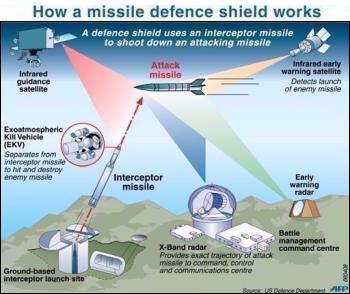 The United States has been trying to rope in India for its plans to build a global missile defence system threatening Russia and China, the Komsomoloskaya Pravda, a popular Russian daily published from Moscow reported on Thursday.
In a story based on the WikiLeaks releases, the report said the U.S. has not only been planning to deploy a missile shield against Russia in Europe, but had also been negotiating with countries along Russia’s borders, such as Japan and India, to jointly build missile defences that would also target Russia.
“The noose [around Russia] is tightening,” the newspaper said. “Thanks to WikiLeaks, it has become known that Washington has been simultaneously conducting talks with countries in other parts of the world for building U.S. missile defences on their territories. Those are different countries, but they form a chain around Russia.”
A 2007 confidential cable from the U.S. embassy in New Delhi carried by the daily refuted media reports that India had abruptly turned its back on a 2005 agreement with the U.S. to cooperate on missile defences. The cable said the Indian media had misinterpreted remarks by External Affairs Minister Pranab Mukherjee after the Russia-India-China trilateral meeting in Harbin, China, on October 24, 2007. Mr. Mukherjee had dismissed as “groundless” the idea that India was going to join a U.S.-led missile defence system.
Misconstrued
“MEA contacts confirm this did not mean India was not interested in continuing to cooperate with the U.S. on missile defence technology and that there has been no change from the current level of bilateral missile defence cooperation,” the U.S. embassy cable said.
The “MEA contacts” explained that Mr. Mukherjee’s comments were “misconstrued” by the Indian press. When Mr. Mukherjee said that “India does not take part in such military arrangements,” the officials said, he had had in mind the U.S. plan to install a missile-detection system in Europe, which his Russian and Chinese counterparts referred to in the same press interaction. Read more…
Kinect could be initial step into gaming biometrics
 Microsoft’s X-Box 360 Kinect, a motion-sensing device for the gaming system that sold million units in its first two months, is being looked at by some as an introduction of biometric technology to gaming, according to a Smart Office article.
Kinect’s biometric capabilities come in the form of face recognition which it uses to login recognized players prior to playing a game.
Although seen as relatively novel new technology, Kinect’s face-recognition was called into question as it was reported to frequently have trouble in poor lighting conditions as well as having trouble logging in users with dark complexions.
Despite its issues in realistically connecting users to their real-life selves, some are wary of the introduction of biometrics into gaming, which has traditionally maintained a very anonymous environment for gamers.
Experts believe that such technology, however, could be a key step into increasing biometrics’ foot hold in U.S. markets where consumers have been apprehensive to trust the technology to handle its most sensitive and unable to be changed data.
As biometric modes such as face recognition make their way into casual gaming, social networking and even places such as online dating sites, it is thought that it could help face recognition and other biometrics gain popularity in handling more serious services Read more…
FBI Launches 1 Billion $ Biometrics Project With Lockheed Martin To Track Everyone’s Every Move
The FBI launched this week a massive program aimed to record all citizen’s biometrics data. This will eventually enable instant surveillance and recognition of any individual walking on the street or entering a building. The 1 Billion $ deal was awarded to Lockheed Martin – the world’s largest defence company, which is part of elite groups such as the CFR (Council of Foreign Relations) and the Trilateral Commission. In short, Lockheed Martin is the official defence company of the world’s shadow government.

Lockheed Martin Logo
Lockheed Martin is active in many aspects of government contracting. It Read more…
Cell Phone Surveillance: Some Cell Phones Record Your Location Hundreds Of Times A Day
 Do you own a cell phone? Do you think that it is private and secure? You might want to think again. The truth is that there is virtually no privacy when it comes to cell phones. In fact, the amount of cell phone surveillance that goes on is absolutely staggering. For example, one German politician named Malte Spitz recently went to court to force Deutsche Telekom to reveal how often his cell phone was being tracked. What he found out was absolutely amazing. It turns out that in just one 6 month period, Deutsche Telekom recorded the longitude and latitude coordinates of his cell phone 35,000 times. Not only that, in the United States cell phone companies are actually required by law to be able to pinpoint the locations of their customers to within 100 meters. Most cell phone carriers are able to track their customers far more accurately than that. The truth is that your location will never again be truly “private” as long as you are carrying a cell phone.
And your conversations will not be private either. A whole host of people could be listening in on your cell phone calls. In fact, your cell phone can be used to spy on you even when you don’t have it on. For example, as one CNET News article noted, if law enforcement authorities are investigating you they can remotely activate the microphone on your cell phone and listen in on your conversations…. Read more…
Why Do These Breathtaking Russian Images of Earth Look So Different from NASA’s?

While this morning’s orbital image of Mercury is historic, these two images are the ones that have truly left me in complete awe today. Even more so than the most accurate, highest resolution view of Earth to date.
But unlike Blue Marble, these images are not by NASA. In fact, they look a lot different from NASA’s Earth imagery. Much better and crisper, some may say. But are they really better? Are they more accurate? NASA has explained to us why they look so different compared to their own.
The russians are back in the space race
It was taken by a Russian spacecraft, a new weather satellite called Elektro-L. It’s now orbiting Earth on a geostationary orbit 36,000 kilometers above the equator, after being launched on January 20 from the Baikonur Cosmodrome, on board a Zenit rocket.
This is the first major spacecraft fully developed in post-Soviet Russia, developed by NPO Lavochkin for the Russian Federal Space Agency. This is a major step in the country’s aerospace industry, after two decades of Read more…
Scientists plan to drill all the way down to the Earth’s mantle

Credit: World Book illustration by Raymond Perlman and Steven Brayfield, Artisan-Chicago
(PhysOrg.com) — In what can only be described as a mammoth undertaking, scientists, led by British co-chiefs, Dr Damon Teagle of the National Oceanography Centre in Southampton, England and Dr Benoit Ildefonse from Montpellier University in France, have announced jointly in an article in Nature that they intend to drill a hole through the Earth’s crust and into the mantle; a feat never before accomplished, much less seriously attempted.
The Earth’s mantle is the part of the planet that lies between the crust and the iron ball at its center, and to reach it, would require drilling down from a position in the ocean, because the crust is much thinner there. Even still, it would mean drilling through five Read more…
Chip in the Brain Controls Computer: Braingate Neural Interface System Reaches 1,000-Day Performance Milestone
 An investigational implanted system being developed to translate brain signals toward control of assistive devices has allowed a woman with paralysis to accurately control a computer cursor at 2.7 years after implantation, providing a key demonstration that neural activity can be read out and converted into action for an unprecedented length of time.

![[Most Recent Quotes from www.kitco.com]](https://i0.wp.com/www.kitconet.com/charts/metals/gold/t24_au_en_usoz_2.gif)
![[Most Recent Quotes from www.kitco.com]](https://i0.wp.com/www.kitconet.com/charts/metals/silver/t24_ag_en_usoz_2.gif)

 crisisboom
 CRISISBOOM
You must be logged in to post a comment.